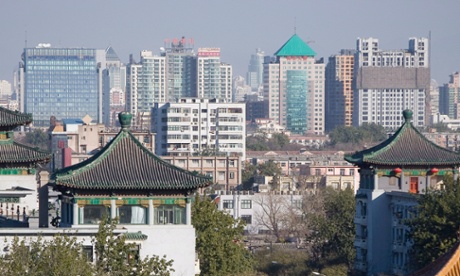
The best city stories from around the web this week take us from Paris to Beijing with food co-ops, urban “cutesification”, public space reclamation and underground apartments.
We’d love to hear your responses to these stories and any others you’ve read recently, both at Guardian Cities and elsewhere: share your thoughts in the comments below.
A world under the streets
In Beijing, residents are choosing an unusual way to make their rent affordable: move underground. As NPR reports, in a city of 21 million inhabitants, space is understandably limited, and demand for housing is high.
But a number of bomb shelters and storage basements under the city’s streets – which continue to be built due to the official building code – have been turned into tiny, windowless, illegal apartments. Photographer Chi Yin Sim has documented the resident communities under the city in a collection called China’s “Rat Tribe”.
Food for thought
Paris mayor Anne Hildago made waves on Sunday by announcing that diesel cars will be banned from the city by 2020 in an effort to reduce dangerous air pollution. But there is more good news from the French capital this week: Collectively reports that work is underway on the city’s first contemporary food co-op.
Influenced by the city’s co-ops of the “ideologically motivated” late 19th century, La Louve will be located in the 18th arrondissement. Its aim to tackle issues of urban inequality is being helped along by a core group of 30 activists.
The game of segregation
Parable of the Polygons may just look like a game of shuffling shapes, but it has a strong social message. As CityLab reports, the interactive “game” is a playable version of Thomas Schelling’s 1971 model of neighbourhood segregation, which demonstrates how small preferences among individuals for their neighbours to be similar to them can scale up to stark divides.
Created by multimedia online storyteller Vi Hart and game developer Nicky Case, the game provides an “explorable explanation” of how damaging social divisions can arise, as well as how they might be solved.
Urban ‘cutesification’ strikes again
If you venture across the road in the German cities of Hildesheim and Oberhausen, you might get a playful surprise. As Fast Co Design explains, new company Urban Invention have installed their Streetpong project in these two places: designed to make the “lost” moments of our daily urban lives more amusing and social, Streetpong is an impromptu video game you play with fellow commuters at pedestrian crossings while waiting for the signal to walk.
But Sarah Goodyear, writing in Next City, finds issue with this so-called “cutesification” of urban design: “The focus on expensive and often impractical ‘playful’ solutions that can’t be scaled up diverts designers’ and planners’ attention from the real challenges at hand. City-dwellers don’t need garbage cans with sound effects, they need more garbage cans, and more frequent trash pickup ... Pedestrians don’t need to play games at the crosswalk, they need shorter crossing distances, longer walk signals, and better separation from cars.”
Reclaiming space in São Paulo
Over the last five years, São Paulo has seen a movement encompassing digital and street-level activism, art and new forms of urbanism: as Brasil wire reports, this has been “the catalyst for a re-imagining of the city’s neglected centre and energised attitudes towards public spaces in a megalopolis where they are scarce”.
Following the contentious introduction of a city-wide network of bicycle lanes, the municipal authorities have voted to transform the controversial Minhocão elevated highway into a public park – a symbolic move in a car-dependent metropolis. Elsewhere across the city, new public spaces known as “urban beaches” have been constructed and food trucks legalised. New film O que e Nosso (That Which Is Ours) aims to document this “amorphous” urban movement.
A world of suburbs
In its new in-depth essay, the Economist explains that the “great urbanisation” we are seeing on our planet is actually a “great suburbanisation”: in both developed and developing countries, city outskirts are apparently growing faster than cores. But what does this sprawl culture mean for our cities – and society? Looking at examples from Chennai, Phoenix and Croydon, the Economist praises the “humble liberation” of suburbia.
Are suburbs good or bad for us? Are “playful” cities ignoring the bigger problems? Share your thoughts in the comments below