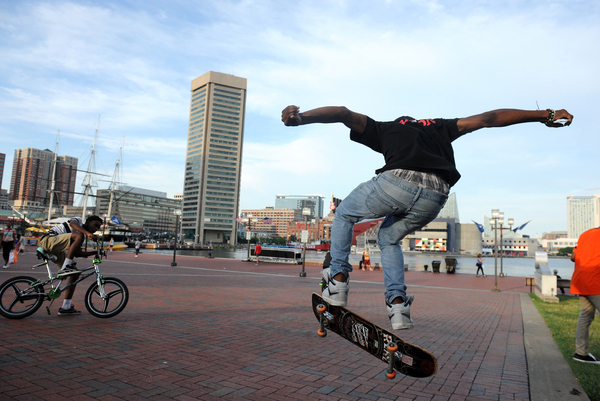
BALTIMORE _ On a gloomy Sunday evening, the patter of torrential rain, rumble of wheels and clank of skateboards hitting concrete fill the entrance of a parking garage on South Charles Street.
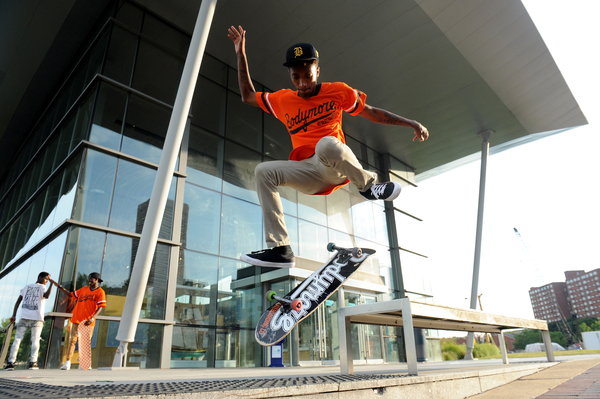
Amid the grunts and howls of exasperated young men trying to master tricks, Jamone Mckenzie, 20, glides, crouches, then leans the ball of his back foot into his skateboard. Mckenzie jumps, and the skateboard flips in the air underneath him. Then, with perfect timing, his feet touch the board as its wheels land.
Mckenzie is part of a burgeoning community of black street skateboarders in Baltimore who gather daily and use the city's landscapes to master their craft. In this emerging, tight-knit subculture, many young men have found refuge, community and stability they say would otherwise be absent in their lives.
They are from different neighborhoods; many of them are from the parts of Baltimore crippled by violence and poverty, while a few are relatively privileged. Some feel overlooked by the city and the mainstream skating community, while others say their skills aren't at the level that would earn acknowledgement. But the bond that connects this disparate group is the love of the skateboard, and it's through the skateboard that their differences are subsumed.
Growing up, Mckenzie briefly lived in a homeless shelter in Reisterstown with his brother and mother. On his journey from school back to the shelter, he'd pass the Hannah More Skate Park and would be captivated by the skateboarders. He vowed that one day he would skate, too.
BLACK STREET SKATEBOARDERS IN BALTIMORE
A burgeoning community of black street skateboarders in Baltimore gather daily and use the city's landscapes to master their craft. In this emerging, tight-knit subculture, many young men have found refuge, community and stability they say would otherwise be absent in their lives.
Initially Mckenzie cultivated his hobby in solitude, but eventually he began to travel from his current home in Randallstown into the city to find fellow skaters.
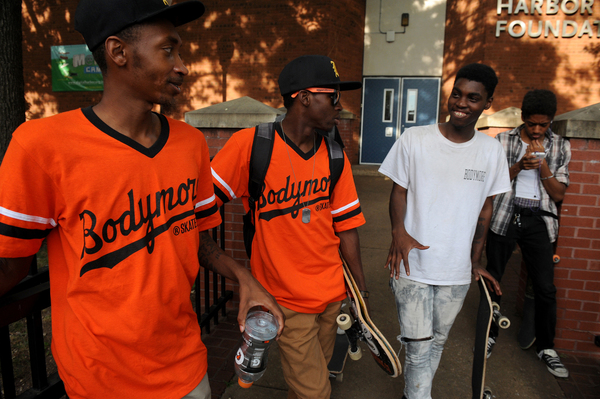
"I never knew it was this big until I got down here _ there are hundreds of us," he said.
Mckenzie is a member of Milk Squad, a Baltimore-based skate crew whose skills have gained enough attention to receive sponsorship from Bodymore Skateboard Co., a subsidiary of indie street wear brand Milkcrate.
His mother, Nicola Mckenzie, 37, said she has watched her son's growth as a skateboarder in awe. "He could be doing something illegal," she said. "I'm just happy he's not a statistic."
That's a fate Yaamiyn Whitaker, 21, knows he avoided. He lifts his shirt and points to stab wounds and the scar left by a bullet.
The thin young man with tattoos of the Natty Boh and Spitfire Wheels logos spent much of his life being shuttled between various parts of East Baltimore and Baltimore County, living with different family members. He has a younger brother who was recently incarcerated, and he recalls with sadness friends who have been murdered.
But for Whitaker, the draw of the skateboard was stronger than the grip of the streets. He said skateboarding offered him the chance to explore a world beyond Baltimore, even traveling to Hamburg, Germany with a group of skateboarders. Today, he's a member of Milk Squad and can often be seen skating around the harbor.
He said the city's reputation for violence means young men like himself often don't receive the mentorship they need or the attention of the broader skateboarding community.
"The scene here is live and dead at the same time. We're live because we got things going on," he said. "The dead part is we ain't got that eye looking over us. We've been overlooked."
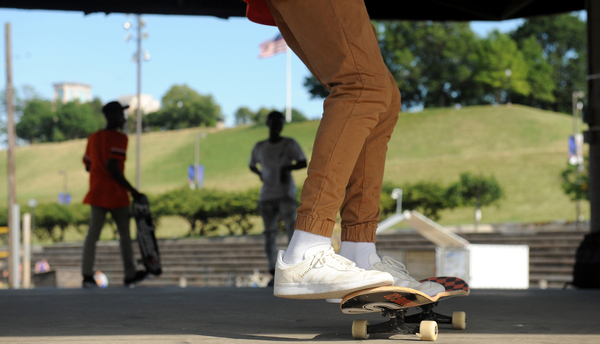
There are, however, some individuals willing to offer opportunities and guidance.
Aaron LaCrate, 40, owner of Bodymore, is an entrepreneur and well-known within the Baltimore skateboard community. He came across Milk Squad fortuitously while driving through Baltimore. He'd been on the lookout for skaters to sponsor who ran counter to the stereotypical image and represented a part of Baltimore he says is ignored by the mainstream skating scene.
"I wanted to endorse the side of town where the kids don't have the network or connections," he said. "I know these kids need a leg up for things to happen for them. This is where the next generation is."
The current generation of skateboarders in Baltimore can skate for free in two public outdoor skate parks: one in Carroll Park and the other in Hampden, which exists, in large part, because of Stephanie Murdock, 33, president of the nonprofit Skatepark of Baltimore. The park recently broke ground on its second phase of construction, and its ambition is to help as many as 100 young people skate for free every day.
"Unfortunately recreation activities are limited for young kids in Baltimore," said Murdock. "It took us 10 years to get our public skate park _ it's an uphill battle."
She said she constantly meets people who don't believe black skateboarders exist in Baltimore.
Despite the popularity of black skaters such as the late Harold Hunter, Stevie Williams or Terry Kennedy, the concept of a black skateboarder isn't ingrained in the mainstream imagination, according to Gregory Snyder, a sociologist and ethnographer who studies urban subcultures and is a leading expert on skateboarding communities nationally. .
"The stereotype surrounding skateboarding is an evolved surfer type. It's rooted in whiteness and the perceptions of it. Skateboarding has always been diverse," said Snyder. "A lot of [skateboarding] history needs to be reconstructed; these groups of boys are not anomalies in the world of skating. There have been black skaters since its inception."
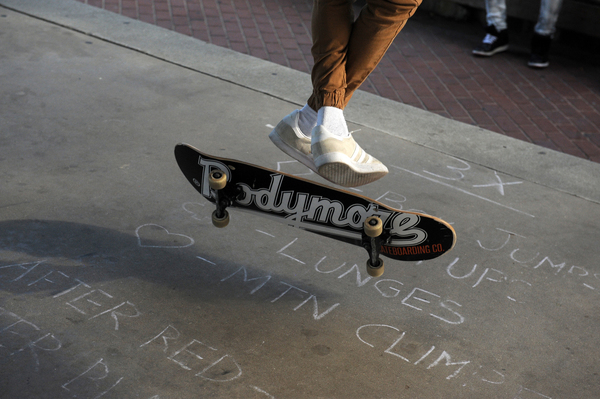
The Baltimore scene specifically has had its own black skater heroes, most notably Shawn Green, who died from a heart attack in 2014 and is memorialized in a mural at the skatepark in Hampden. Jason Chapman, 42, a friend of Green's and owner of Charm City Skatepark, said Green was a versatile and gifted skater who could master any landscape.
"He blazed trails. At the time there were like one or two black skaters," Chapman said.
While Green carried dreams of the city in the past, today the hope is that Teryn Dickson, 23, a member of the Charm City Skatepark team, will be Baltimore's breakout black skateboader. Dickson's aware of these expectations but balances them with a dose of realism.
"[The lack of recognition is] not always about race _ it's about skill. You can be the best in Baltimore, but it doesn't mean you're the best anywhere else," he said. "I'm just trying to get as good as possible."
Whatever their racial background, skateboarders are not always welcome in Baltimore's public spaces, which they often prefer over skateparks. They're often asked to leave by police officers and private security guards, which only exacerbates what Snyder calls a historically adversarial relationship between police and skateboarders.
The official approach of the Baltimore Police department is to consider the interests of the skaters and the businesses concentrated around the areas where they skate. This conciliatory approach is markedly different from the one taken with the illegal dirt bikers, another subculture dominated by young black men.
With skateboarders, "it's balancing the policies for the private property and the needs of the skaters themselves. It's not an 'us versus them,' " said Lt. Jarron Jackson, the deputy director of communications. "It's working together as a group to find out where the balance is so everyone is satisfied."
That could prove an elusive goal, considering the feelings of skaters like Malcolm Wiggins, 18.
"They don't want us anywhere, and they don't want to build us anything," Wiggins said after a Baltimore City police officer instructed him and his friends to stop skating around Harbor East. He said he doesn't understand why skating is discouraged when he and his peers are surrounded by more harmful outlets.
Wiggins recently returned to West Baltimore with his father after a few years living in Gaston, N.C. Skateboarding helped him find friends and a sense of belonging at a time in his life when the concept of "home" is hard to define.
For Caleb Clemons, 21, skateboarding has been the antidote to the destructive influences in his life.
He said that when he stopped skating, he started engaging in criminal behavior and, after a litany of charges that included theft and armed robbery, he was incarcerated.
Clemons now has a job and said he's trying to avoid people who live the life he's left. This is why, after a meeting with his probation officer, he meets his friends to skate.
"I'm not going to put my skateboard down at all. I need it in my life," he said. "It keeps me focused and centered. It gives me something to do away from the negative."
As the sun sets, the skaters decide to do more daring tricks and play a game _ Wiggins, the least accomplished skater in the group, is assigned the job of lying down while the others leap over him on their skateboards. Wiggins remarks he needs to learn more tricks in order to move past his role as "sacrificial lamb."
As the game evolves, the young men make more noise and draw more attention, and before long, security arrives and asks them to move. They end the evening back on the hunt for somewhere else to skate.