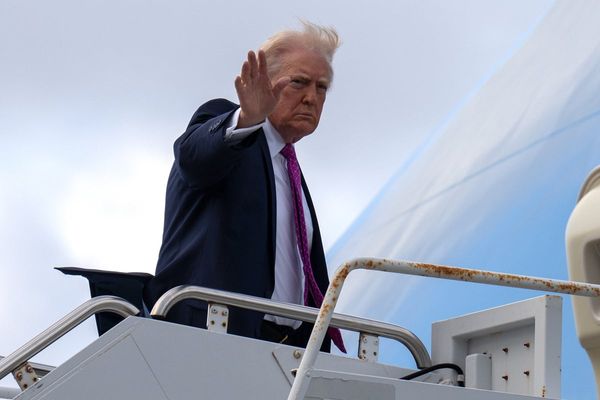
WASHINGTON _ President Donald Trump may be quitting the Paris agreement on climate change, but forcing the nation to go along with him is proving more of a challenge.
Dozens of states and cities across the country responded Friday to Trump's attack on the worldwide agreement by promising to fulfill the U.S. commitment without Washington _ a goal that is not out of reach.
The defiance is a signal to the world that the political forces behind America's climate fight aim to outmaneuver this White House and to resume the nation's leadership role when Trump changes jobs or changes his mind.
The pushback also reflects how far most of the country _ including many Republican parts _ already have moved in transitioning to cleaner energy, even as Trump works to slow that momentum.
"The American government may have pulled out of the agreement, but the American people remain committed to it _ and we will meet our targets," former New York Mayor Michael Bloomberg, a special envoy for cities and climate change to the United Nations, said Friday after meeting in Paris with French President Emmanuel Macron and Paris Mayor Anne Hidalgo.
It will be difficult. States and cities would have to meet a pledge to reduce America's greenhouse gas emissions to 26 percent below 2005 levels by 2025, America's self-declared target under the deal.
Even with buy-in from the federal government, there were doubts about hitting that nonbinding target. Trump has made it a lot more complicated by spurning the agreement _ but not impossible.
California, the nation's leader in emissions reduction, has already joined New York and Washington state to build an alliance of states that will guide the nation to Paris compliance in the absence of leadership from the federal government.
Los Angeles Mayor Eric Garcetti is leading cities in a parallel effort that already has enlisted 150 members.
"Cities and states are already where most of the action on climate is," Garcetti said Friday. "Our message is clear to world: Americans are with you, even if the White House isn't ... . Trump's move is going to have unintended consequences of us all doing the opposite of what the president wants. It will in many ways greatly backfire."
Garcetti estimated that 70 to 80 percent of the work on reducing emissions is happening at the state and local level, regardless of federal policy. That includes renewable energy mandates set by utility commissions, fuel mileage standards and efficiency rules for appliances.
While mayors and governors can't sign on to the Paris agreement _ only heads of state can do that _ they can be effective shadow participants.
Many of them have forged close relationships with the key climate players in other countries over the years, signing their own climate agreements abroad and participating in various capacities in climate negotiations, such as those in Paris and Kyoto, Japan.
Bloomberg, a billionaire philanthropist, has pledged to cover the $15 million the U.S. is reneging on by personally paying into the operations fund of the United Nations agency overseeing the Paris accord.
He announced Friday that he would inform the U.N. that the U.S. will meet its emissions obligations, noting that it is already halfway there _ because of better fuel economy standards, the shale gas revolution and more renewable energy sources _ and is positioned to step up its efforts without any help from Washington.
None of this is new for California. During the climate inaction of President George W. Bush's administration, the state passed one of the world's most aggressive climate change laws at the time.
Decades before that, California imposed vehicle emissions standards before the federal government did. In recent years, many other states have begun to compete with California in the race to reduce emissions.
"We have more rivals, if you will, with other states stepping up to act in this area," said Mary Nichols, the state's top climate change regulator.
The success of the renegade effort to bring the U.S. in compliance with the Paris agreement will probably hinge on how much further California can push the nation. Even there, the Trump White House is angling to insert itself.
It is threatening to block California from implementing aggressive new fuel mileage standards. If the White House successfully follows through, that could jeopardize the ability of states and cities to meet the Paris climate action commitments, according to Michael Wara, a professor of energy law at Stanford University.
Vehicles account for more than a third of greenhouse gas emissions, and California has unique authority under the law to set mileage standards lower than the federal government's. Under the Clean Air Act, other states can adopt those standards, and several have.
The other big source of greenhouse gases is power plants, and in that sector the U.S. continues to cut emissions significantly without the federal government.
Wara said natural gas prices had dropped so low that most states would probably meet the targets the Obama administration set for them through the Clean Power Plan _ the signature federal climate action Trump has ordered dismantled.
Prices for solar and wind power are also plunging, leading to their proliferation even in states that are not aggressively mandating their use.
Experts say that without the backstop of a federal commitment to Paris, the momentum could slow and the goal of meeting the initial pledge in the agreement could drift out of reach. An increase in natural gas prices or the price of solar panels, or a further drop in the cost of gasoline at the pump, could throw things off.
"I have no doubt we can achieve a lot," said Jody Freeman, who advised President Barack Obama on climate change. "But it is challenging to match what would have been possible staying in Paris."
Many politicians are trying. Among them is Bill Peduto, the mayor of Pittsburgh _ the city Trump repeatedly mentions he is putting ahead of Paris in his rebuke of the climate deal.
On the eve of Trump's planned "Pittsburgh Not Paris March" Saturday, Peduto announced a pledge to move his city to 100 percent renewable energy by 2035.
Trump's "misguided decision to withdraw from the Paris climate (agreement) does not reflect the values of our city," said Peduto, a Democrat.
Similar sentiments echoed across the nation.
"The City of Atlanta will intensify our efforts to reduce (carbon dioxide) emissions, work to cool the planet by 2 degrees, ramp up clean energy solutions and seek every opportunity to assert our leadership on this urgent issue," Atlanta Mayor Kasim Reed said in a statement.
Even in areas in the Deep South where Trump's move was welcomed by Republican lawmakers, state policies that will spur significant emissions reductions are in place.
"Even the red state governments understand that the economic circumstances have changed and clean energy is at least as cheap as dirty energy," said Kurt Ebersbach, senior attorney with the Southern Environmental Law Center, a nonprofit legal advocacy organization.
In Trump's hometown of New York, Democratic Gov. Andrew Cuomo expressed resolve to persevere with the Paris commitments by ordering One World Trade Center and the Kosciuszko Bridge between Brooklyn and Queens to be illuminated in green.
New York Mayor Bill de Blasio, also a Democrat, was visiting a Brooklyn neighborhood devastated by Hurricane Sandy when Trump announced the U.S. withdrawal from the climate pact Thursday.
"All that occurred in that superstorm was because of climate change," De Blasio said during the opening of a new ferry service in the low-lying Red Hook neighborhood. "We've already borne the brunt here in New York City. It's only going got get worse if something is not done quickly to reverse the course the earth is on."
����
(Los Angeles Times staff writers Barbara Demick in New York and Liam Dillon in Sacramento, and special correspondent Jenny Jarvie in Atlanta, contributed to this report.)