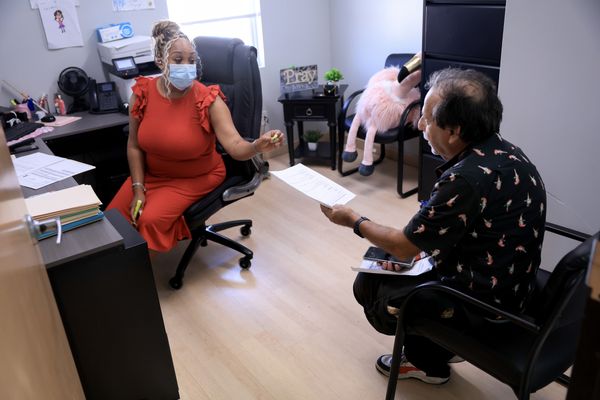
Jess Townsend makes $90,000 a year working as a lawyer. Her weekly shop is made up of home-brand products. There is no red meat.
Despite those restrictions, she can’t save. At least once in the past year, she has gone to a food bank.
Like an increasing number of middle-class Australians, Townsend is living on a financial precipice.
“People say it’s because you have coffees and you do this and you don’t do that,” she says.
“I don’t do any of the luxuries. I do my own hair at home. I don’t get my nails done. I can’t afford to buy makeup … it’s the bare minimum.”
A recent report from Food Bank Australia revealed one in five households earning $91,000 or more experienced food insecurity in the past 12 months, down from 32% in 2022.
The AMP chief economist, Shane Oliver, says average grocery prices are up 21% since 2020 but average wages are only up 16%.
“So people who are really stretched have to make choices as to what they cut back on,” he says. “And some would cut back on some food items.”
Essential items have risen in price since 2022, Oliver says – coinciding with rate hikes that increased the cost of housing.
“If you’re on a middle or lower income, you would be spending more of your budget on essentials: food, housing and, in particular, energy and they’ve gone up by more than the overall [consumer price index],” he says.
“Whereas, if you’re a higher income earner, you would have maintained a broader base of spending. Your overall cost of living wouldn’t have deteriorated much.”
Sign up: AU Breaking News email
If people are looking after a child or caring for another adult in their lives, living off one wage can feel almost impossible.
Townsend, whose son is attending university but still lives at home, was forced to move out of her last rental at the end of 2023. She had been paying $340 a week but struggled to find a new home near that price. The only place she could find was $700 a week in Parramatta, which is 55% of her wage. She says she feels as if she is treading water.
“When you put electricity and fuel costs – and then my car died, so I had to buy a new vehicle – that went on finance,” she says. “I’m just surviving.”
‘You need a very high income’
According to Food Bank Australia, while the cost of living remains the primary contributor to food insecurity, cited by 79% of food-insecure households, the connection between housing stress and food insecurity has become more pronounced.
The rate of food insecurity among renters was 48% and there was an increase in households citing “changes in my household/living arrangements” as a reason for their food insecurity (up to 29%, from 25% in 2024).
Exclusive data from real estate data firm Cotality shows there is no capital city in Australia where someone making under $100,000 would be able to afford the median rental or mortgage repayments without paying more than 30% of their wage.
Assuming someone is getting into the housing market with a 20% deposit and spending 30% of their income on a mortgage, individuals would need to be making from just over $100,000 in Darwin to about $230,000 a year in Sydney.
“You need to have a very high income,” says Cotality’s head of residential research for Australia, Eliza Owen.
“In a well-distributed housing market, a median-income household should be able to buy the median dwelling … but the housing market is clearly out of whack.
“For example, the median example in Sydney is closer to a pre-tax $120,000 a year, not $230,000 a year.”
While renters needed to earn less to service the median rent, they still needmore than $100,000 a year in every capital city.
“That is the income that you might expect to make as a single [person] in a decent job,” Owen says. “Or as a household with essential services professionals. And it’s not good enough, we need to be doing better.”
Many renters are paying well above 30% of their income, or living in share houses, Owen said.
Median wages in Australia have stagnated in the past decade, with the purchasing power of wages after inflation increasing just 2.6% over 10 years, according to a report released earlier this year by Per Capita. In comparison, real wages grew by 16% between 1991 and 2001, and another 16% between 2001 and 2011.
‘I feel like a clock running down’
Peter Whiteford, a professor in the Crawford School of Public Policy at the Australian National University, says the median income trends in Australia since about 2013 have “been fairly disappointing”.
“Living standards are still much higher than they were in 2002 or 2001 but they haven’t really significantly improved since 2009,” he says.
Whiteford says there is a divide between generations – with research from the Productivity Commission showing people born in the 1990s were the first generation to not have higher incomes by their 30s.
“That’s the first time that income and earnings are not greater than people born 10 years earlier,” he says.
The latest figures from the Australian Bureau of Statistics show almost one million people are now working two jobs to keep up with the cost of living, up from 818,700 in June 2021.
Josh* lives in Sydney, has three jobs and calls himself a “workaholic”.
He works in communications for a not-for-profit organisation, writes freelance and lectures at a university for a combined annual income of between $80,000 and $90,000. His rent is $800 a week for two-and-a-half bedrooms, which he shares with his partner and son. That’s relatively cheap for Sydney, but more than he can easily afford. He often uses the Addi Road food pantry to make ends meet.
“It’s been really helpful to be able to access food for free, or food that’s discounted because it’s meals as well that are pre-prepared and pretty nice,” he says.
“But I feel like a clock running down, like I’m working harder and harder and harder to just tread water. Nothing is really improving.”
Owen said the severe gap between what the typical household could afford and the median price of housing suggested that a smaller group of wealthy buyers, who have high incomes or have built wealth and equity through the housing bubble, are driving prices up.
“There’s more going on than incomes and savings and a 20% deposit,” she says. “Because prices wouldn’t be this high if people couldn’t afford to pay them.
* Some names have been changed.