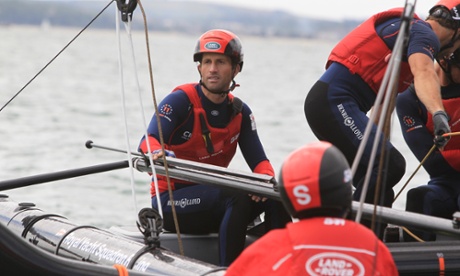
Sir Ben Ainslie is making waves once again. This weekend his Land Rover BAR crew (BAR stands for Ben Ainslie Racing) becomes the first British team to contest an official America’s Cup World Series competition in front of a home crowd since 1851.
Half a million people are expected to descend on Portsmouth this weekend and millions more will be watching on TV around the world. Ainslie’s extraordinary achievements in the 2012 London Olympics have helped Britain rediscover its love of sailing and allowed a nation to dream an impossible dream: that the America’s Cup, the oldest major sporting trophy in the world, can be brought to these shores for the first time.
But while the crowds are focusing on Ainslie’s heroics at sea, the key to Britain’s hopes of winning the America’s Cup in 2017 will not be wowing them out on the water. Last Thursday it could be spotted resting on sturdy metal legs in the dry dock of the BAR team’s purpose-built ultra-modern HQ – an eye-catching, six-storey building that stands proud on the harbour-side of Portsmouth old town, among Georgian pubs and multistorey boat parks.
“This is the boat that Batman would have,” said Andy Claughton, the BAR team’s chief technology officer, as he inspected a sinister-looking grey catamaran hull, smooth as a shark’s skin. The hull belongs to the T2, an experimental craft that the team will use to develop its boat for the next America’s Cup, in Bermuda in 2017.
As Ainslie and his crew worked out in the state-of-the art gym high above the T2 last week, a team of mechanics and engineers were busy equipping it with sensors that will be able to report back a wealth of performance data. The frantic activity around the craft is understandable. T2 will take to the water in one month’s time, and learning as much from the catamaran as possible over the next two years will be crucial if Britain’s hopes for sporting glory at sea are to be realised.
This is because, unlike this weekend’s World Series event, in which all the boats are built to exactly the same dimensions and specification, the America’s Cup gives competing teams licence to design and develop their own craft. To put it another way: if the results of this weekend come down to how well Ainslie and his crew perform, Bermuda 2017 will be about how they can best understand and exploit their boat’s technology.
Claughton draws comparisons with the world of cycling, where Chris Boardman and Sir David Brailsford revolutionised the sport by ensuring that Team GB athletes develop an almost symbiotic relationship with their bikes. “They understood that athletes have to have time to get comfortable with the equipment,” he said. “Stuff that comes in at the last minute is hopeless. It’s like learning to run in a new pair of shoes.”
But this learning does not come cheap. Ainslie’s quest is costing £80m. He has secured high-profile sponsors and, given that his headquarters did not even exist a year ago, his team’s progress is remarkable. “We went from having no staff to 70 in nine months,” said Andy Hindley, the team’s chief operating officer. “That’s not normal.”
A stellar team of technical experts, meteorologists, analysts and fitness coaches has been drafted in. A technical innovations group that includes British Aerospace – a world leader in designing submarines and fighter planes – has been established. A team culture now permeates the HQ. Staff wear BAR team polo shirts. Key moments in the history of the America’s Cup are emblazoned on the walls. A board of shareholders and independent directors hold the BAR team to account.
“This is one of the most exciting things I’ve been involved with,” said one board member, former BBC chairman Lord Grade. “And I’ve met Elvis.”
But, despite their early success, they know the clock is ticking. Claughton spends hours fretting over the calendar, trying to work out how much time he can devote to testing any given piece of equipment. The rules stipulate that crews are not allowed to launch the boat in which they will compete until 150 days before the competition. This means that getting the design right long before the race begins is crucial.
New rules are complicating matters. The next America’s Cup will be contested by boats that are 50ft long; those that competed at San Francisco in 2013, when Ainslie helped Oracle Team USA achieve a memorable comeback, were giants by comparison, at 72ft.
“They were massive boats in San Francisco,” Claughton said. “Just getting something that big to the start line was the limit of the teams’ ambition. But now the challenge is: how do you get to the start line with a faster boat than your competitors?”
It is a demanding question given that those competitors include an Oracle Team bankrolled by software tycoon Larry Ellison – on a good day the fifth- richest man on the planet – and Ainslie is adamant that Land Rover BAR must pay its way.
“The goal is to bring the cup home but also to build a sustainable business that will be around for years to come,” he said.
The hope is that the business generated will become an economic catalyst for Portsmouth and the wider Solent area. A recent report suggested that the siting of the Team New Zealand base in Auckland created 1,000 jobs and brought an $88m boost to the local economy.
It was for this reason that Ainslie insisted the team be based in Portsmouth rather than Bermuda, where most of the other teams will locate as they prepare for the race. “There is no point saying you’re British and being based in Bermuda,” Claughton said.
But the need to operate as a business inevitably brings tensions. Difficult choices have to be made about how and where to spend a large but finite pot of money. “Tiny gains cost a lot of money,” Hindley said. “We have to work out how much each percentage improvement costs in pounds.”
In a major coup, the BAR team has poached Martin Whitmarsh, the former team principal of Formula One’s McLaren Racing, to be its chief executive. The hope is that the Solent area could eventually become the sailing world’s equivalent of Motorsport Valley, the global centre for motorsport technology centred on Oxford.
“What drew me was the vision that Ben and the team have,” Whitmarsh said. “There is a belief that we can do this thing.”
But many other Britons have harboured similar convictions down the years, only to see them dashed ignominiously on the rocks. “We do have a history of glorious failure,” conceded Claughton, who has tasted America’s Cup success – as part of Team New Zealand in both 1995 and 2000.
This is a source of national embarrassment, given that the first America’s Cup, in 1851, was contested around the Isle of Wight, observed by Queen Victoria. Since then the competition has never been staged in British waters, because the winner of the cup determines the format and the venue for the next contest. Last week, Ainslie revealed that he had a vision of his team racing to a finish line stretching across Portsmouth harbour, powered by “a nice south-westerly breeze”.
A year ago many would have dismissed his vision as hubris. But few now doubt Ainslie’s conviction that he can bring the cup home.
“It’s the only major event that we have never won,” he said. “If I didn’t think it was possible, trust me, I wouldn’t be doing it.”