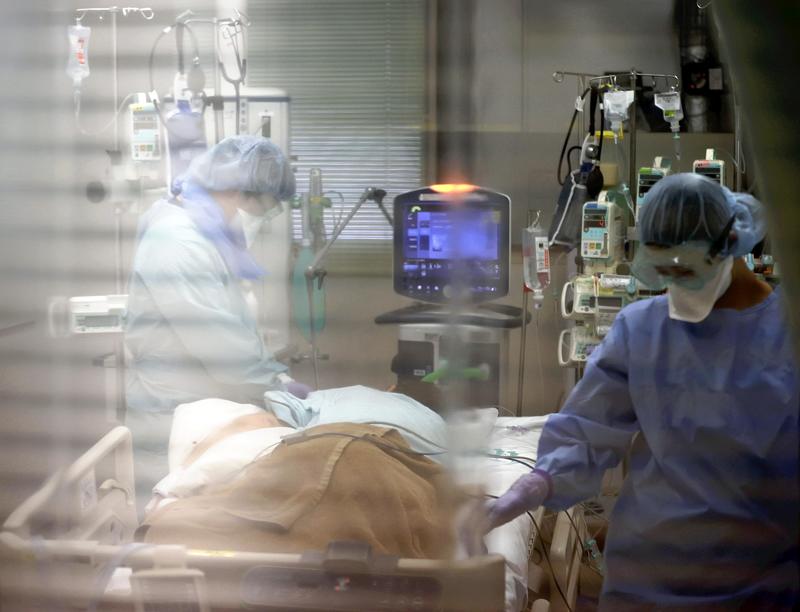
In one corner of the intensive care unit, a negative-pressure room has been set up to lower the air pressure and prevent the corona virus from leaking out.
"Psss ... psss ..." echoes the regular sound of a ventilator in a space partitioned by a transparent curtain.
"Breath frequency 20, oxygen concentration is ... " An air tube is inserted into the trachea of an elderly man lying on a bed, and a doctor and a nurse wearing light blue protective clothing pay close attention to the numbers on the device.
In the ICU unit of Yokosuka Kyosai Hospital in Yokosuka, Kanagawa Prefecture, earlier this week, I am afforded an up-close look at the struggle of health care workers as they fight to save the lives of the most seriously ill patients affected by the new coronavirus. The hospital is one which has recently begun accepting patients in critical condition.
The man on the bed was found to be positive through a PCR test and was brought to the emergency room of the hospital when his condition suddenly worsened several days ago. He was given the anti-influenza drug Avigan, and while his condition stabilized, the situation remains unpredictable.
"Body position change, 10 centimeters upper right." The doctor and the nurse shift the man slightly to the upper right and the doctor places a stethoscope on his chest. Treating an infected patient also carries the risk of the medical staff themselves being infected. After about 30 minutes, the examination is finished and the two meticulously remove their goggles and masks and methodically sterilize their hands with alcohol. The goggles leave red marks around their eyes.
The hospital, a core medical facility on the Miura Peninsula, began accepting infected patients in late March. In early April at the request of the prefectural government, it set aside two beds in the ICU for critical patients and 24 beds in general wards for patients with moderate symptoms. In the ICU, 11 doctors and more than 30 nurses from the emergency center work in shifts treating patients.
While the psychological and physical burden on the staff continues to increase, it is a relief to all that no one has been infected in the hospital. Twice a year, all hospital staff undergo training in countermeasures for infectious diseases. They use fluorescent cream to check for spots on their hands missed while washing, and study how to properly put on and take off gowns and other protective equipment."We can attribute not having any in-house infections due to our know-how on dealing with infections," the head of the emergency center says with pride.
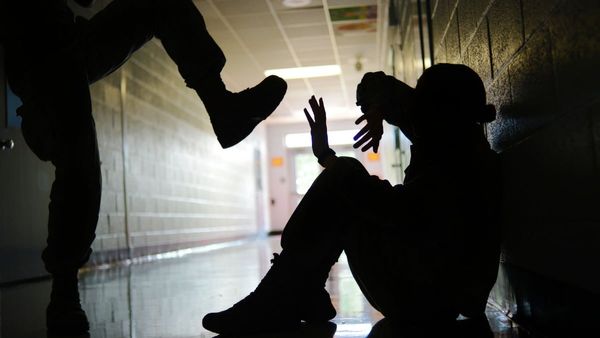
Meanwhile, there has been at least one case of a nurse quitting at the request of family concerned that they will be infected. Many doctors and nurses who have accepted that risk also encounter discrimination and prejudice from outside. "My child was told not to attend the school's opening ceremony," lamented one. "My husband was treated as a someone who has come into close contact [with an infected patient], so he had to voluntarily refrain from going to work," said another.
"We regard accepting infected patients as our mission," said Kaoru Nagahori, director of the hospital, speaking on behalf of all medical workers. "We have no choice but to join together in this fight against this powerful enemy called the new coronavirus."
One aspect in which Japan is said to be lacking is available ICU beds. According to an estimate released by the Japanese Society of Intensive Care Medicine on Thursday, there are about 6,500 ICU beds in the nation, or about five for every 100,000 people. The figure is small compared to about 29 in Germany, about 13 in Italy and about 12 in France.
In central Tokyo, which has the highest concentration of infections, several hospitals at one time saw their ICU beds completely filled.
"The number of patients has leveled off in recent days," said Osamu Nishida, president of the society. "We need to use this chance to prepare to accept critical patients in beds outside the ICU as well."
Read more from The Japan News at https://japannews.yomiuri.co.jp/