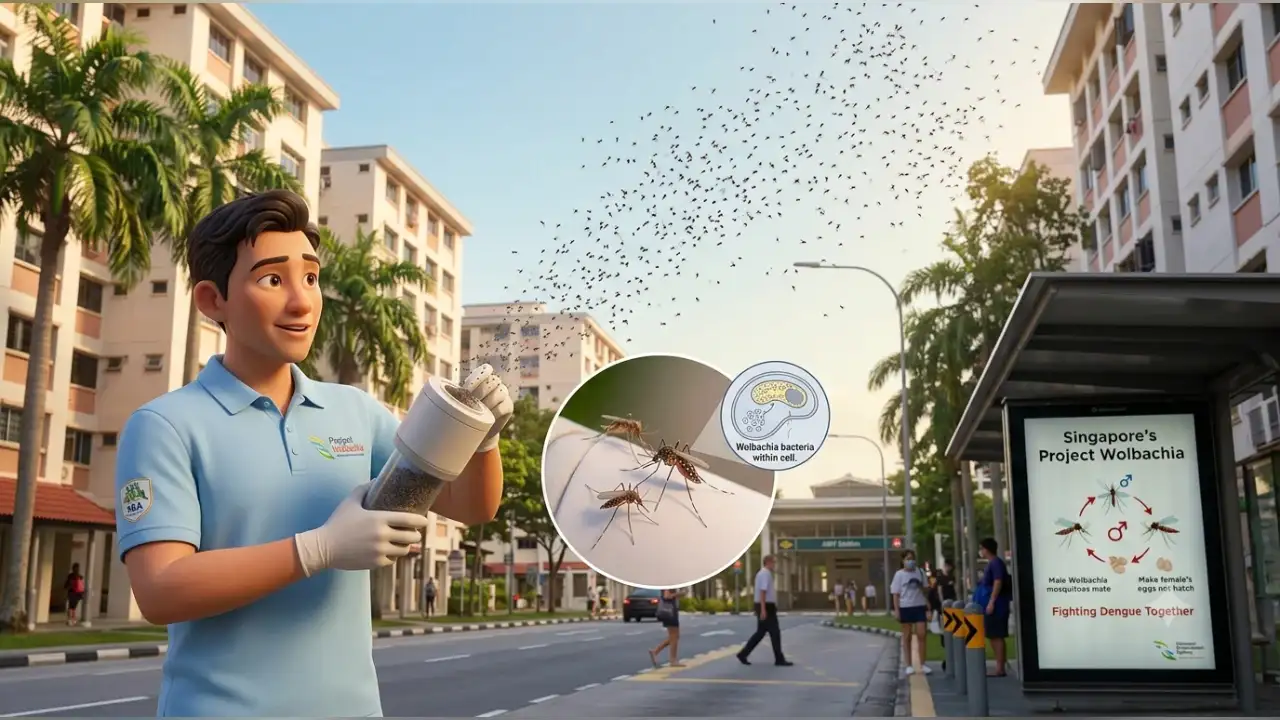
Scientists using mosquitoes to fight dengue : Mosquitoes are usually something people try to get rid of. Singapore took a different approach in 2016, releasing male mosquitoes carrying Wolbachia, a bacterium that can interfere with mosquito reproduction.
Why Singapore turned to Wolbachia
Dengue cases have soared in recent decades, while warmer conditions have created more opportunities for disease-carrying mosquitoes to thrive.
The virus can cause severe joint and bone pain, earning it the nickname "breakbone fever." In severe cases, it can cause hemorrhagic fever and death.
Scientists in Australia discovered Wolbachia's dengue-fighting abilities, with the first trials held there in 2011, as per a report.
The bacterium occurs naturally in mosquitoes and other insects. Scientists found that Wolbachia can make it harder for dengue to grow inside mosquitoes and be transmitted to people.
Singapore began its own program in 2016, using Wolbachia-carrying males to suppress the Aedes aegypti population, according to a Phys.org report.
The mosquitoes released in Singapore do not bite
The mosquitoes being released are male, so they do not bite people.
They are released to mate with females that do not carry the same Wolbachia strain. When that happens, the resulting eggs do not hatch.
By repeatedly releasing infected males, the program can reduce the number of Aedes aegypti mosquitoes.
It is not the only way scientists use Wolbachia.
Another strategy involves releasing both male and female mosquitoes carrying the same Wolbachia strain. In that case, their eggs hatch normally and the bacteria can spread through the mosquito population.
Marcelo Jacobs-Lorena, a Johns Hopkins University professor emeritus who studies the field, favors releasing both male and female mosquitoes carrying the same Wolbachia strain, allowing the bacteria to spread through the population rather than suppressing mosquito numbers, as per the Phys.org report.
The bacteria itself blocks transmission of diseases including dengue, Zika and chikungunya. Mosquitoes can still bite people, but those carrying Wolbachia are less able to transmit the diseases.
READ ALSO: Best Hispanic baby girl names for 2026: Popular picks and their meanings
Singapore now releases more than 10 million mosquitoes a week
Singapore's Project Wolbachia has expanded since its launch.
More than 10 million mosquitoes are now released every week, making it the largest public-sector deployment of the technology.
A study published in the New England Journal of Medicine found that the intervention significantly reduced the Aedes aegypti population and lowered dengue risk by more than 70%, as per the Phys.org report.
Wolbachia programs have spread beyond Singapore
Singapore is not the only country where researchers are using or testing Wolbachia mosquitoes.
In Colombia, the World Mosquito Program has spent nearly a decade replacing local Aedes aegypti populations with mosquitoes infected with Wolbachia.
The Colombian project began in Medellin in 2015 and was later expanded to Cali. Health authorities in the northwestern Antioquia department said dengue cases had fallen by 95%.
The same experiment has also been conducted in Indonesia and Brazil and was expected to be implemented in El Salvador.
In the United States, another Wolbachia-based approach is being used for residential mosquito control. Male tiger mosquitoes are released because they do not bite. When they mate with females that do not carry the same strain, the eggs do not hatch.
Local conditions can affect the results
The effectiveness of Wolbachia mosquito programs can depend on local conditions.
Jacobs-Lorena said "Mosquitoes can migrate with the wind, so it depends on the geography of the environment," and added that the efficacy depends on the scale of the intervention, as quoted by Phys.org.