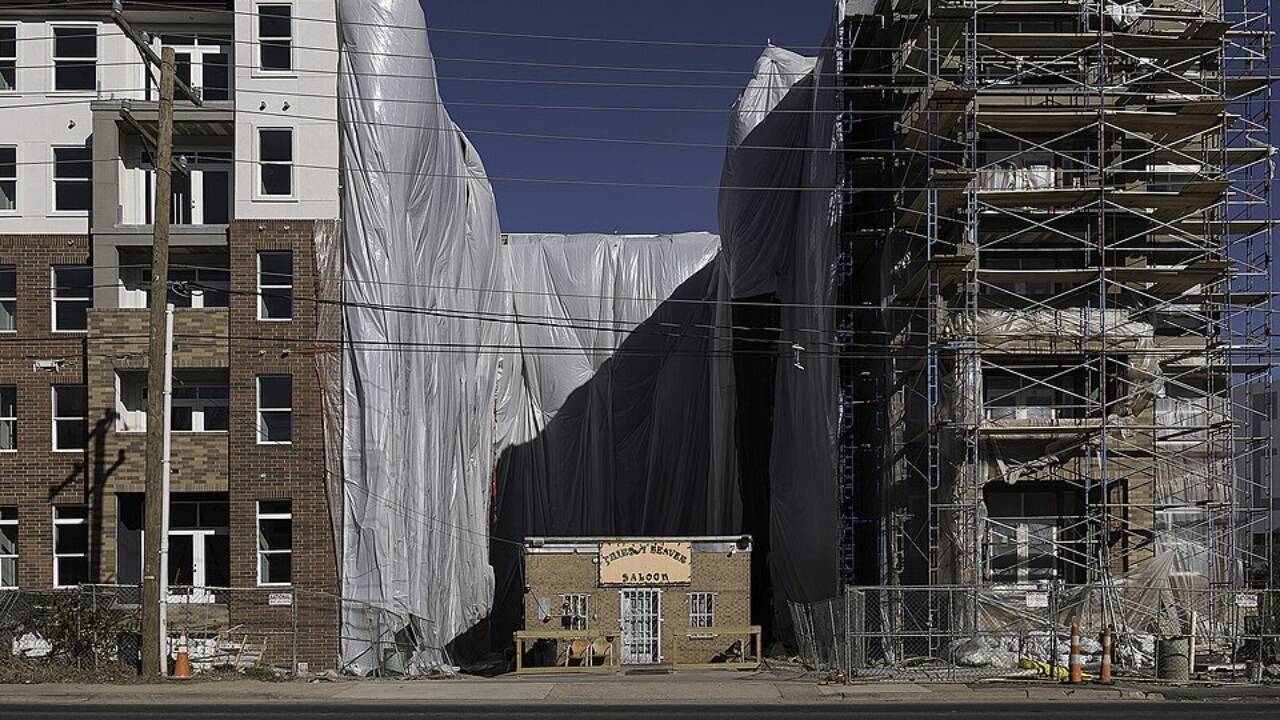
In Charlotte, North Carolina, one small property became an unusually visible holdout against rapid urban redevelopment. Thirsty Beaver Saloon, a one-storey neighbourhood bar in the Plaza Midwood area, opened in 2008 on a parcel that had been preserved for over seven decades. The building parcel belonged to George Salem, and brothers Mark and Brian Wilson operated the bar. While Plaza Midwood is one of Charlotte’s oldest established communities, the specific blocks surrounding the bar had long been dominated by older commercial structures and underutilised industrial lots. In 2015, developer CW Development bought the surrounding land for $8.5 million and planned a 323-unit apartment complex. Salem, however, declined the developer’s offers to purchase the Thirsty Beaver property, leaving the company to build around it instead of acquiring it. The completed apartments wrapped around the bar on three sides in a horseshoe-like structure.
Get breaking news anytime, anywhere. Download the TOI app now!
How one small plot complicated major development
The Thirsty Beaver had been intentionally designed as a neighbourhood bar, and its location looked quite different when it first opened. According to the Charlotte Observer, the Wilson brothers leased the property from George Salem, whose family had owned the property for decades. However, by the middle of the 2010s, Plaza Midwood was undergoing a wave of residential construction, with new apartment projects appearing along Central Avenue and its surrounding streets. This development increased pressure on the older, low-rise properties of the region. The Charlotte Observer noted that in 2017, around 820 new apartments were being added along a quarter-mile stretch of road near the bar.
The Charlotte Observer reported that Salem decided to retain the property rather than sell it, citing the plot's 70-year history in his family. Therefore, the developers could assemble the surrounding properties but could not obtain the small plot occupied by the Thirsty Beaver. Several reports suggest that despite the developer’s several attempts to purchase the property, Salem remained adamant in his refusal. Notably, rather than leaving the larger project unfinished, they designed the new apartment building around the existing structure.
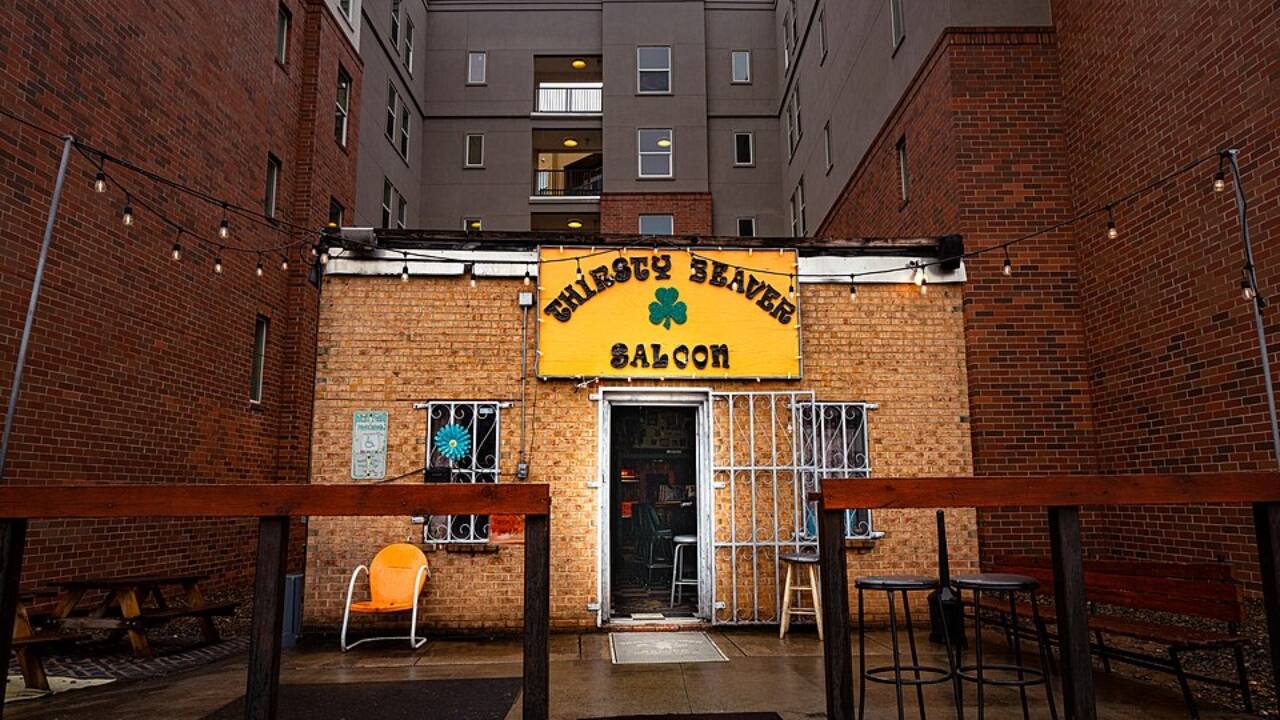
The resulting landscape looked almost surreal: an unassuming orange building remained at ground level while a much larger five-story apartment development rose around it. The Associated Press compared this scene to the house in Pixar’s Up , while local coverage deemed the bar an emblem of Plaza Midwood’s distinctive character. Axios later described the Thirsty Beaver as one of the neighborhood’s surviving independent businesses at a time when new apartments, restaurants, and other developments were reshaping the community.
The economics behind a “holdout” property
The standoff in Charlotte perfectly illustrates a phenomenon studied extensively by urban economists: the land assembly holdout problem. Large developers typically require contiguous parcels of land to maximize density, meaning a single owner's refusal to sell can disrupt entire development plans. In a subsequent peer-reviewed study titled Who’s Holding Out? An Experimental Study of the Benefits and Burdens of Eminent Domain , published in the Journal of Urban Economics in 2018, researchers Abel M. Winn and Matthew W. McCarter analyzed these exact friction points.
Interestingly, the researchers' market experiments found that traditional holdout inefficiencies usually stem from buyers making low, uncompetitive offers rather than from sellers strategically holding out for astronomical payouts. However, the Thirsty Beaver scenario completely inverted this academic model. CW Development was aggressively competitive, paying a staggering $8.5 million for the surrounding acreage and making multiple premium offers for the bar's small footprint. Because Salem’s refusal was rooted in deep-seated family sentimentality rather than a strategic financial calculation, no amount of market-rate capital could alter his decision. The 2018 study underscores why the situation became so unusual: when a property owner operates entirely outside traditional profit motives, standard corporate purchasing strategies lose all transactional leverage.
Meanwhile, for the Thirsty Beaver, its unusual property arrangement eventually became part of the neighbourhood’s identity. The story, thereby, is less about a small bar defeating a giant developer than about how property ownership can shape the physical form of a city. While the CW Development was able to assemble enough surrounding land to develop a 323-unit apartment complex, one privately retained parcel remained outside the project. Instead of removing the obstacle, the development incorporated it, creating a striking example of how one small parcel can shape a rapidly changing neighbourhood.