Honeybees trained to detect explosives : Honeybees are known for finding flowers, but researchers in Croatia have spent years exploring a far more unusual use for their strong sense of smell: detecting traces of explosives.
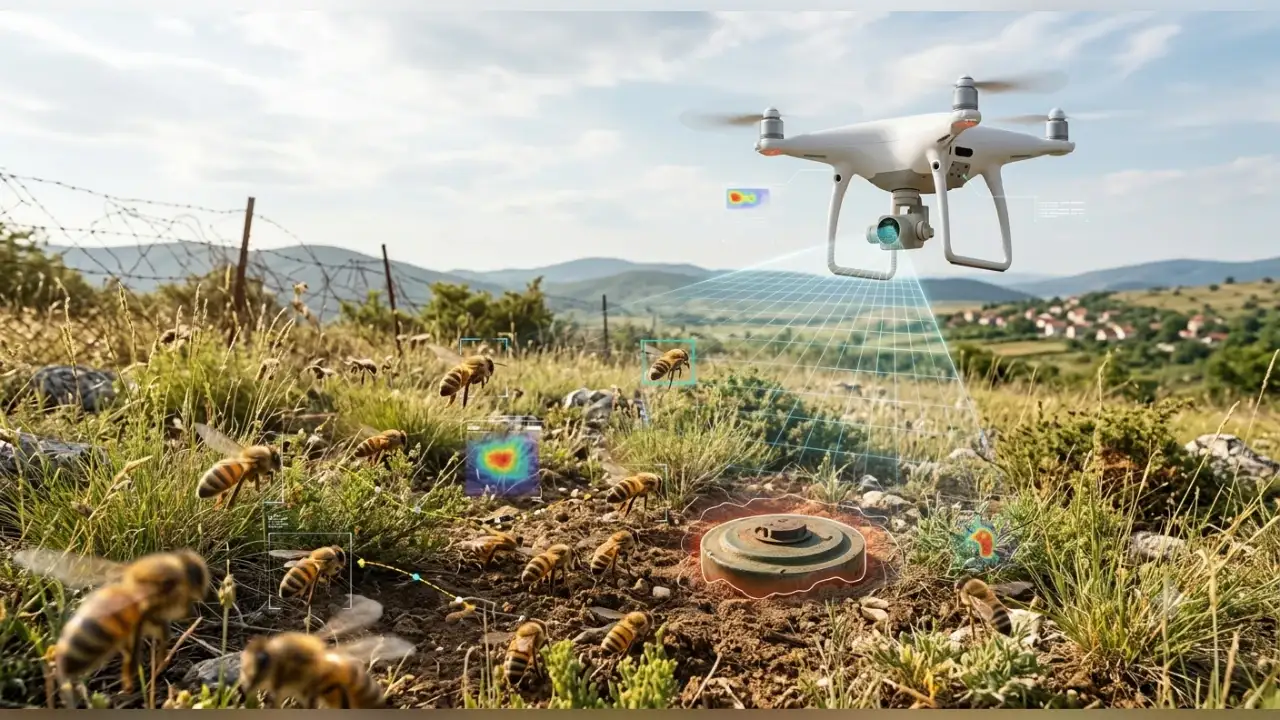
Earlier research involved training bees to associate the smell of TNT with food. A newer project involving researchers from Bosnia and Herzegovina and Croatia is taking the idea a step further by using drones and artificial intelligence to track the insects as they search, as per a report.
The approach could eventually provide another way to check areas affected by land mines left behind by the Balkan wars of the 1990s. Bosnia and Herzegovina is estimated to have about 80,000 land mines, while Croatia has around 30,000.
Earlier research trained bees to recognize TNT
Researchers in Croatia developed a method that took advantage of honeybees' ability to detect smells with their antennae.
Honeybee behavior expert Nikola Kezic trained bees to associate the smell of TNT with a sugar solution, as per a Phys.org report. When the insects encountered the scent during training, they learned to connect it with a food reward.
In field conditions, trained bees tended to gather around areas where mines were buried, creating a potential way to identify locations containing traces of explosives.
Kezic shared that bees could learn the smell of an explosive and then search for it, although training an entire colony of thousands of insects presented a greater challenge, according to Phys.org.
Tracking the bees became the next challenge
Training bees to recognize TNT was only part of the problem. Once released into a mine-contaminated area, the insects could fly freely, making it difficult for people on the ground to keep track of their movements.
That is where researchers from Bosnia and Herzegovina and Croatia turned to drones.
Vladimir Risojević of the University of Banja Luka said the team wanted to reduce the need for people to enter potentially dangerous areas and instead use drones to monitor the bees, as per a BBC report.
The unmanned aircraft fly over the area and record footage of the insects. Computers can then analyze the footage to determine where the bees are clustering.
Artificial intelligence learned to follow the insects
Tracking tiny flying bees in video footage proved difficult, even for computer systems.
The researchers first used drone footage of an outdoor area and added synthetic bees — fuzzy grey shapes moving through the scene.
After making the artificial bees resemble real bees in the footage, the team trained a machine-learning algorithm to detect and follow them.
In tests described in a published paper, the algorithm was more than 80% accurate at tracking the synthetic bees.
The researchers then moved to a practice minefield at the Croatia Mine Action Center. The site contained real but defused mines buried in undisclosed locations, allowing the team to test the system under realistic conditions without exposing the researchers to active explosives.
READ ALSO: A hidden black hole stayed invisible until it destroyed a passing star, revealing a cosmic mystery
Bees clustered near known mine locations
The drones were programmed to fly along predetermined routes across the practice minefield while recording the bees.
Researchers later analyzed the footage to identify areas where the insects clustered. According to Risojević, there was a strong correlation between the locations where bees gathered and the known positions of mines at the test site.
However, the detailed results of this field test had not yet been published in an academic paper at the time of the report.
The researchers also said the system was not yet ready to be used in areas containing dangerous, active mines.
The technology could provide an additional check
Land mines left behind by conflicts decades ago continue to pose a danger across parts of the Balkans.
Many thousands of mines were planted during the wars of the 1990s, and clearing them remains a long-term and difficult process. Even after de-mining teams work through an area, it can be difficult to know whether every device has been removed.
The researchers believe bees and drones could eventually provide an additional way to check areas that have already been de-mined.
The system would not necessarily replace existing de-mining techniques. Instead, researchers envision using drones to follow trained bees and identify areas where the insects cluster, potentially helping confirm whether mines may have been missed.
Other technologies already used in mine clearance include handheld metal detectors with built-in ground-penetrating radar.
READ ALSO: Scientists uncover how ancient Roman concrete became more durable over nearly 2,000 years
The bee-and-drone system is still experimental
The technology is not yet a quick solution to the mine problem.
Risojević said it could be several years before the approach is used in areas containing dangerous active mines. He believes it could eventually complement other de-mining techniques.
Matthew Breay Bolton of Pace University also pointed out that mine clearance involves challenges beyond technology, as per the BBC report. Political disagreements and a lack of resources can delay clearance projects even when technical tools are available.
The researchers remain hopeful that their system could eventually contribute to efforts to clear mine-contaminated areas in countries such as Croatia and Bosnia and Herzegovina.
The technology could also help study pollinators
The researchers see another possible use for the computer-vision technology developed to follow the bees.
Computer vision researchers have already developed experimental systems for tracking insects in the wild. Similar tools could potentially be used to monitor pollinators such as bees, which are important to crops and ecosystems.