Slime mold Tokyo rail system : In 2010, a team of scientists discovered that a single-celled slime mold could help solve a problem that has challenged city planners for decades. While studying a slime mold searching for food, they found that it created a transport network strikingly similar to the rail system around Tokyo, as per a report.
The researchers believed the slime mold's natural behavior could help design more efficient transportation networks
A slime mold built a network like Tokyo's railway
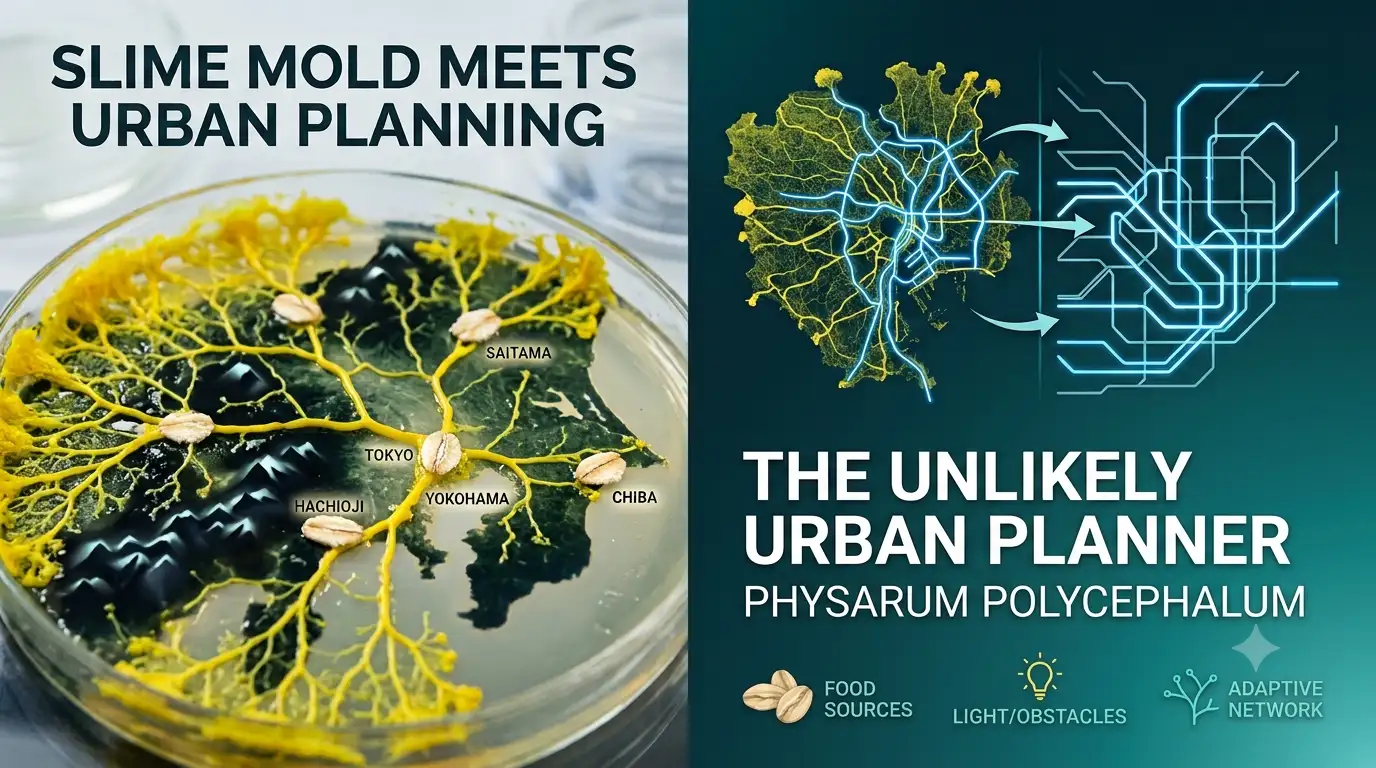
The researchers studied Physarum polycephalum, a single-celled, fungus-like organism that spreads across surfaces by growing a web of connected veins in search of food.
To see how it would organize itself, they placed oat flakes on a wet surface in positions matching the cities surrounding Tokyo, as per a Livescience report. They also used bright light to represent mountains and other geographical obstacles because slime mold naturally avoids light.
As it expanded toward the food sources, the organism formed a network that closely resembled the railway connecting the cities around Tokyo.
READ ALSO: Brazilian ecologist who migrated to the US in 1976 discovered why mosquitoes love human blood
The organism relied on simple rules, not a central plan
The researchers explained that slime mold naturally grows in interconnected networks as part of its strategy for finding and using food.
They found that the organism was able to connect food sources while keeping the overall network short and maintaining relatively short routes between different points, as per the Livescience report. In some respects, the network it created was even more efficient than the existing transport system.
Rather than following instructions from a central control point, the slime mold constantly adapted as it grew. It reinforced routes that worked well and gradually removed unnecessary connections.
Scientists hope the findings can improve future transport systems
After observing the slime mold's behaviour, the researchers incorporated its growth and feeding patterns into a computer model.
They hope the model can help design transportation networks that are both efficient and adaptable.
In an accompanying essay published in Science, Wolfgang Marwan of Otto von Guericke University pointed out that the study showed how mathematical models inspired by biology could lead to highly efficient algorithms with features found in living systems, as per the Livescience report.
Marwan said, "The model captures the basic dynamics of network adaptability through interaction of local rules, and produces networks with properties comparable to or better than those of real-world infrastructure networks," adding, "The work of Tero and colleagues provides a fascinating and convincing example that biologically inspired pure mathematical models can lead to completely new, highly efficient algorithms able to provide technical systems with essential features of living systems," as quoted by Livescience report.