Honeybees have no need to recognize human faces in their everyday lives. Yet researchers found that the insects could learn what makes a face look like a face and use that information to identify unfamiliar images.
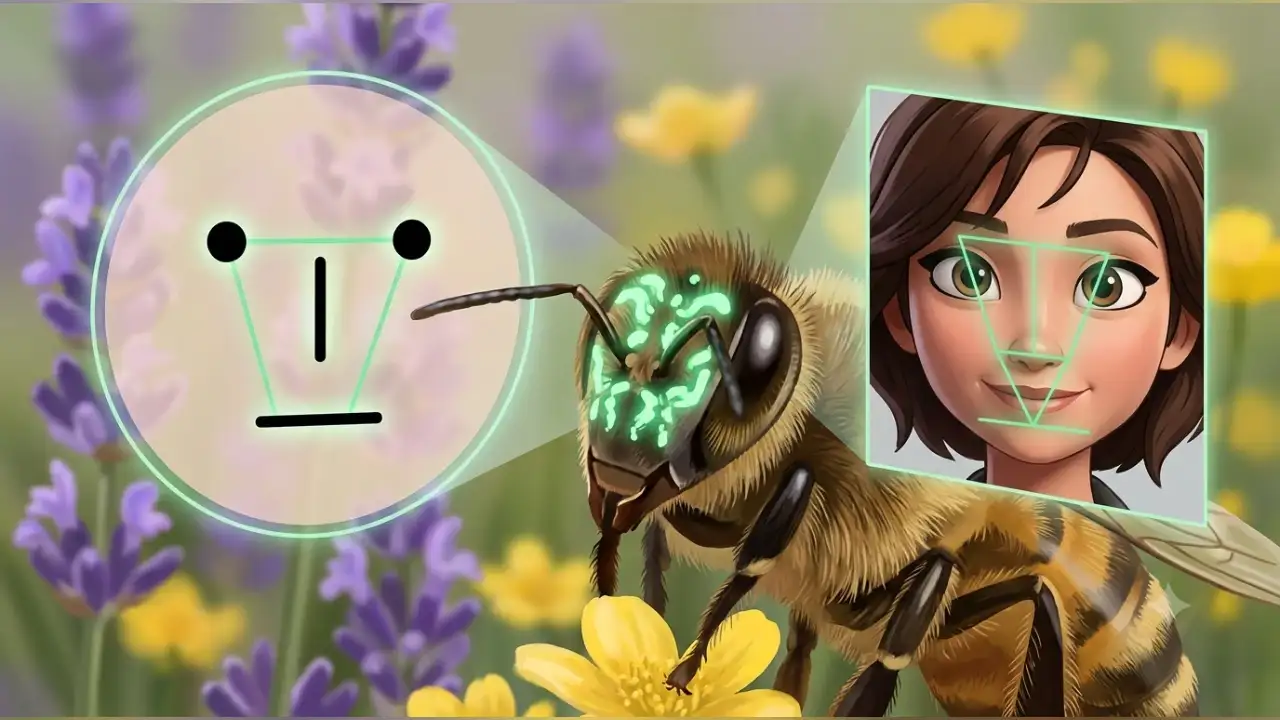
The discovery came from experiments published in the Journal of Experimental Biology in 2010. Researchers from Monash University and the Université de Toulouse found that bees were not recognizing individual people. Instead, they were paying attention to the relative positions of features such as the eyes, nose and mouth.
The findings also suggested that the visual strategy used by bees could provide ideas for developing automatic facial recognition systems.
The experiment started with a simple question
The research followed earlier work by Adrian Dyer of Monash University, who had trained bees to associate photographs of human faces with sugar rewards.
Martin Giurfa of the Université de Toulouse wondered whether the bees were actually recognizing faces.
Because the insects received sugar when they selected the photographs, Giurfa suspected they might simply be responding to the images as unusual patterns, similar to the way they respond to flowers, as per a Sciencedaily report.
Giurfa teamed up with Dyer and Aurore Avargues-Weber to find out exactly what the bees were learning.
Bees learned the arrangement of facial features
The researchers began with simple images that barely looked like faces. Each one contained two dots for eyes, a short vertical dash for a nose and a longer horizontal line for a mouth.
The bees were trained to distinguish between two versions of the image. In one, the features were close together. In the other, they were farther apart. The correct choice was rewarded with a weak sugar solution.
When the researchers removed the reward and tested the bees again, the insects still returned to the image they had learned. This indicated that the bees were remembering the visual arrangement rather than simply following the sugar reward.
The bees recognized faces they had never seen
The researchers then tested whether the bees could apply what they had learned to completely new images.
The insects were shown five pairs of pictures. One image in each pair was face-like, while the other consisted of dots and dashes arranged differently.
After learning that face-like images were associated with a sugar reward, the bees were shown a new pair they had never encountered before. They still picked the face-like image. That suggested the bees had learned the general relationship between the features rather than simply memorizing individual pictures.
Moving the features changed the result
The team next placed the simple dot-and-line faces inside photographs of real faces.
Even with the more complicated backgrounds, the bees could recognize the familiar arrangement of features.
But when the researchers scrambled the positions of the eyes, nose and mouth in photographs of real faces, the bees no longer treated the altered images as familiar.
The experiments pointed to the relative position and order of facial features as an important part of what the bees were learning.
Bees were not identifying individual humans
The findings did not show that bees could recognize individual people. Instead, the insects appeared to recognize a face-like pattern based on how its features were arranged.
Giurfa suggested that bees may use a similar strategy when learning to recognize different objects in their environment, as per the Sciencedaily report.
What a bee's tiny brain could teach technology
The researchers were particularly interested in how an insect with a tiny brain could perform this kind of visual analysis.
Humans have entire regions of the brain dedicated to processing faces. Bees accomplish this type of image analysis with a much smaller nervous system.
Giurfa suggested that studying the bees' approach could provide useful ideas for researchers developing automatic facial recognition systems.