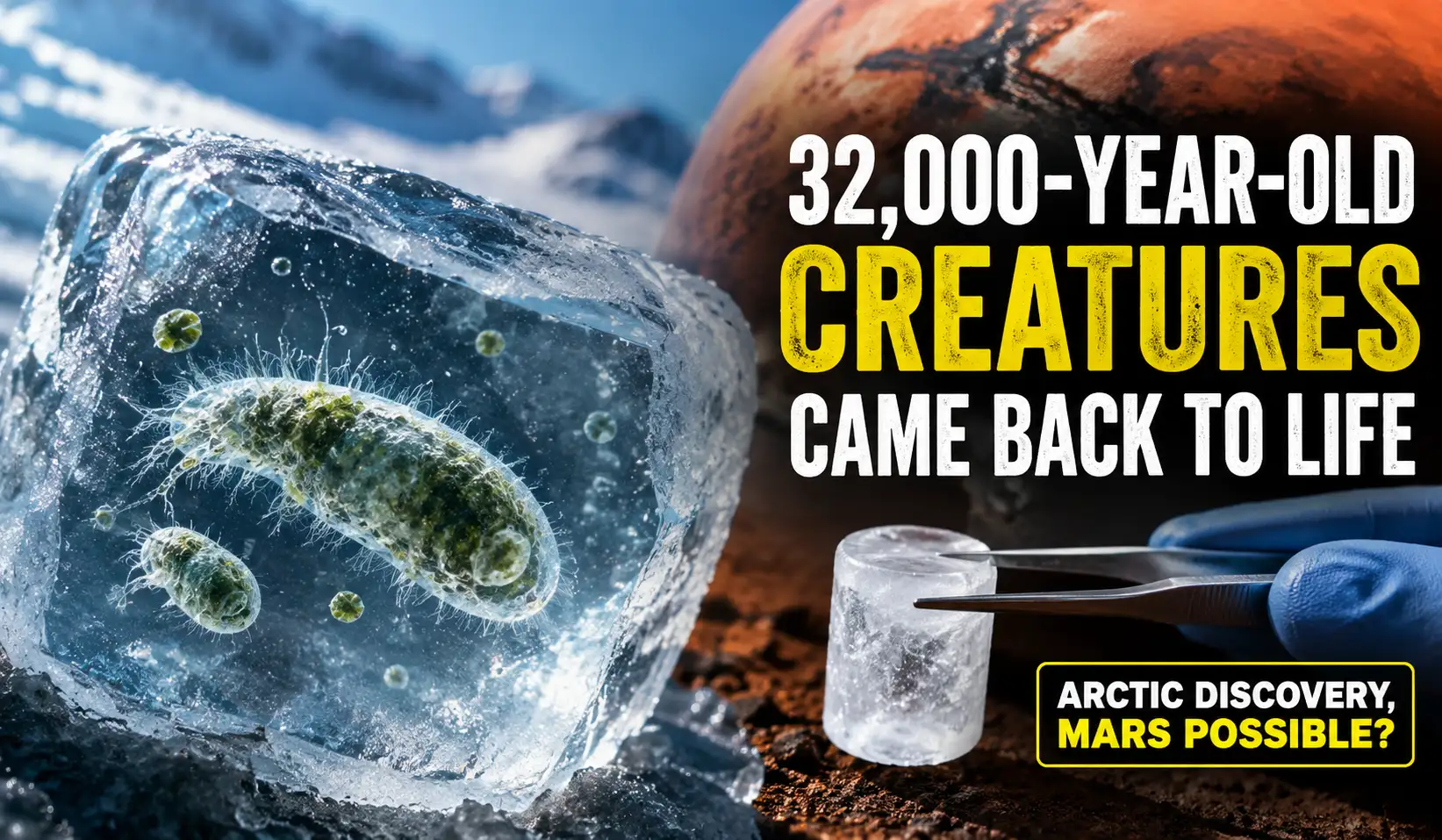
In 1999, a team led by NASA astrobiologist Dr. Richard Hoover entered a frozen research tunnel near Fox, Alaska, looking for life that could survive in one of Earth's harshest environments. What they found seemed almost impossible. Hidden inside 32,000-year-old Arctic permafrost were microscopic organisms that had remained trapped since the Ice Age. When the ancient ice was carefully thawed in the laboratory, the bacteria did not simply survive. They quickly became active, started swimming, feeding, and multiplying. The discovery challenged long-held scientific beliefs about how long living organisms can remain dormant and still return to life.
The remarkable microbe was later identified as Carnobacterium pleistocenium , a previously unknown species of extremophile. Unlike many organisms that die after prolonged freezing, these bacteria had survived thousands of years without oxygen in deep permafrost. Scientists believe special protective proteins and cellular adaptations allowed them to endure extreme cold while preserving their ability to function once conditions improved. In 2005, NASA described it as the first fully validated living species recovered from ancient ice, making it one of the most extraordinary discoveries in modern microbiology and cryobiology.
More than two decades later, the discovery remains highly relevant. Researchers studying ancient microbes , Arctic permafrost , cryopreservation , and extremophiles continue to examine how these organisms survived for so long. The findings have also influenced the search for life beyond Earth. With spacecraft revealing vast ice deposits on Mars and frozen oceans beneath the icy crusts of Europa and Enceladus , scientists believe similar dormant microorganisms could exist elsewhere in the solar system.
How did scientists revive creatures that were frozen for 32,000 years?
The microorganisms were recovered from ancient Arctic permafrost in Alaska, where they had remained trapped inside ice for tens of thousands of years. Once researchers carefully thawed the frozen samples under laboratory conditions, the organisms showed signs of life almost immediately.
According to scientists involved in the research, the revived microorganisms began moving shortly after the surrounding ice melted. They also appeared capable of feeding and reproducing without requiring an extended recovery period. That immediate response surprised researchers because many microorganisms preserved in frozen environments survive in dormant forms that often require special laboratory conditions before becoming active again.
The discovery demonstrated that certain microscopic life forms can tolerate extreme cold for far longer than scientists once believed possible.
Why is this discovery important for NASA and space exploration?
The research attracted significant attention from NASA because frozen environments are considered some of the most promising places to search for ancient life beyond Earth.
Richard Hoover, an astrobiologist at NASA's Marshall Space Flight Center who studied the organisms, explained that microorganisms surviving inside Earth's ancient ice provide an important scientific model for future planetary exploration. If microbes can remain preserved inside Arctic permafrost for thousands of years, scientists believe similar frozen environments elsewhere in the solar system deserve careful investigation.
The discovery does not confirm extraterrestrial life, but it strengthens the scientific case for exploring icy regions where biological material could remain protected for extremely long periods.
Could similar microorganisms exist on Mars or Europa?
One of the biggest questions raised by the discovery is whether frozen worlds beyond Earth could contain comparable microscopic life.
Mars has long been known to contain large amounts of water ice beneath its surface, while Jupiter's moon Europa is believed to hide a vast global ocean beneath a thick shell of ice. These environments are considered among the most promising locations in the solar system for searching for microbial life.
Scientists suggest that if life ever developed on Mars billions of years ago, ancient ice deposits could have preserved microscopic organisms in much the same way Earth's Arctic permafrost preserved these microorganisms. Any future mission capable of collecting uncontaminated ice samples could potentially search for preserved biosignatures or dormant microbes.
At present, however, no confirmed evidence of living or fossilized organisms has been found on Mars or Europa.
What makes these frozen microorganisms different from other Ice-dwelling microbes?
Researchers have previously discovered microorganisms living in glaciers, polar ice, and permanently frozen ground. Many survive by entering highly dormant states or by occupying tiny pockets of liquid water trapped within ice.
The organisms recovered from Alaska stood out because they resumed activity rapidly after thawing instead of requiring lengthy laboratory cultivation before becoming active.
NASA described the organisms as the first fully described and validated species recovered alive from ancient ice at the time of the research. Their ability to tolerate extreme freezing conditions continues to interest scientists investigating how cells protect themselves against severe environmental stress.
Understanding these natural survival mechanisms may eventually contribute to advances in cryobiology, including improved preservation of biological materials for scientific and medical research.
What does this discovery mean for future space missions?
Every new discovery about life surviving in Earth's extreme environments helps scientists improve future missions searching for signs of life elsewhere.
Modern Mars missions continue investigating rocks, minerals, and ancient environments that may once have supported microbial life. Meanwhile, upcoming missions targeting icy moons are expected to study whether oceans hidden beneath frozen surfaces possess conditions suitable for biology.
Researchers view Earth's ancient permafrost as one of the best natural laboratories for understanding how microorganisms respond to freezing temperatures over immense timescales. These studies help mission planners decide where spacecraft should search, what samples should be collected, and which instruments are most likely to detect biological evidence.
Although scientists remain cautious about drawing conclusions regarding extraterrestrial life, discoveries like this continue expanding our understanding of the remarkable resilience of living organisms.
More than three decades after these microorganisms were first brought back to life in laboratory conditions, the discovery remains one of the most compelling examples of life's ability to survive extreme environments. It reminds scientists that frozen landscapes are not always biologically inactive and that ancient ice may preserve valuable clues about Earth's past as well as the potential for life elsewhere in the solar system.
The research also continues to influence modern astrobiology by providing a practical example of what researchers might encounter if future missions retrieve uncontaminated samples from Mars or the icy moons orbiting the outer planets. While no one knows whether similar organisms exist beyond Earth, discoveries like this encourage scientists to keep exploring with careful observation and evidence-based research.
As NASA and international space agencies prepare future missions to icy worlds, the lesson from Earth's Arctic is clear: some of the biggest scientific discoveries may still be locked inside ancient ice, waiting for the right technology—and the right moment—to reveal their secrets.