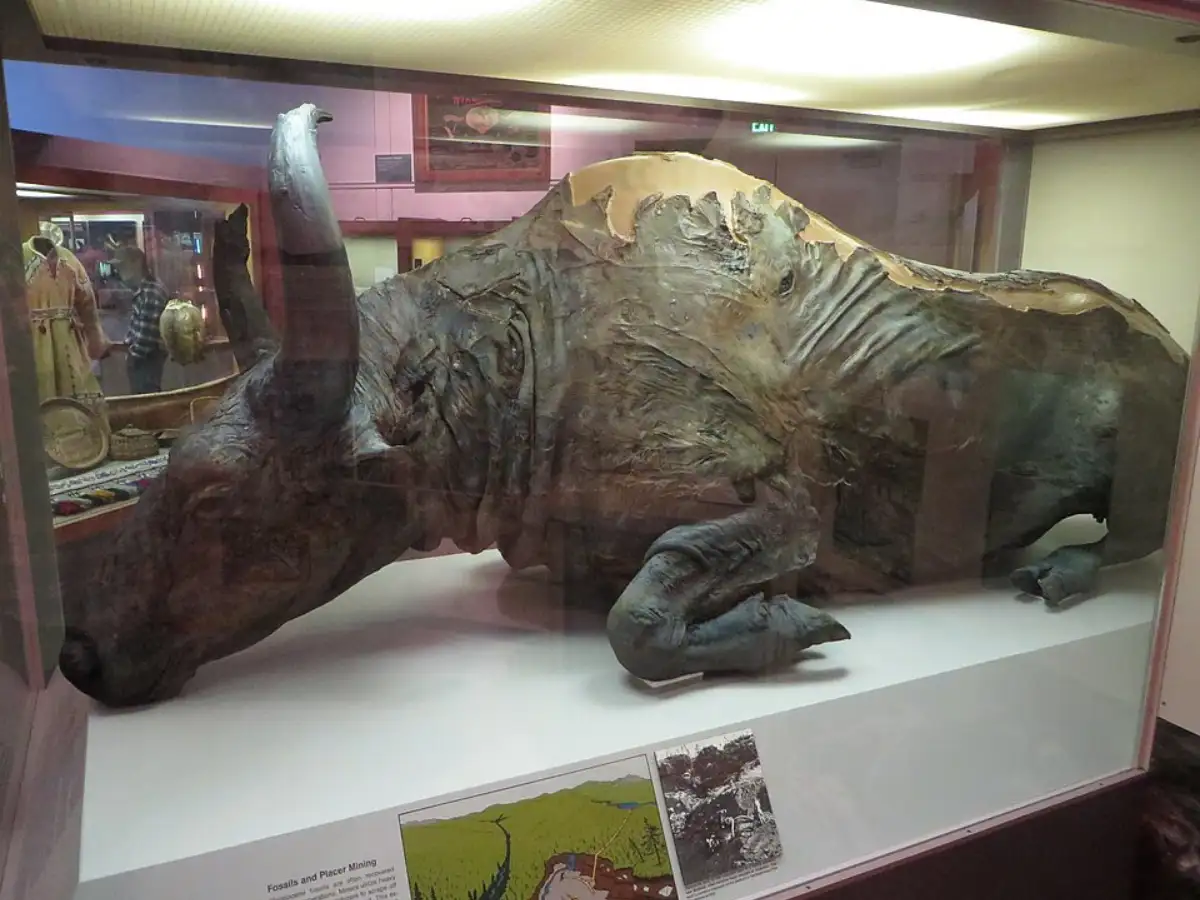
Gold miners working in northern regions around Fairbanks, Alaska, in 1979, were engaged in washing away frozen sediments at a placer mining operation with hydraulic hoses when something extraordinary caught their attention in the permafrost. Rather than rocks or other forms of soil, they unearthed a skull along with some body parts still covered with skin. As reported by the University of Alaska Museum of the North, the fossil is that of a 36,000-year-old Alaska steppe bison known as “Blue Babe” for its blue-colored hide.
What makes this find fascinating is that the bison has been preserved in an entirely different way compared to most fossils. It does not consist of just bones that have turned into minerals, but instead has retained most of its soft tissues, hide, and even some sections of its carcass. Scientists considered this fossil a mummified specimen rather than a fossil in the traditional sense.
The term "Blue Babe" is derived from the unique coloration found on the carcass following exposure to the elements. According to researchers, vivianite, a mineral, grew on the tissues of the carcass while in the ground. Once exposed to oxygen, it turned a blue color.
The finding was unique enough to differentiate the find from many others discovered during the same time period in other parts of the Arctic region. At the same time, it showed just how random and coincidental some discoveries can sometimes be. While miners had not gone out looking for an Ice Age carcass, one was unearthed in the process of mining operations.
The carcass preserved evidence of Ice Age life and predation
Blue Babe's scientific significance was based on the fact that much more could be studied aside from the bone. As noted by the University of Alaska Museum of the North, claw marks and bite wounds were found on Blue Babe's body, implying that the bison was probably attacked by an American lion at the end of the Pleistocene epoch.
This discovery made it possible for scientists to learn about the last few hours of the bison's life in a way not easily possible using fossilized bones. Rather than analyzing the skeleton only, scientists were able to look at soft tissues and other environmental evidence, making Blue Babe significant in terms of understanding the Ice Age environment.
Scientists were also interested in learning about the overall environment of the late Pleistocene time in Alaska by studying this specimen. Frozen soil is able to preserve biological materials much better than other environments, as the process of decay is interrupted.
In particular, according to the information provided by the University of Alaska, Blue Babe is among the best examples of the capability of Arctic permafrost to serve as a natural biological freezer. The reason why the find is still being discussed is its fresh look, which creates a unique feeling of proximity between the Ice Age and the present day. Prehistoric finds are usually distant, since little remains except stone or bone fragments.
Blue Babe was not like that: the preserved skin, tissue, and colors made a visitor feel unusually close to the Ice Age. Blue Babe became one of the most notable Ice Age finds in Alaska because an ordinary mining activity led to its discovery.