Do you think about how desperate one should be to actually choose to confine oneself to a small wooden box and travel all around the world inside it? To all of us, it is an absolutely terrifying experience to be kept for days locked inside a small, dark wooden box. But it was once done by a teenager in the mid-sixties!
Get breaking news anytime, anywhere. Download the TOI app now!
The extraordinary journey began when nineteen-year-old Brian Robson left his home in Cardiff to take up a job with Victorian Railways in Australia. It was 1965, and a fresh start in a new country seemed exciting to the young man. However, the harsh reality of living so far away from his family quickly caught up with him. He became unhappy, isolated, and homesick for Britain.
According to a detailed archival retrospective published by the BBC News Magazine , the teenager faced a massive financial hurdle that prevented him from simply buying a ticket home. He had travelled to Australia under an assisted passage scheme, which meant he was legally required to pay back the cost of his journey if he left before completing his contract. Combined with his low wages, the total amount he needed to find was roughly seven hundred pounds, a sum that was completely out of reach for him at the time.
Frustrated by his circumstances and unable to see any other way out, the young Welshman hatched a truly bizarre escape plan. He decided that if he could not afford to fly home as a passenger, he would simply transform himself into air freight. He spent days working out the logistics, convinced the plan would let him avoid the travel costs.
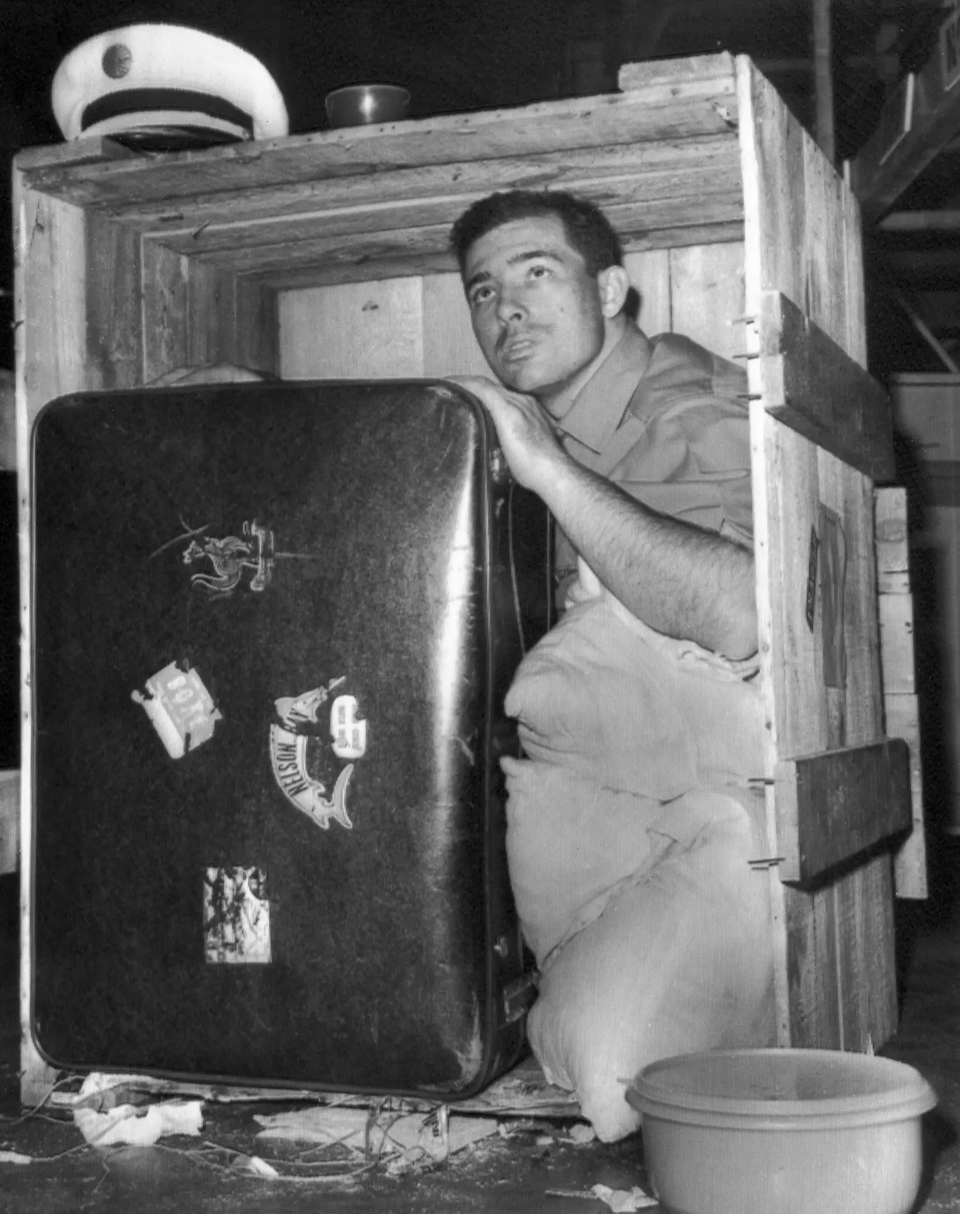
He managed to obtain a very small wooden box that was made initially for housing a typewriter. The box was almost one meter long and less than one meter wide. What is more important, the box was very shallow. It was so small that it was impossible to stand in it or stretch. In order to ensure his survival during the journey, he purchased a pillow, torch, water bottle, plastic bottle for his waste, and laxatives, which would be required to avoid digestive problems during the trip.
It required coordination; therefore, he managed to convince two of his co-workers, John and Paul, to assist him in his endeavour. He climbed into the box, and his co-workers nailed the lid to keep him inside. It was planned to deliver the box from Melbourne to London, and it was expected that it would take thirty-six hours.
In the darkness of a transportation mistake
Only thirty-six hours were enough to turn the trip into a test of endurance for him. This all happened when the aeroplane took off because of some logistical problems at the airport. The aeroplane was filled with passengers.
Instead of heading straight for the United Kingdom, the wooden crate containing the teenager was transferred onto a Pan Am flight. This unexpected change meant he would have to endure a much longer, multi-stop route that took him through Sydney and across the vast Pacific Ocean. To make matters worse, airport baggage handlers ignored the bright stencils on the box that read 'This side up.'
For a significant portion of his journey, the teenager was stored completely upside down on his head and shoulders. The physical pressure was immense, causing blood to rush to his head and leaving his limbs completely numb. The lack of space meant he could not shift his weight or alter his position to relieve the intense pain building up in his spine and muscles.
As the days blended into one another, the environment inside the cargo hold shifted between unbearable extremes. When the aeroplane was parked on the tarmac during airport stopovers, the temperature inside the crate would skyrocket, causing him to sweat heavily and suffer from severe dehydration. When the plane was flying at high altitudes, the unheated cargo compartment became freezing cold, causing his body to shake violently in the dark.
However, it did not take him long before he found himself lacking water and the air inside the box becoming more and more stale. He began fainting because of the heat and dehydration that he had to face. At some point, he had delusional thoughts and felt that he would die inside that wooden box where no one knew of his existence.
Discovery and world headlines
Finally, his torture ended when the plane landed at its destination in the United States. As explained in the CNN Travel article, the box was unloaded and placed in a freight shed in Los Angeles, California, after a period of continuous flight for five days. That is when the customs officer realised there was something wrong with the wooden box.
The officer spotted a small hole in the side of the crate and peered inside with a flashlight, expecting to see ordinary cargo. Instead, he found himself looking directly into a pair of wide, human eyes. The shocked worker initially thought he was looking at a corpse until the weakened teenager managed to make a slight movement.
Emergency services were called to rescue the traveller from the crate. When the nails were finally pried loose from the lid, the young man was found in a truly pitiable state. His body was curled in a fetal position, his skin was blistered, and he was too weak to speak or stand on his own.
He was rushed to a Los Angeles hospital, where doctors treated his severe dehydration and worked to restore sensation in his legs and arms. Remarkably, despite the incredible physical toll of the five-day journey, he made a full recovery within a matter of days.
The story quickly became an international media sensation, with journalists from all over the world eager to interview the boy who had mailed himself across the globe. Because he entered the United States without legal documents, a passport, or a visa, he could have faced charges and imprisonment for illegal entry.
However, the Americans considered this incident as nothing more than a foolish mistake committed by a despaired teenager homesick rather than a criminal offence. Rather than charging him with the crime, authorities allowed him to travel back to London and go home to his family in Wales.
For several years after that, the Welshman wrote a book about this ordeal and confessed that it was quite dangerous. Afterwards, he made attempts to find his two colleagues to let them know that he did not blame them for the fiasco. In retrospect, he considers himself lucky that he managed to survive this ordeal.