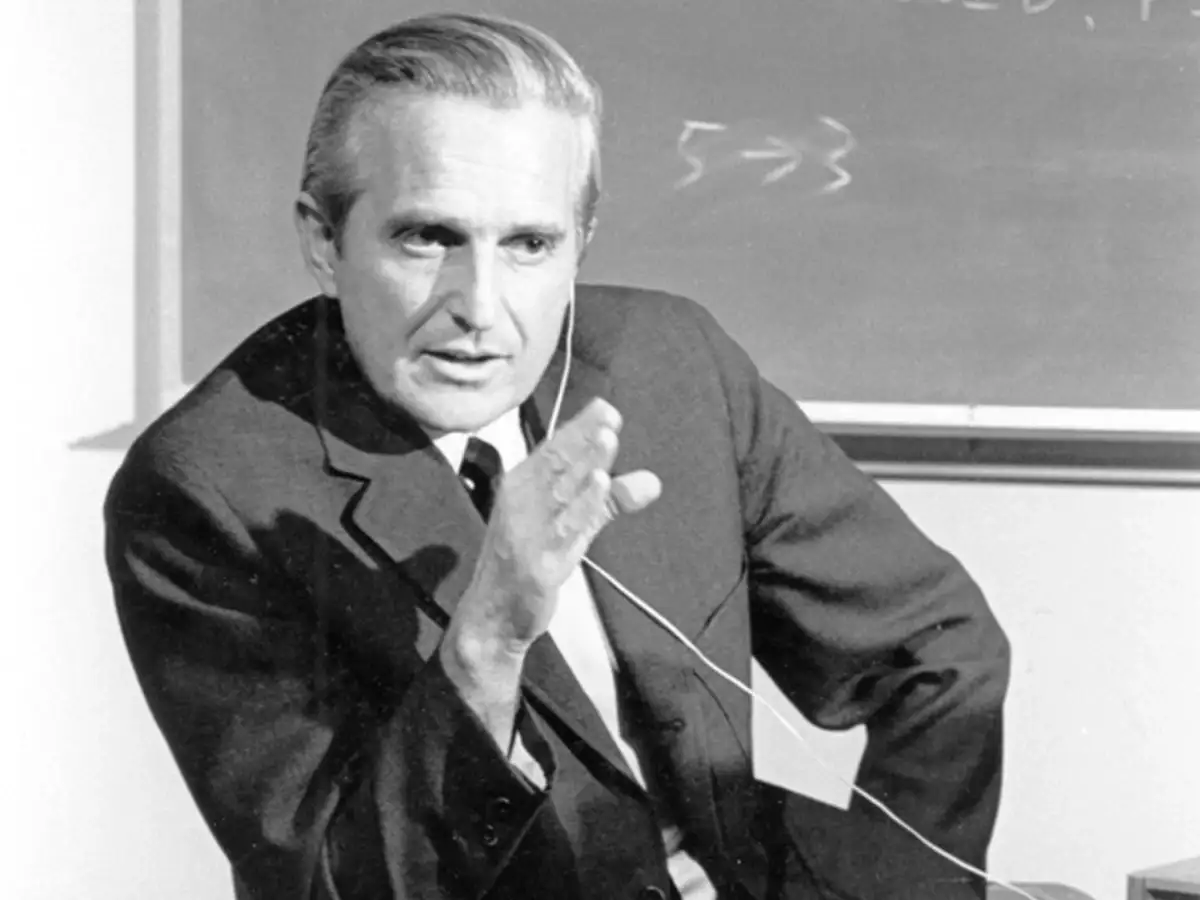
In the early 1960s, computers were large machines that could be found in government, educational, and corporate settings. Most computers utilized punch cards and typed commands without much interactivity between users and screens. However, Douglas Engelbart was convinced that computers would become interactive devices created to facilitate humans in the organization, navigation, and dissemination of information. As noted by the Computer History Museum, Engelbart saw computers of the future where users would manipulate information displayed on the screen through physical control.
In that era, it was quite revolutionary. Most computers executed programs through batch processing, where users submitted jobs and the computer produced outputs later. Engelbart, on the other hand, conceived the notion of real-time human-machine interaction.
As per the Lemelson-MIT Program, Engelbart had this broader perspective of developing computer-based technology as a means of enhancing human intellect rather than merely treating computers as huge calculators. It is from this more comprehensive approach that the invention of probably the most important computer gadget came into existence: the computer mouse. He envisaged that information handling would be made simpler.
The first computer mouse was built as a practical navigation tool
It was not until 1963 that Engelbart, along with his colleague Bill English, started working on the prototype of a pointing device that would make it possible for the user to manually move the cursor over the screen. It should be noted that, according to the Computer History Museum, the first mouse prototype was made of wood with a couple of wheels underneath, allowing the device to track motion over a flat surface.
Though the mouse itself looked quite simple, its principle of operation was truly revolutionary; instead of typing out each instruction separately, a person could actually use his hands to point, select, and navigate through the information on the computer screen.
During one of his public demonstrations known as "The Mother of All Demos" (conducted in 1968), Engelbart presented not only the prototype of the mouse, but also collaborative editing, video conferencing, interactive text systems, windows, and hyperlinks, which became familiar to consumer-level computers many years later. Researchers were shocked to see a fundamentally new approach towards working with computers, which, instead of viewing them as passive processing machines following delayed instructions, considered computers as active tools for effective thinking and communication.
Engelbart’s ideas revolutionized modern computing far beyond the mouse itself
While it is true that the mouse eventually became associated with personal computers by the likes of Apple and Microsoft, Engelbart had far-reaching visions of what computers could do. For him, the computer was a means to better human cooperation and knowledge-sharing and to enhance human problem-solving capabilities. As stated by the Computer History Museum – Pioneers Collection, various ideas presented by Engelbart eventually became standard components of today’s computers, such as the graphical interface, collaborative editing, and navigational interfaces.
What enabled the mouse to become a success was its ability to make interactions with computers easier and more immediate. A small handheld controller simplified interactions in a digital environment as more sophisticated technologies became available. Although other forms of interfaces, like touchscreens, have been introduced since, the basic premise behind Engelbart’s inventions still plays an important role: Humans and computers work best together when interactions with information become natural and intuitive. Well before the advent of personal computers, Douglas Engelbart saw how humans could guide digital information on screens using their hands.