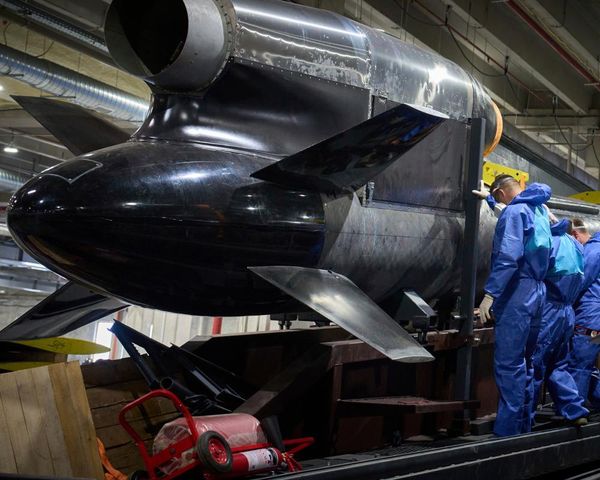
For a few moments on July 21, 1962, Egypt had exactly the spectacle it wanted. Four surface-to-surface rockets blasted into the sky near Wadi El Natrun as journalists watched from the desert. The rockets eventually fell into the Mediterranean, but the message had already been delivered: Egypt wanted the world to see that it had entered the "missile age," as per a report.
The government followed the launches with rallies and fireworks, while a plane dropped candy over Cairo. State-owned radio celebrated the country's new long-range firepower.
What the public saw was a military demonstration. Behind it was a secretive program involving former German rocket scientists, covert supply networks and growing pressure from Israel. One of the men at the center of the program, German rocket scientist Heinz Krug, soon disappeared.
On September 11, less than two months after Egypt's public missile display, Krug left his Munich office with a young man who called himself "Mr. Saleh," as per a Popular Mechanics report.
Krug never returned. More than six decades later, there is still no confirmed explanation for what happened to him.
Egypt wanted missiles but did not have the industrial base
Nasser's interest in rockets was closely tied to Egypt's confrontation with Israel. Following the 1956 Suez crisis, when Israel, Britain and France attacked Egypt, Nasser wanted weapons capable of threatening Israel. But Egypt lacked the industrial capacity needed to build powerful missiles on its own.
Factory 333 in Heliopolis became the center of the effort. The facility had originally been a British hospital before being converted into an aircraft engine factory.
Nasser also could not count on either superpower. Neither the United States nor the Soviet Union was prepared to help him develop the weapons he wanted. That pushed Egypt toward Germany.
Nasser approached West German intelligence chief Reinhard Gehlen, whose organization was staffed largely by former Nazi and SS officers. According to author and former intelligence analyst Owen L. Sirrs, Gehlen connected Nasser with Otto Skorzeny, the former Nazi commando who had become famous during World War II, as per the Popular Mechanics report.
Skorzeny spent about a year training commandos for Nasser before leaving Egypt. Other German specialists, however, stayed behind to work directly on the missile program.
German rocket scientists helped turn the plan into reality
Among the scientists who joined the Egyptian effort was Wolfgang Pilz, who had helped design the V-1 flying bomb. Rocket propulsion engineer Eugen Sänger also became involved, along with Hans Kleinwachter and Hans Goercke.
Heinz Krug became another key figure. Krug had worked closely with Sänger and, beginning in 1958, managed operations at the Research Institute for the Physics of Jet Propulsion in Stuttgart.
By 1960, he had allegedly become a frontman for INTRA Commercial Company, a shell company linked to the Egyptian War Ministry.
From his office in Munich, Krug helped source, procure and ship missile components to Egypt. That made him an important connection between the German suppliers and the Egyptian program.
Egypt's rockets appeared faster than expected
Beginning in 1960, the German scientists helped Egypt develop two surface-to-surface missiles. By 1961, prototypes were being tested at Factory 333. German-led teams were also producing missiles at Site 36 and Site 135 near Memphis and Helwan.
The program moved quickly. In 1962, Egypt paraded 20 missiles through Cairo. Then came the highly publicized launches near Wadi El Natrun.
Israel was watching closely. It had its own weapons program and had already successfully launched a suborbital missile, adding to Nasser's concerns about the regional balance of power.
Israel tried to stop the German scientists
Egypt's growing missile capability alarmed Israel, which pressured West Germany to stop its citizens from assisting Nasser.
West German intelligence chief Reinhard Gehlen moved toward closer cooperation with Israel. According to Sirrs, evidence suggests West German intelligence may have directly assisted Mossad in targeting the Egyptian missile program, as per the Popular Mechanics report.
The campaign initially focused on pressure and intimidation. German officials forced Sänger to resign from his institute in November 1961. Several other scientists eventually abandoned the Egyptian project.
Krug did not. He continued coordinating missile-related work from Munich. That decision would put him at the center of a mystery that still has no definitive answer.
Then Heinz Krug disappeared
On September 11, 1962, a young man arrived at Krug's Munich office. He introduced himself as "Mr. Saleh." The two men spoke for about half an hour before leaving together in Krug's car. That was the last confirmed sighting of Krug.
His wife quickly reported him missing, saying he had no reason to disappear voluntarily. Police eventually found his car in the Munich suburb of Solln. It was covered in mud and had been abandoned within driving distance of several large wooded areas.
Then police reportedly received an anonymous call claiming that Krug was dead. But there was no body. Authorities appealed to the public for information and launched an investigation with Interpol. Nothing provided a definitive answer.
The pressure on the missile program continued
Krug's disappearance was followed by attacks against other people involved in the Egyptian missile effort.
Pilz's secretary opened a letter bomb that left her blind. The next day, another letter bomb killed five Egyptians and wounded six others at a rocket factory office.
Hans Kleinwachter, who continued resisting pressure to leave the program, narrowly survived an attempted shooting in Bavaria in 1963. Three men believed to be Mossad agents allegedly targeted him, leaving a bullet hole through his neck scarf.
Kleinwachter later accused the West German government of failing to protect him. By 1963, the German government had ended financial contracts with companies involved in supplying missile parts to Egypt, as per the Popular Mechanics report. It also warned the scientists involved to stop their activities.
Some continued until 1964, but the risks had become impossible to ignore. Scientists carried guns for protection and checked their mail for explosives.
What happened to Krug is still unclear
The years after Krug's disappearance produced several theories, but no confirmed account. One version claims he was taken to Austria and lived under an assumed name.
Another says he was killed by a Mossad assassination team and buried in a forest. There are also claims that Otto Skorzeny was blackmailed by Mossad into helping arrange Krug's death. Sirrs considers Skorzeny an unlikely culprit in Krug's possible assassination, as per the Popular Mechanics report.