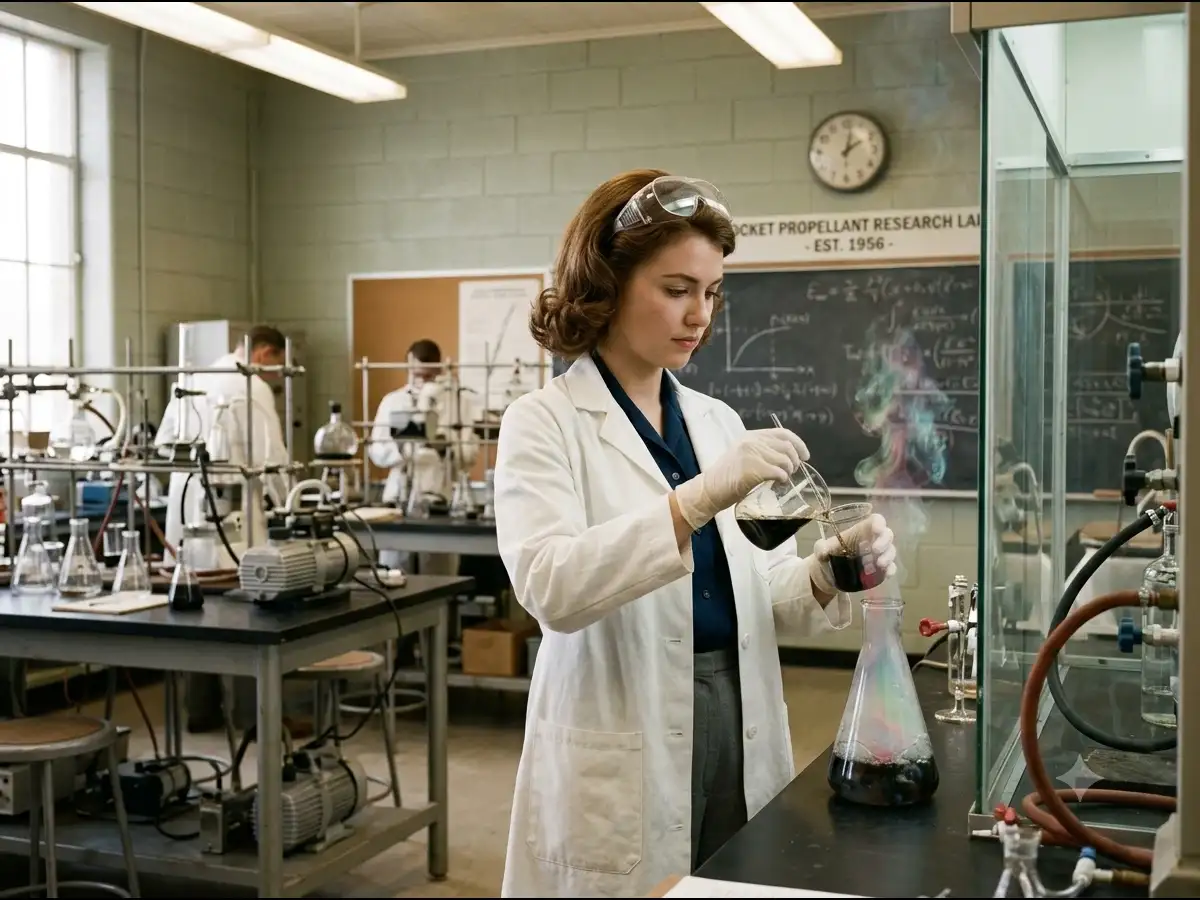
In 1957, an American woman scientist invented a liquid fuel Hydyne which helped United States create history and make space travel a reality. Mary Sherman Morgan developed the rocket fuel at a time when the United States was trying to improve its missile technology. The Soviet Union had launched Sputnik, increasing pressure on the US to place a satellite into orbit. Engineers could not redesign the Redstone rocket engine within the available time. Morgan was asked to work on its fuel instead. Her work led to Hydyne, a new propellant mixture that provided more performance than the existing fuel. Hydyne later powered the Jupiter-C and Juno I rockets. On January 31, 1958, a Juno I rocket carried Explorer 1 into orbit.
How Mary Sherman Morgan became Rocket Girl or America's first female rocket scientist?
Mary Sherman Morgan was born on November 4, 1921, on a farm near Ray, North Dakota. She was the second youngest of six children born to Michael and Dorothy Sherman. Her childhood was shaped by farm work. Her family had limited money, and her parents kept her away from school so that she could work on the farm. She also faced bullying from her siblings.
Morgan did not begin formal schooling until she was about eight or nine years old. A social worker became involved in the family situation and threatened to have her father arrested if he did not allow Mary to attend school. The social worker also arranged for Morgan to have a horse and riding lessons. The horse helped her travel to a one-room schoolhouse.
Despite starting school later than other children, Morgan performed well in her studies. In 1939, she graduated from high school as valedictorian. Her academic performance earned her a college scholarship.
She enrolled at DeSales College in Toledo, Ohio, where she studied chemistry. Other accounts of her education state that she later ran away from home to attend Minot State University. She did not complete her degree because she accepted a job as a chemist during the war effort.
Her early work as a chemist
Morgan's interest in chemistry developed partly from her childhood experiences. She had been fascinated by the coal her family burned for heat. After leaving college, she found work as a chemist. One of her early jobs involved testing nitric acid for purity. The position later ended, and Morgan moved to California.
She then joined North American Aviation, also known as NAA. There, she worked on rocket fuels and calculated their performance. Her work required an understanding of chemistry and thermodynamics. These skills later became important when she was assigned to develop a new propellant for the US Army Ballistic Missile Agency.
In 1957, American woman scientist Mary Sherman Morgan invented Hydyne to help US create history
Mary Sherman Morgan developed Hydyne in 1957 when the United States needed to improve the performance of its Redstone rocket. The existing fuel mixture of ethyl alcohol and water could not provide enough thrust for an orbital launch. Morgan developed Hydyne using 60% unsymmetrical dimethylhydrazine (UDMH) and 40% diethylenetriamine (DETA). The new fuel increased rocket performance by about 10% to 12%. Hydyne was later used in the Jupiter-C and Juno I launch vehicles. On January 31, 1958, a Juno I rocket used Hydyne to launch Explorer 1, the first successful American satellite, into orbit. Morgan's work became part of the US effort during the Space Race.
Why the United States needed a new rocket fuel?
During the 1950s, the United States was developing missile and rocket technology. The Redstone missile was one of the systems being developed. The Redstone used a mixture of ethyl alcohol and water as its propellant. The mixture worked for the missile, but it did not provide enough thrust for launching a satellite into orbit.
The situation became more urgent after the Soviet Union launched Sputnik in 1957. The satellite launch showed that the Soviet Union had the ability to place an object into orbit. The United States faced political and scientific pressure to achieve its own orbital launch.
Engineers working on the Redstone had limited time. Redesigning the engine was not considered possible within the required schedule. The remaining option was to find a way to improve the rocket's fuel. This work was assigned to Mary Sherman Morgan.
The development of Hydyne
Morgan developed Hydyne in 1957. It was a liquid propellant designed to provide more performance than the Redstone's existing ethyl alcohol and water mixture. Hydyne consisted of 60% unsymmetrical dimethylhydrazine, known as UDMH, and 40% diethylenetriamine, known as DETA.
The mixture increased the rocket's specific impulse. Specific impulse is a measure used to compare the efficiency of rocket propellants. A higher specific impulse means a rocket can produce more thrust for a given amount of propellant.
Hydyne provided about 10% to 12% more performance than the earlier Redstone fuel mixture. That increase mattered because the rocket needed enough performance to carry an upper stage and satellite into orbit.
How Hydyne helped launch Explorer 1?
Hydyne was used in the Jupiter-C launch vehicle, which was based on the Redstone missile. It was later also used in the Juno I launch vehicle. The most important use of Hydyne came on January 31, 1958.
On that date, a Juno I rocket launched from Cape Canaveral in Florida. The rocket carried Explorer 1, the first successful satellite launched by the United States. Explorer 1 reached orbit and marked the US entry into the satellite phase of the Space Race.
The satellite also carried scientific instruments that helped researchers study Earth's environment. Its mission contributed to the discovery of the Van Allen radiation belts. Morgan's fuel development was therefore connected to a major event in the early history of American space exploration.
Why Mary Sherman Morgan's work was important?
Morgan worked in a period when women had limited opportunities in engineering and rocket development. She was not a university professor or a public figure during the launch of Explorer 1. Her contribution was also not widely known outside technical circles for many years.
Her work shows that rocket development involved more than designing engines and spacecraft. Propellant chemistry was also a key part of achieving enough performance for spaceflight. The Redstone engine could not be redesigned before the planned launch. Morgan's solution focused on changing the propellant instead. By developing Hydyne, she provided a way to increase the performance of an existing rocket system.