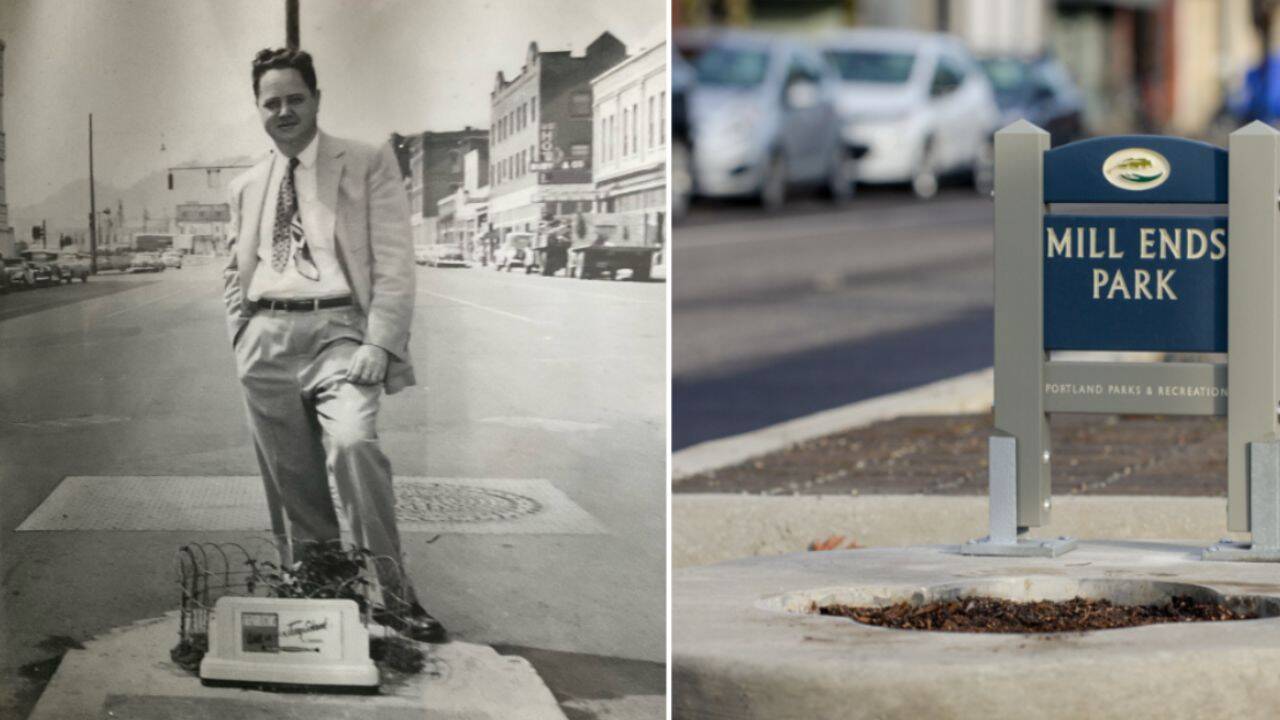
Mill Ends Park in downtown Portland, Oregon, is unlike any other public park in the world. Barely two feet across and occupying just 452 square inches in the middle of a busy road, the tiny green space holds the Guinness World Record as the world's smallest park. At first glance, it appears to be little more than a small planted circle with a single tree, yet its history stretches back nearly eight decades. What began as an unused hole intended for a light pole was transformed into a quirky local landmark by a newspaper columnist with a vivid imagination. Over the years, it has hosted tiny parades, miniature celebrations and whimsical decorations that continue attracting curious visitors from around the world. Since then, the miniature park has become part of Portland's identity, complete with annual traditions, curious additions and an enduring place in the city's history.
Get breaking news anytime, anywhere. Download the TOI app now!
How an empty hole became the world's smallest park
Mill Ends Park stands in the median of Southwest Naito Parkway in central Portland, Oregon. The entire park covers just 452 square inches, or roughly 0.00007 acres, making it little more than a circle surrounding a single tree.
Its dimensions have earned it an official place in the record books. Guinness World Records first recognised it as the smallest park in the world in 1971, several years before it was formally adopted into Portland's park system. While countless visitors travel to large national parks, this one can be viewed without taking more than a couple of steps.
The park officially became part of the city's collection of public spaces in 1976, but by then its reputation had already spread well beyond Oregon.
How journalist Dick Fagan turned an empty space into a landmark
As per the Portland and the federal government, the story begins nearly around 1946 after the Second World War when journalist Dick Fagan returned to work at the Oregon Journal, where his office overlooked Front Street, now known as Naito Parkway. From his window he regularly noticed a small circular opening left in the road's median. It had originally been intended for a light pole, though the installation never happened.
As time passed, weeds filled the neglected space. Rather than continue watching the unused patch, Fagan planted flowers there himself. What began as a personal gesture slowly turned into an ongoing joke that readers eagerly followed.
Fagan wrote a column called Mill Ends, named after the leftover pieces of timber produced by sawmills. Before long, the tiny planted circle became an extension of that column, with its own identity and an increasingly imaginative history.
A tiny park with a big Irish legend
Portland and the federal government reported that the park was dedicated on St Patrick's Day in 1948, reflecting Fagan's Irish heritage. From that point onwards, he treated the miniature landscape as though it were a fully functioning public park, describing activities there in his newspaper writing.
Many of those stories centred on a community of leprechauns said to live within the park. According to Fagan, their settlement was the only one west of Ireland, and he insisted he alone could see their leader, Patrick O'Toole. Readers embraced the humour, allowing the fictional world to become inseparable from the real place.
Those playful stories continued until Fagan's death in 1969, by which time the tiny park had become one of Portland's better-known local curiosities.
The traditions that keep Mill Ends Park alive
Despite its size, Mill Ends Park has hosted an assortment of events over the years. St Patrick's Day celebrations have remained closely tied to the site, carrying on the tradition established during Fagan's lifetime.
Other additions have reflected the same light-hearted spirit. At various times the park has featured miniature attractions including a tiny swimming pool complete with a diving board designed for butterflies, small statues, a model Ferris wheel delivered by a full-sized crane and even the occasional appearance of a flying saucer as part of its playful mythology.
Real gatherings have taken place too. Musicians, community groups and participants in Portland's Rose Festival have all found ways to include the tiny landmark in larger civic celebrations.
The tiny park that changed location more than once
Even a park only two feet wide cannot always stay in the same place. Road improvement work along Naito Parkway required Mill Ends Park to be temporarily relocated in 2006.
It returned the following March during another St Patrick's Day celebration attended by members of Dick Fagan's family, Portland's Royal Rosarians and local bagpipers. The ceremony reflected how firmly the tiny space had become woven into the city's traditions.
Years later, further improvements along the waterfront again affected the park. As part of Portland's Better Naito Forever project, completed in 2021, Mill Ends Park shifted six inches west to accommodate permanent changes to nearby walking and cycling routes.
The relocation was modest, though the city treated it with the same sense of ceremony that has surrounded the park for decades. The refreshed site received a new clover-shaped border, a replacement sign and landscaping that nodded to its long-running leprechaun folklore.