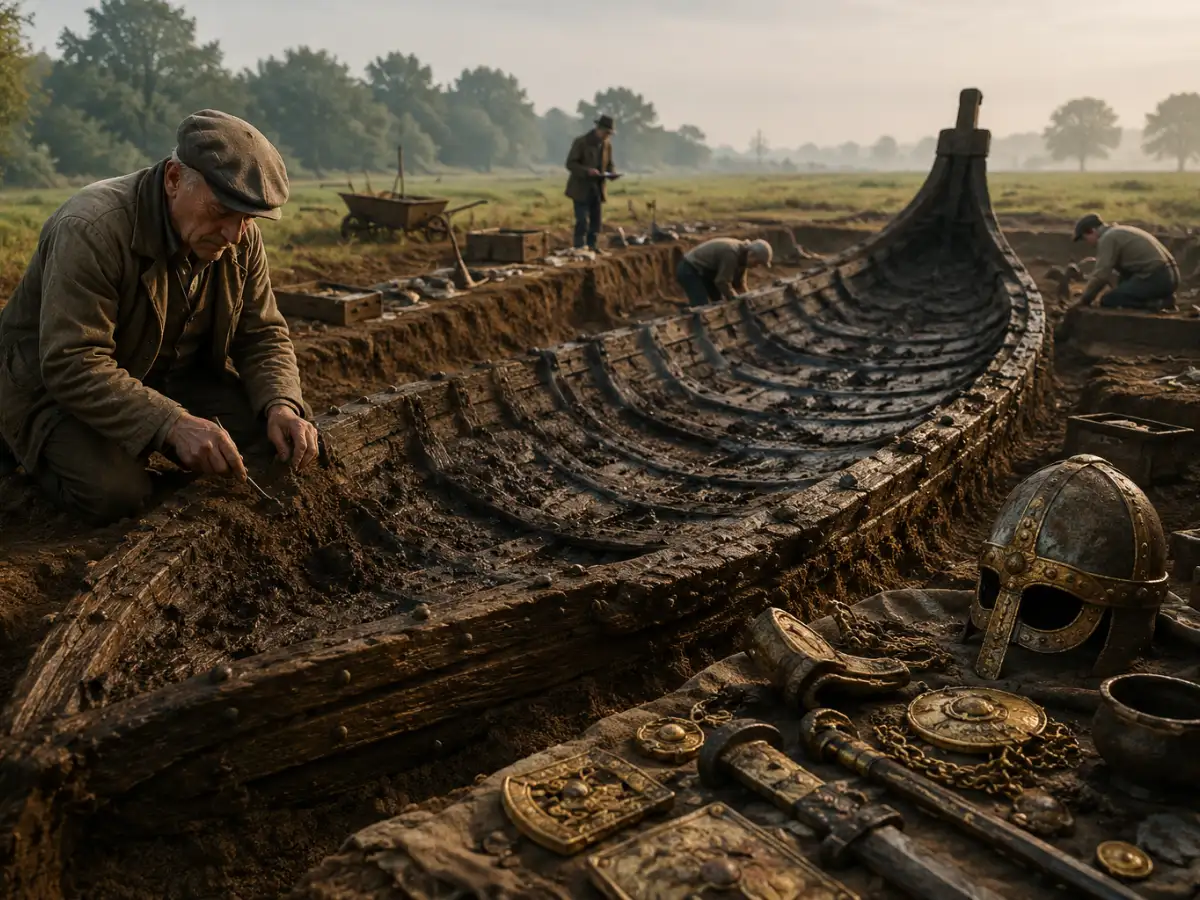
In 1939, a quiet countryside dig in England turned into a history-shaking discovery that blew apart the myth of the so-called “Dark Ages.” What amateur archaeologist Basil Brown uncovered beneath a grassy mound at Sutton Hoo stunned the world — a gigantic Anglo-Saxon ship burial packed with treasures, weapons, gold, and clues of a powerful global civilisation hiding in plain sight.
The excavation began after wealthy landowner Edith Pretty asked Brown to investigate mysterious burial mounds on her Suffolk estate. What he found beneath Mound 1 changed British history forever.
Buried deep underground were the ghostly outlines of a massive wooden ship stretching around 27 metres long — roughly the size of a modern blue whale. Though the wood had rotted away over centuries, hundreds of iron rivets survived, helping experts reconstruct the vessel’s exact size.
And this was no ordinary boat.
Experts believe the colossal ship served as the final resting place of an Anglo-Saxon king or elite ruler. The dramatic burial ritual also linked medieval England with powerful cultures across Northern Europe, where ship burials were reserved for society’s most important figures.
But the real shock came from what lay inside.
The grave was stuffed with luxury items — weapons, jewellery, ceremonial objects, and exotic imported materials. Among the most surprising discoveries was Middle Eastern bitumen, a substance linked to ancient trade routes thousands of miles away.
That single find smashed the old stereotype that early Anglo-Saxon England was isolated and uncivilised.
Instead, Sutton Hoo revealed a wealthy, sophisticated society connected to international trade networks and cultural exchange far beyond Britain’s shores. Historians suddenly realised medieval England was far more advanced than previously believed.
For decades, historians lazily described early medieval Europe as the “Dark Ages,” painting it as a time of collapse and ignorance after the fall of Rome. Sutton Hoo tore that theory to pieces.
The site proved Anglo-Saxons could build enormous ships, create intricate metalwork, organise huge construction projects, and maintain long-distance international connections. Far from primitive tribes, they were part of a thriving and organised civilisation.
And at the centre of it all was Basil Brown — a self-taught archaeologist with no formal university education.
Working carefully with fragile soil marks and rusted rivets, Brown preserved crucial evidence that others could easily have destroyed. His painstaking work ensured Sutton Hoo became one of the greatest archaeological discoveries in European history.
Today, Sutton Hoo is considered one of Britain’s most important archaeological sites and is maintained by organizations including the National Trust and the British Museum.
What began as a small private excavation in 1939 ended up rewriting history itself — proving that beneath England’s quiet fields lay evidence of a powerful civilisation the world had almost forgotten.