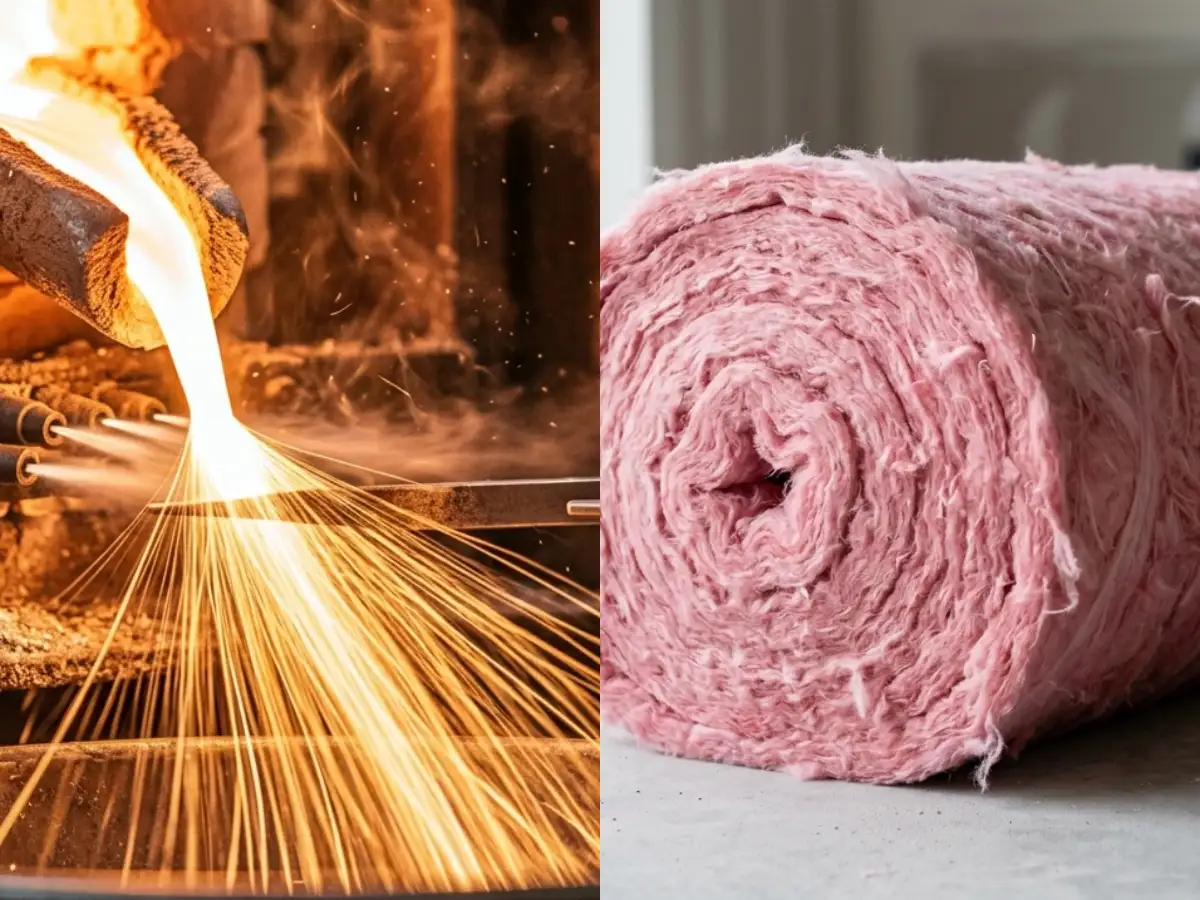
In 1932, a bizarre incident during the glass production process led to the formation of one of the key insulating materials used by industries today. According to the information provided by the National Park Service, the introduction of compressed air into the flow of molten glass created extremely thin fibers. What was perceived as an industrial oddity at first attracted attention due to the fact that the material demonstrated unique properties, which made it distinct from regular glass.
What is more important, the event was crucial because the characteristics possessed by the fibers happened to be quite valuable within the context of the growing needs of the industry. In particular, they were light enough, malleable, and capable of trapping air efficiently. Yet, people failed to recognize their importance at first. In other words, the whole process started as a reaction to heat and pressure applied to the molten glass.
However, many incidents occur in the realm of industry; most are soon forgotten due to a lack of particular use. Fiberglass was unique in the sense that its importance was immediately realized, allowing engineers to figure out ways in which it could be used for practical purposes once it became possible to produce it in a consistent manner. According to the National Park Service, it was later found to be highly associated with the fiberglass-reinforced plastic industry and industrial manufacturing systems.
The discovery became important only after manufacturers learned how to control it
However, the single incident in 1932 was not sufficient to give rise to the entire fiberglass industry overnight. The process of creating a commercially viable product out of thin glass fibers took several years of engineering efforts. As mentioned in the EPA report on fiberglass manufacturing, the present-day fiberglass industry came into existence in the year 1935, once the methods to manufacture glass fibers on a large scale were practically devised by the producers. This is important since many innovations require practical production procedures in an industrial setting to become commercially viable.
Fiberglass, on the other hand, was very useful as an insulator due to its ability to trap air. From the EPA document, molten glass was able to "be made into fiber." After manufacturers learned how to do this, fiberglass became popular not only for buildings but also for other uses, such as insulating materials used in industrial machines, and then finally for consumer use for home insulation.
In addition, the invention of fiberglass coincided with the industrialization period of the United States. In the mid-20th century, industries required materials that were lightweight, long-lasting, cheap, and versatile. Therefore, fiberglass fit right into place as a product of the era.
Fiberglass changed how the industry approached insulation and lightweight materials
Fiberglass had a quick rise to fame because it solved multiple problems at one time. People wanted better insulators, manufacturers were looking for more lightweight reinforced materials, and production was shifting toward materials that could be mass-produced. In the National Park Service account, fiberglass would come to play an integral part in reinforced plastics in modern times.
The ease of production and flexibility allowed for a wide variety of products using fiberglass that are found in modern industry. What really made fiberglass special in this instance is how unassuming its first use appeared. Hair-like fibers formed in compressed air were hardly what you might expect from something that changed the industry so radically. Those nearly imperceptible fibers ended up being a crucial component of home insulation, industrial machines, transportation, and building systems all over the world.
Manufacturing has seen many of these types of incidents, where a side reaction becomes something useful through mass production. Fiberglass itself was never an industry-changing moment on its own. It came to define an entire industry only when people realized the potential of its discovery and put it to work.