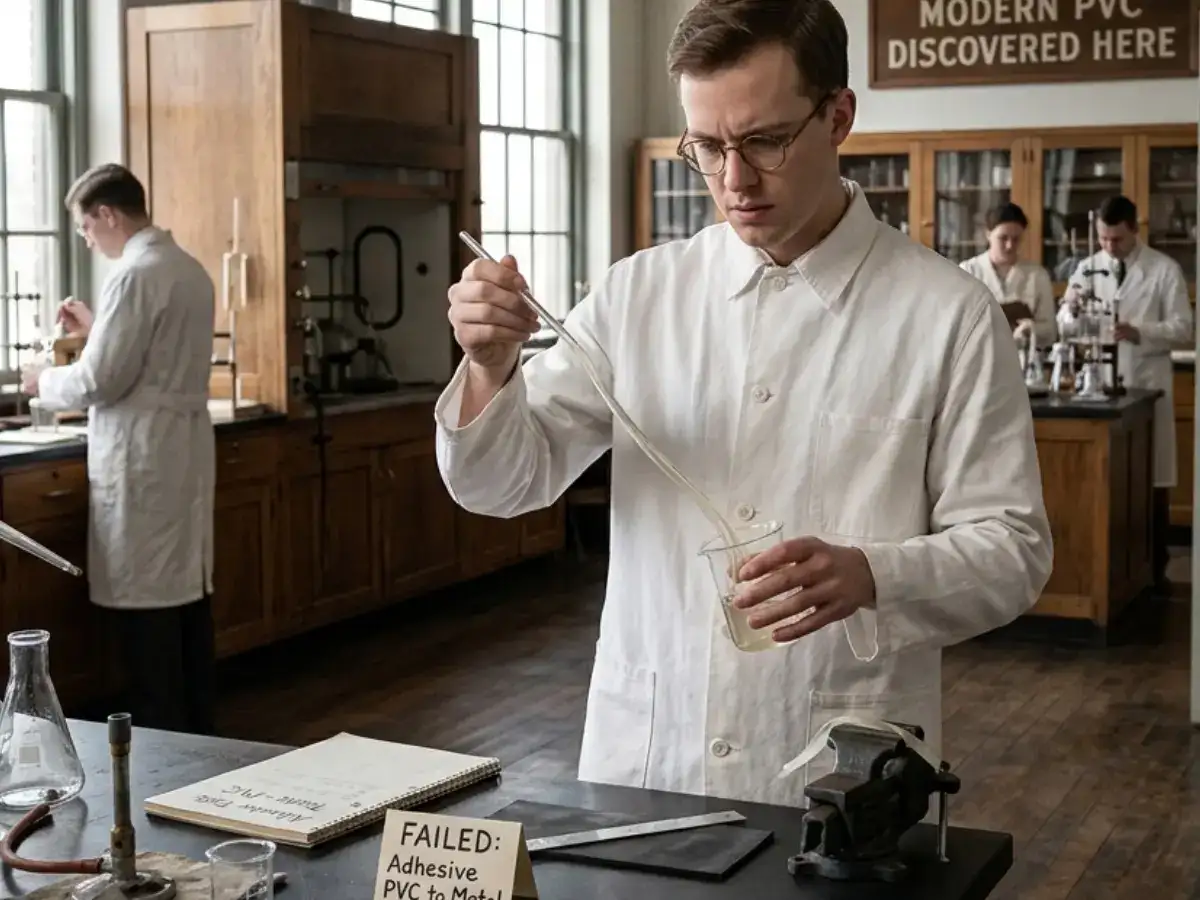
In 1926, chemist Waldo Semon tried to solve the problem of rubber coating for B.F. Goodrich in Akron, Ohio, when he had no idea that his invention would revolutionise the plastics industry. But when the supply of rubber ran out, the course of the experiment took an unexpected turn.
Semon started working with a synthetic resin called polyvinyl chloride, or PVC, which at the time was thought to be a material that was inflexible, hard and brittle and cannot be used in manufacturing due to its inability to be molded. However, what happened after, proved to be one of the most significant accidental discoveries in industrial chemistry.
By heating PVC in a high-boiling solvent, Semon got a unique elastic material that could be melted, molded and shaped. Thus, Semon's discovery led not to the creation of an adhesive, but to a solution of how to process PVC into a flexible industrial plastic. This discovery played a pivotal role in the emergence of the vinyl industry.
An unexpected experiment that led to a major discovery
According to the Lemelson-MIT Program, Semon had initially joined B.F. Goodrich Company to create a rubber covering for metal products. However, when materials were scarce, he decided to conduct experiments with PVC. The experiment immediately resulted in an unexpected outcome.
As The Franklin Institute reports, Semon found out that when PVC was heated in a solvent, it produced an elastic, jelly-like substance. It became clear that the brittle polymer could be made flexible and malleable. At that time, PVC did not have any commercial applications because it was difficult to work with.
However, Semon managed to discover a way of softening the polymer. The discovery happened accidentally, but the results it brought were extraordinary.
How PVC is used in our everyday life today
Various studies noted Semon's invention as a key step in the development of vinyl. The invention of flexible PVC resulted in numerous uses for the plastic. Products made from vinyl started being used in wiring, flooring, piping, packaging, raincoats, upholstery, and various consumer goods. Timing was also crucial.
The twentieth century was growing more and more reliant on artificial materials that could be manufactured in large quantities, cheaply and effectively. PVC was an ideal fit for that trend due to its durability, versatility, and affordability. According to multiple studies, the period witnessed the rise of industrial laboratories as significant centres of invention.
Scientists were not only conducting theoretical research but also finding solutions to factory and manufacturing problems that could easily be transformed into commercial products. The invention of Semon was no exception.
Why the invention is still relevant today
PVC ultimately turned into one of the world's most common plastics. A modern review indexed through PubMed emphasises the importance of PVC as one of the most important thermoplastics invented, thanks to its extensive industrial use and affordable production. But there is one more side of the issue that researchers have highlighted.
It is the negative impact that PVC can have on the environment. The same review mentions that researchers are still looking into the long-term health and environmental risks related to the use of certain additives and waste products from vinyl production. It makes the story interesting, historically speaking.
The accidental discovery made by Semon played an important role in changing both manufacturing and people’s lives, but also became part of a larger environmental discussion around plastic products and industrial waste.
Invention is as important as the inventor
One common remark made by historians is that accidental discovery is of little value until it is recognised. Semon did not just let the curious elastic substance go without investigating it further. He worked on improving his discovery and realised its industrial importance.
According to the Franklin Institute, most of the important inventions were made accidentally. That explains why Semon’s invention became so famous. It was not luck. It was observation combined with determination.
An experiment that didn’t work but redefined the synthetic world
What began as a standard industrial experiment in an Ohio laboratory in 1926 ended up aiding in the creation of one of the most important materials in modern manufacturing. Polyvinyl chloride transformed the way industries manufactured goods, packaged products, insulated wires, and produced consumer materials during the entire twentieth century.
The case is still very relevant because it demonstrates how revolutionary inventions often start in an unremarkable fashion. An unsuccessful adhesive experiment, a lack of rubber, and one elastic material played a significant role in creating the synthetic world that people inhabit nowadays.