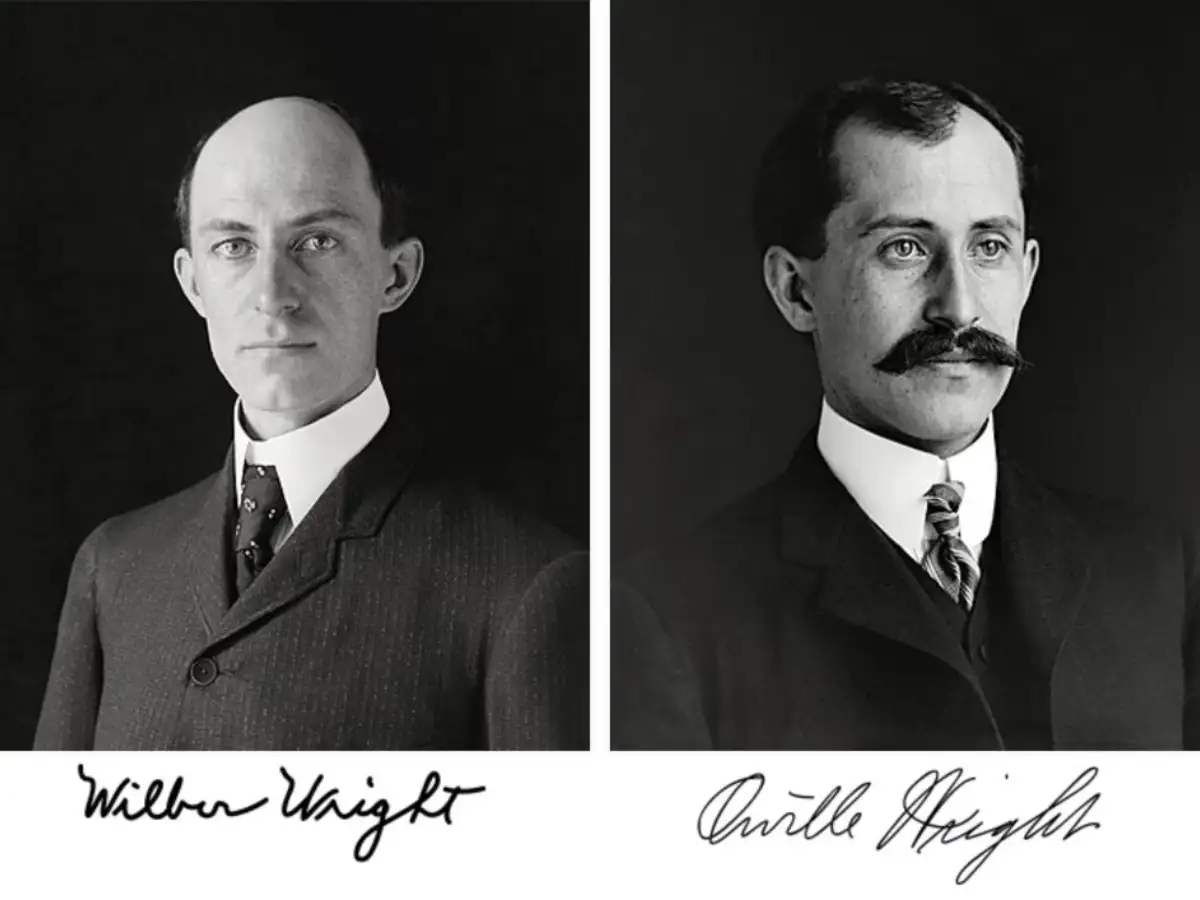
Although the Wright brothers succeeded with the invention of the first flying machine in 1903, the majority of people at that time considered the idea of a human-made aircraft to be too unrealistic or too dangerous. Previously, several inventors had been working on aircraft, but their designs failed because the devices they developed lacked proper stability and control mechanisms.
The Wright brothers had a different approach toward this problem. Unlike the other inventors who focused exclusively on the power of the engines, the Wright brothers had a special interest in stability and balance. As per the Smithsonian National Air and Space Museum, the Wright brothers studied birds' wings and turns while creating their theories on controlled flights.
Moreover, the Wright brothers had a background in the bicycle industry before they started their careers in the aviation field. The Wright brothers owned a bicycle business in Dayton, Ohio, according to the Library of Congress. They learned much about lightweight structures, balance, chain drives, and mechanical control systems from working on a bicycle.
The Wright brothers understood that the secret to successful flight lay in the ability to stay in control while airborne, not just in taking to the skies. In their day, most attempts at flight were concerned primarily with increasing engine power and wing size. But Wilbur and Orville spent much of their time figuring out how to steer, balance, and stabilize their aircraft in motion.
Bird studies and wind tunnel tests helped refine their aircraft designs
In particular, Wilbur Wright took special interest in the way birds changed their wing shapes when they made turns or compensated themselves against the direction of air streams. As reported by the Smithsonian National Air and Space Museum, the brothers got inspired to develop their wing warping system that helped pilots twist wings slightly while flying to achieve balance and control over the plane’s movement.
To test their hypothesis about flight, the Wright brothers conducted numerous experiments with gliders. In 1900, the brothers started traveling to Kitty Hawk, North Carolina, known for its powerful sea breezes and soft sand hills, where flights could be carried out safely. As noted by the NASA Glenn Research Center, they were dissatisfied with the aerodynamics data obtained from other sources and decided to develop their own wind tunnel.
The wind tunnel was also one of their most significant instruments. Instead of basing everything they did solely on prior research, the Wright brothers tested air flows and wing performances themselves. As per the NASA Glenn Research Center, these tests helped them refine their wing designs and achieve greater aerodynamic efficiencies compared to several other inventors who were trying to accomplish the same thing. By late 1903, the Wright brothers had developed a machine that incorporated their knowledge about aerodynamics, wing controls, propellers, and engines.
The first successful powered flight changed transportation history
Orville flew the first flight on December 17, 1903, at Kitty Hawk, and his brother Wilbur assisted him from the ground. As cited by the Library of Congress, the plane took off for 12 seconds and covered a distance of 120 feet. The flight duration was quite short, but according to historians, the invention marked the start of aviation. The Smithsonian states that the invention revolutionized transport, engineering, military technology, and travel in general.
The uniqueness of the Wright brothers' invention lies in their careful approach. In other words, the two inventors were not affluent businessmen or scientists researching in a laboratory in a prestigious institution. On the contrary, the Wright brothers were self-taught inventors using a systematic approach over a period of several years to solve technical issues related to aviation. Moreover, they succeeded partly due to their perception of the flight as an engineering problem that required step-by-step solutions. Thus, the careful observation of bird wing behavior contributed significantly to solving the issue of human flight.