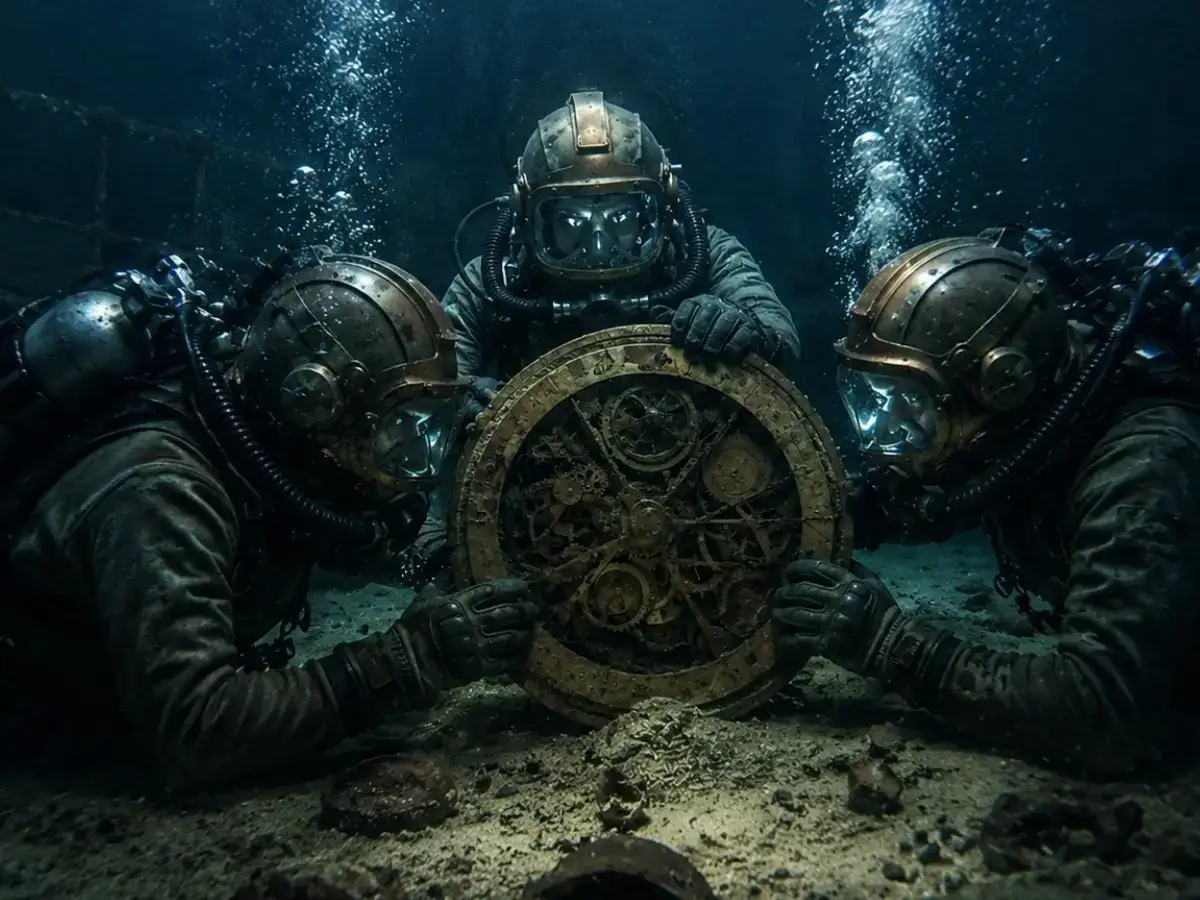
From what was supposed to be a routine sponge diving trip near the Greek island of Antikythera emerged an unprecedented discovery in the field of archaeology. In 1900, a group of sponge divers, who, due to unfavorable weather, had been forced to alter their intended path of travel, discovered an ancient shipwreck full of valuable statues, ceramic pieces, and other luxurious items. Among the items found in the wreckage were some corroded bronze plates that proved to be a remarkably sophisticated piece of machinery known today as the Antikythera Mechanism.
This discovery was significant since it presented a challenge to previous notions regarding the level of technological sophistication of ancient civilizations. It was discovered through subsequent analysis that the mechanism is able to perform complex calculations of astronomical cycles that were assumed to be far too complicated to be produced during that time period.
According to the American Society of Mechanical Engineers (ASME), the Antikythera Mechanism represents one of the first geared calculating devices ever created.
The story behind the discovery of the shipwreck
The whole process of discovering the wrecked vessel began by sheer luck. During their dive below the waters, they found the remnants of a shipwreck that had lain on the ocean floor. Initially, the ship itself was seen as the primary discovery. The ship carried statues, glassware, coins, and many other artifacts of high monetary value.
However, amongst all of the valuable items, there lay corroded bronze pieces coated in various sediments of marine life. They appeared to be broken and of no particular importance. According to the National Hellenic Museum, the bronze pieces received special interest after the small gears were found within them.
This would shift the course of the entire discovery, as what was believed to be wreckage turned out to be machinery. Upon closer inspection, it was understood that it was far more complex than it initially appeared to be. The Antikythera mechanism was not an easy object to decipher, as researchers worked for many years on the study of the pieces, analyzing their structure, and decoding the mechanism used in them. It was found to have the ability to predict eclipses, calculate the position of planets and stars, and record astronomical cycles.
ASME declared that the device is a masterpiece of mechanical engineering, when it identified the device as a Historic Mechanical Engineering Landmark. The University of Texas Marine Science Institute reveals that the mechanism was based on bronze gear technology to simulate the motion of heavenly objects. The degree of sophistication stunned historians since there wasn’t anything similar built for the next few hundred years until the Renaissance period.
It revolutionized the perception of ancient technology
When the Antikythera Mechanism wasn’t yet discovered and well-understood, most people regarded ancient technology as practical but unsophisticated. Ancient civilizations were famous for architecture, irrigation technologies, and weaponization, but certainly not for devices that could calculate the motion of planets and stars. But the Antikythera discovery made researchers and historians change their mind about the matter.
Historians at the Kotsanas Museum state in the museum's educational materials that the mechanism has rewritten our knowledge of ancient Greek technology. Scientists are beginning to think that this device was part of a larger scientific tradition that might not have survived until subsequent ages. This discovery proved that the knowledge of ancient science was much more developed than scientists used to know before. An additional layer of mystery surrounded the discovery due to its location.
One reason why the discovery remains famous is that it was discovered in an unusual place. The mechanism was submerged for around two millennia before it was taken apart and found in pieces on the sunken vessel. According to TIME, archaeologists still work to excavate the site since it might yield further discoveries related to the machine itself.
The water helped to preserve the artifact, yet it also corroded and glued bronze pieces of the mechanism together. It took time for researchers to be able to see through all of the corrosion. Thus, it took many years to finally decipher the significance of what used to be a pile of broken pieces.