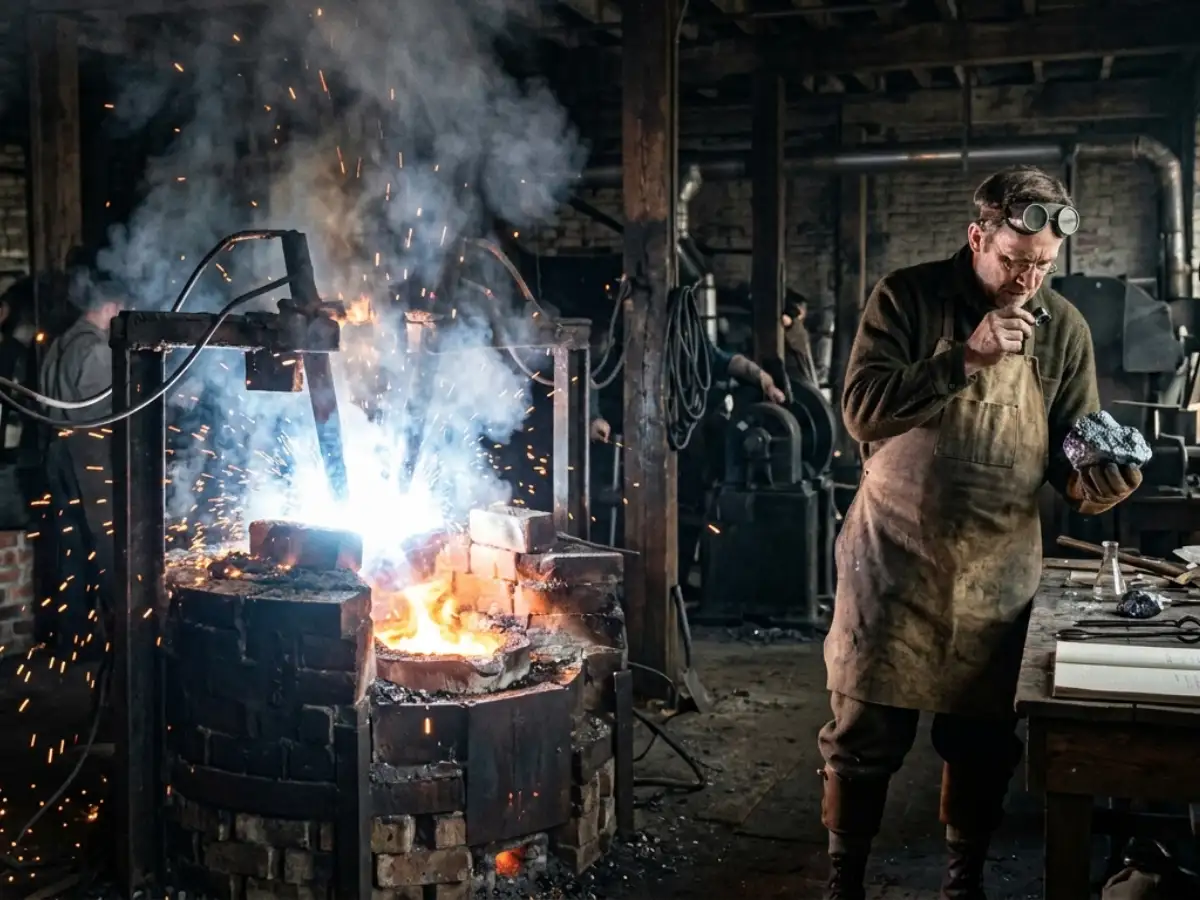
In the spring of 1892, Willson was not attempting to revolutionize industrial chemistry in any manner whatsoever. Instead, he was working towards discovering a more economical path for aluminum production. However, his experimental endeavors took an unplanned path at some point inside a furnace in Spray, North Carolina.
As per the account by the American Chemical Society, Willson, unintentionally made the discovery of the electric-arc process for calcium carbide on May 2, 1892, when he was working with high temperatures within furnaces. He did not discover the aluminum process, which was the ultimate objective of his experiment; rather, he found out a new compound that had its own economic prospects.
Soon, his serendipitous discovery led him towards acetylene, making it possible for many lighting, mining, and welding industries.
This story is highly relevant today as it tells us how many discoveries were made through unplanned reactions, which were identified only later by the researcher(s).
The solid that changed the experiment
Calcium carbide was not just an unnecessary byproduct of a failed furnace experiment.
According to the North Carolina Department of Natural and Cultural Resources, Willson recognized its importance soon enough to file a patent application for the reaction just a few months after his initial observations. As stated in their historical marker, it took only six months until August 1892. Such speed indicates something specific about this scientific discovery.
The field of industrial chemistry is characterized by its relatively slow progress unless the practical advantages of the findings are immediately obvious. In the current case, the key practical value of calcium carbide resided in its capacity to be turned into acetylene gas with the help of water.
As explained by a review article indexed by PubMed, calcium carbide byproducts are directly linked to the process of generating acetylene gas via hydrolysis. In other words, the solid could yield the necessary gas when required, which made it very useful to industries.
In practice, instead of delivering the highly volatile gas to industries, the solid could be shipped and converted into gas at the destination point.
From furnace accident to industrial process
The invention gained more importance when scientists were able to determine precisely what Willson had invented.
As reported by the American Chemical Society, Willson did not know precisely what he was making in his furnace himself at first. Later on, he consulted with Francis P. Venable, from the University of North Carolina, who recognized the material as calcium carbide, while the emitted gas was called acetylene.
This difference is essential for history. While the gas, acetylene, was known to chemistry already, Willson’s contribution consisted of developing a process that could produce the gas industrially. Thus, the process was not only about inventing a substance that could produce a flame but rather creating an industrial process out of laboratory experiments.
Moreover, the process is typical for industrial innovation. The person who starts the chemical reaction may do so accidentally, but further research will most likely be necessary.
Why did acetylene spread so quickly
Acetylene quickly entered industrial society due to its capability to satisfy several requirements.
As indicated by the North Carolina historical marker, the first commercial carbide plant came about by 1894, just two years after the furnace test. It is also stated that acetylene quickly found applications in lighting, mining, and welding.
These applications all required a steady supply of gas.
Mine owners required a reliable underground light source. High temperature was useful for the welding industries. The reason why acetylene became the chosen lighting option in those days was its ability to produce a bright flame without the need for electricity.
According to a study reviewed by ScienceDirect, acetylene can be considered an industrial precursor, and it states that calcium carbide is among the earliest methods of producing acetylene gas on a massive scale.
It is also explained how the calcium carbide route became so popular initially. Calcium carbide, which can be derived from limestone and coke under high temperatures, made industries capable of producing their own acetylene.
A local experiment with national consequences
The discovery at Spray, North Carolina, quickly grew well beyond one furnace laboratory.
According to the North Carolina Department of Natural and Cultural Resources, Willson and James Turner Morehead went on to sell patents for lights and developed their own carbide factory commercially. This process ultimately led to Union Carbide.
This progression from the laboratory setting to corporate-scale production demonstrates the general trend of growth within North American industrial chemistry during the late nineteenth century.
The American Chemical Society now considers this calcium carbide discovery to be a significant milestone in U.S. chemical industry history due to its impact on the industry.
This furnace laboratory was not merely involved in the synthesis of a new material. Rather, it played a role in developing an industrial process based on electric arc synthesis and gas production.
Why the accident still matters today
It has been more than one hundred years since this event took place, but the calcium carbide case is relevant even now, since it illustrates that many breakthroughs in industrial processes happen by accident.
Willson was not looking for a new type of carbide; instead, he was trying to find the cheapest way to produce aluminum. Yet the result was much more profitable than the initial aim.
In addition, the discovery illustrates the very nature of the industrial history process. Breakthroughs happen through understanding the meaning of a seemingly failed endeavor.
As it can be seen from the sources cited above, both ACS and North Carolina, Willson's discovery quickly developed into a patented process and mass production.
This is exactly what made the story unique, because it transformed an unsuccessful experiment conducted in the furnace into an innovative process influencing the lighting industry and its further development.