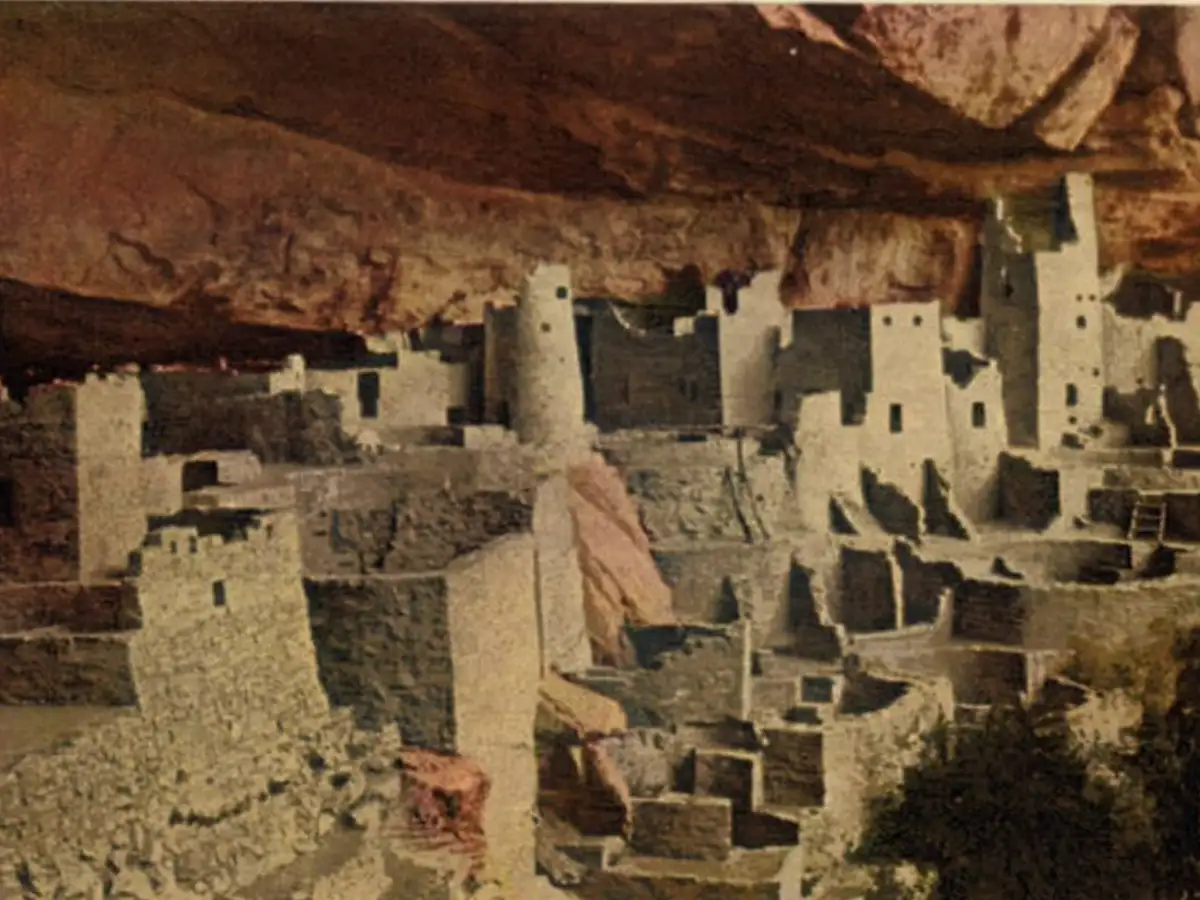
This vast settlement of the ancestors of the Pueblo was not at all lost; it stood out there, visible, but protected by the sandstone cliffs and natural geography around it for ages. Nevertheless, this settlement only became a part of history when it was discovered by two cowboys in December 1888.
Nowadays, Cliff Palace of the Mesa Verde National Park is known as the largest and most famous dwelling. According to the National Park Service, this discovery was made possible by Richard Wetherill and Charles Mason, who were employed as cowboys in ranching back then, discovering an enormous ancestral Pueblo community that was hidden in a sandstone alcove. The thing is, this community had been standing there for about seven hundred years at the moment of discovery.
Here lies the beauty of this story, since a huge ancestral community was built into the cliffs, protected by the natural environment, and was not discovered by any scientists but by cowboys wandering around the area.
A discovery tied to ordinary work
In accordance with records of the National Park Service, it is evident that Wetherill and Mason discovered the Cliff Palace during their exploration of the area around Mesa Verde in late 1888. What should be noted is that the discovery of the Cliff Palace did not take place in the process of an organized archaeological exploration. On the contrary, it happened in the course of the daily work of the cowboy.
One should note that according to the records of the National Park Service, the 1880s and 1890s witnessed numerous discoveries of ruins by cowboys, ranchers, and travelers exploring the region.
What makes the discovery of the Cliff Palace unique is that at that time, it was the everyday citizens who were usually the first witnesses to such amazing things.
Why the pueblo remained overlooked
The geography of the area explains why this large settlement could have remained unknown for so long.
As stated by the United States Geological Survey, the ancient buildings are located in natural alcoves that were carved in Cliff House Sandstone. In fact, only some alcoves possessed enough space for a large community. As a result, Cliff Palace was rare among the other settlements.
Geology is also an important element when speaking about concealment. At times, the structure was clearly visible while being concealed at other vantage points.
One can learn from the official website of the national park that the view of Cliff Palace was available to the people standing at the rim of the canyon; however, it was not too difficult to overlook it due to its surroundings. In fact, the ancient ruins were neither buried under the ground nor concealed by the surrounding vegetation.
It all constitutes the core of the "hidden in plain sight" concept.
A massive ancestral community
Cliff Palace was not just a small shelter or a refuge.
Mesa Verde National Park describes the number of rooms in Cliff Palace as being roughly 150 and kivas numbering 23, making it the largest cliff dwelling in the park. Early descriptions by the National Park Service indicated that Cliff Palace could accommodate up to 400 people. Over the years, archaeological techniques and estimation procedures have advanced, but the overall idea that Cliff Palace was a significant community formed through careful planning and construction has remained constant.
What impresses both tourists and historians today is the sheer size of Cliff Palace. Mesa Verde hosts over 600 cliff dwellings, some of which are quite small. It is the magnitude of Cliff Palace that makes it unique.
As per the National Park Service, it was also the first major cliff dwelling discovered at Mesa Verde, which contributed to making the area one of the most important sites for archaeology in North America.
Discovery also brought destruction
Rediscovering Cliff Palace was not just an episode of amazement. It signaled the start of destruction as well. The article by the National Park Service says that when news about this place got out, Richard Wetherill and his family started excavating rooms and took away pottery, tools, wood, bones, and even human remains. Recognition, then, did not immediately translate to preservation.
The tale thus bears a more complicated significance. Unveiling, then, subjected the pueblo to both reverence and damage.
According to the Mesa Verde preservation literature, Cliff Palace is a vulnerable site that remains under constant watch. The National Park Service notes that weather, moisture, freeze-thaw effects, and the highly volatile nature of the alcove setting remain threats to the building. The site also incurred extensive damage following its rediscovery towards the close of the 19th century.
Why the story still resonates
This is due to the size of the structure and the historical elements that went into its making at such an opportune time.
Here you have an entire village of the ancestral Pueblo people hidden away for hundreds of years in a sandstone alcove and then discovered centuries later by two cowboys passing through canyon country. This story reminds us that many of history's greatest finds are not necessarily made through extensive exploration but simply through noticing something while traveling through it.
At Mesa Verde, the past had never really been left behind. Instead, it was locked in stone until it was rediscovered by history itself.