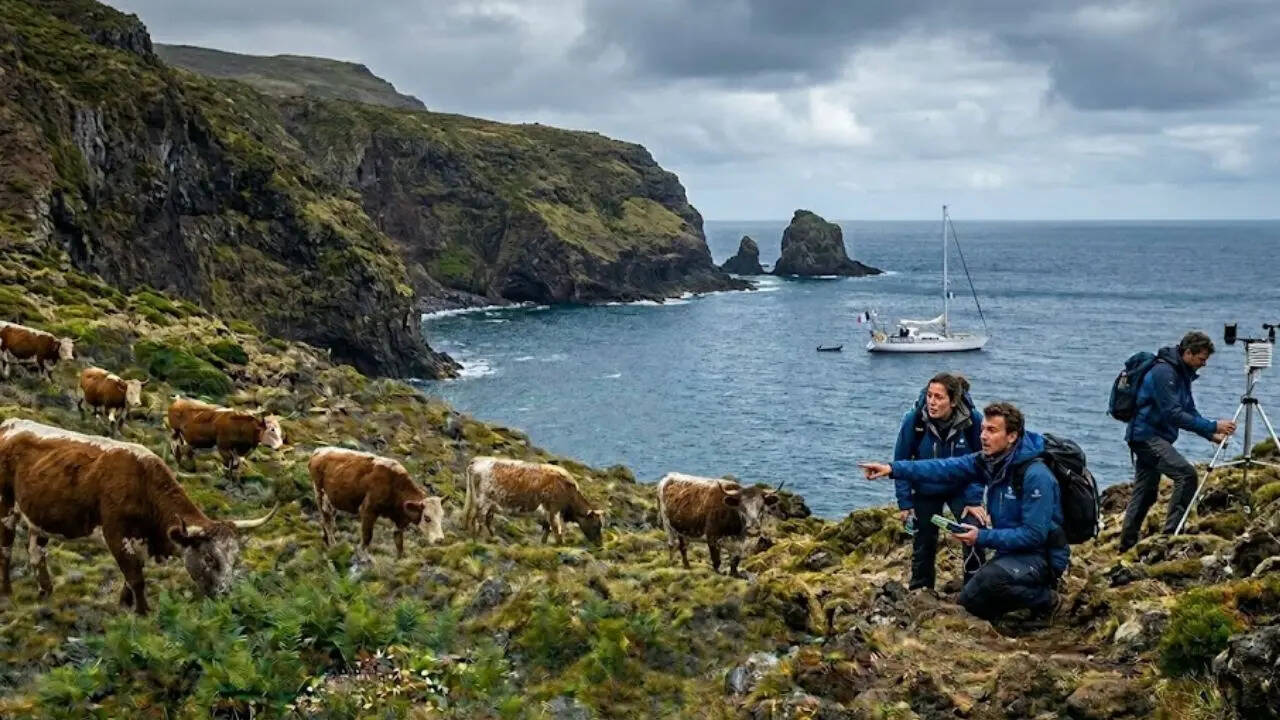
In 1871, a French settler by the name of Heurtin left Amsterdam Island in the Indian Ocean. He left behind five cattle on this barren volcanic land, and without any human help, it appeared biologically unsustainable. Over a century later, scientists returned to check on the herd and found something astonishing. The cattle population had grown to nearly 2,000 strong, despite severe inbreeding and tough weather conditions.
Known as ‘Heurtin cows,’ these animals managed to survive against all odds. Studies have shown that this isolated group developed a special set of genetic traits that could change how we understand resilience and quick adaptation in domestic animals when they return to the wild. This unique population demonstrates nature's remarkable ability to thrive in isolation, offering invaluable lessons on evolutionary survival and genetic endurance.
Scientists sequenced the genomes of the 5 cows that were abandoned by a farmer on Amsterdam Island in 1871
According to the study published in Molecular Biology and Evolution, the story of this evolutionary anomaly starts with a failed cattle ranching effort on one of the planet’s most isolated islands. Left behind were five animals - a bull, two cows, and two calves-who became the ancestors of a large wild population. Typically, such a founder effect can lead to extinction because harmful mutations build up over time. Surprisingly, though, by 1988, the population had grown to about 2,000 animals that spread across the entire 55-square-kilometre island.
Why did these cattle not face inbreeding depression
Genomic analysis conducted by a team of international researchers found that the Amsterdam Island cattle have one of the highest inbreeding coefficients ever recorded in a thriving mammalian population, close to 0.30, which is rare for a successful mammal population. Interestingly, these cows don't show any obvious signs of problems usually associated with inbreeding, like poor health or low fertility. Over about a hundred years, the herd successfully purged harmful mutations-a feat typically taking millennia.
The genetic toolkit that conquered a volcanic wilderness
Researchers delved into the DNA and discovered that the herd wasn't purely bred. Their ancestors came from a mix of European Jersey cattle and Indian Ocean Zebu, as noted in the study published in Molecular Biology and Evolution. This blend gave them hybrid vigour, which means they inherited high fertility from the Jersey and impressive heat and parasite resistance from the Zebu. This specific combination allowed them to withstand the island’s volatile volcanic environment.
The HPA axis turned cattle into wild survivors
One of the most remarkable discoveries was that cattle's nervous systems adapted more rapidly than their physical traits. According to the study published in Molecular Biology and Evolution, researchers noticed major changes in genes linked to the hypothalamic-pituitary-adrenal axis, which manages how stress is handled. Over just 130 years, these cattle reverted from domestic docility and became highly vigilant again. This transformation helped them survive against predators and adapt to the island's challenging landscape.
The herd had significant scientific importance, yet it posed a danger to the island's native biodiversity. The cattle consumed too much of the Phylica arborea trees and destroyed the nesting areas of the endangered Amsterdam Albatross. From 1987 to 2010, the French government (TAAF) implemented a program to systematically eradicate the herd. Nowadays, all that remains of this 130-year evolutionary wonder are DNA samples in freezers and bones used for research.