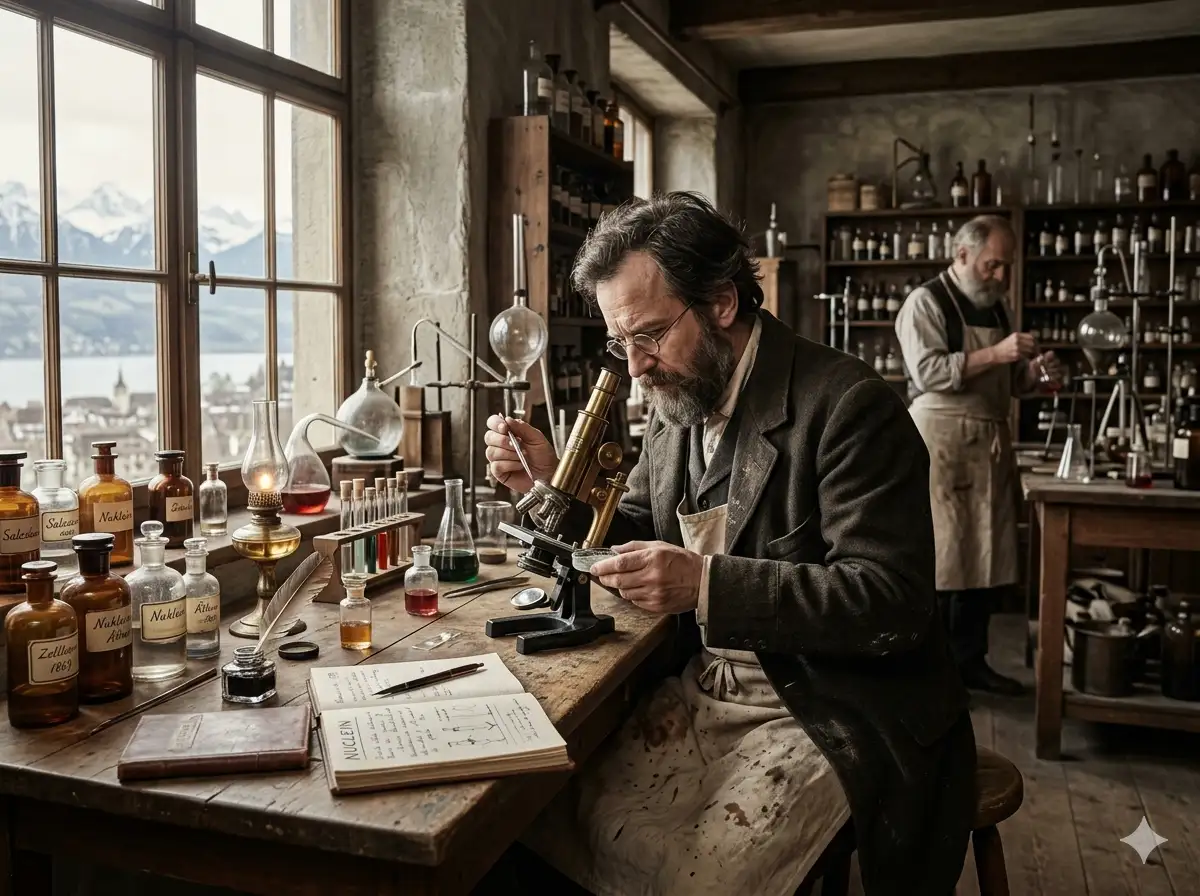
In 1869, a Swiss physician-cum-biochemist while checking pus-filled surgical bandages made this remarkable discovery accidently . The scientist was Friedrich Miescher, a physician and biochemist from Switzerland. While studying white blood cells collected from surgical bandages, he isolated a substance that was different from proteins known at the time. He named the material “nuclein” because it was found in the cell nucleus. This substance was later renamed nucleic acid and eventually deoxyribonucleic acid, or DNA. Although the significance of DNA was not understood immediately, Miescher’s research became one of the most important discoveries in the history of biology.
From Basel to the Research Laboratory
Friedrich Miescher was born in Basel, Switzerland, in 1844. He came from a family known for contributions to medicine and science. His father was a physician who taught pathological anatomy, while his uncle Wilhelm His was a recognized embryologist.
As a student, Miescher performed well in academics despite being shy and having a hearing impairment. He first considered becoming a priest, but his father encouraged him to pursue medicine. After graduating from medical school in 1868, he decided to focus on scientific research rather than patient care because of his hearing difficulties. Miescher joined the University of Tübingen in Germany and worked under Felix Hoppe-Seyler, a scientist who specialized in tissue chemistry. The laboratory was among the first in Germany dedicated to studying the chemical components of cells.
The Search for White Blood Cells
At the time, scientists were still trying to understand the structure and composition of cells. Hoppe-Seyler assigned Miescher the task of studying lymphoid cells, also known as white blood cells.
Obtaining enough white blood cells for research was difficult. Miescher found a solution by collecting used surgical bandages from a nearby clinic. These bandages contained pus from infected wounds, which was rich in white blood cells. He carefully washed the bandages to separate the cells. This unusual source of research material became the starting point for one of the most important discoveries in science.
How the Discovery Happened?
While studying the white blood cells, Miescher wanted to examine their protein content. He dissolved the cells and treated them with digestive enzymes known as pepsin. During the process, he noticed a substance that formed a precipitate. Further examination showed that this material came entirely from the nucleus of the cell rather than the rest of the cell structure. Because the substance was found in the nucleus, Miescher named it “nuclein.” This was the first time a scientist had isolated what would later be identified as DNA.
What Made Nuclein Different?
Miescher analyzed the chemical composition of nuclein and found that it differed from proteins in several ways. The substance was slightly acidic. It contained a large amount of phosphorus. It lacked sulfur, which was known to be present in proteins. He also determined that nuclein consisted of hydrogen, oxygen, nitrogen, and phosphorus. The ratio of phosphorus to nitrogen was unusual and distinguished it from any known protein. These findings convinced Miescher that he had discovered an entirely new biological substance.
Expanding the Research
After isolating nuclein from white blood cells, Miescher continued his experiments using other biological materials. He successfully isolated the same substance from different cell types. Later, he used salmon sperm as another source because it contained large numbers of nuclei and was easier to study. His work showed that nuclein was not limited to pus cells. Instead, it appeared to be present in many living cells. This observation strengthened the idea that nuclein played a fundamental role in biological processes.
Publication and Scientific Response
Although Miescher completed much of his research in 1869, his findings were not published until 1871. Felix Hoppe-Seyler was initially skeptical about the results because nuclein appeared unlike any molecule previously identified. Before allowing publication, he repeated experiments to verify Miescher’s conclusions. Only after confirming the findings did Hoppe-Seyler approve the publication. The delay reflected the scientific caution of the period and the unusual nature of the discovery.
Career at the University of Basel
In 1872, Miescher returned to Switzerland and became Professor of Physiology at the University of Basel. The position had previously been held by his father and later by his uncle. The appointment provided him with additional resources, equipment, and funding for research. However, teaching responsibilities also became part of his role. Miescher devoted much of his time to laboratory work and continued investigating nuclein and other biological processes. His perfectionism and dedication often led him to spend long hours conducting experiments.
Why DNA Was Not Immediately Recognized?
Although Miescher discovered nuclein, neither he nor most scientists of the late nineteenth century understood its true importance. At the time, researchers believed proteins were responsible for carrying hereditary information because proteins seemed more chemically complex. Miescher also shared this belief. He thought nuclein might serve an important function inside cells but did not consider it the molecule of heredity. As a result, the significance of DNA remained unrecognized for decades.
The Legacy of Friedrich Miescher
Later scientific discoveries revealed that DNA carries genetic information and controls heredity in living organisms. Researchers in the twentieth century built upon Miescher’s work to uncover the structure and function of DNA. His isolation of nuclein became the foundation for molecular biology, genetics, biotechnology, forensic science, and genetic medicine.
Although he did not live to see the impact of his discovery, Miescher's research opened the door to many scientific advances. Friedrich Miescher died from tuberculosis in 1895. His work remains one of the most significant milestones in scientific history. The discovery that began with pus-filled surgical bandages eventually transformed humanity’s understanding of life itself.