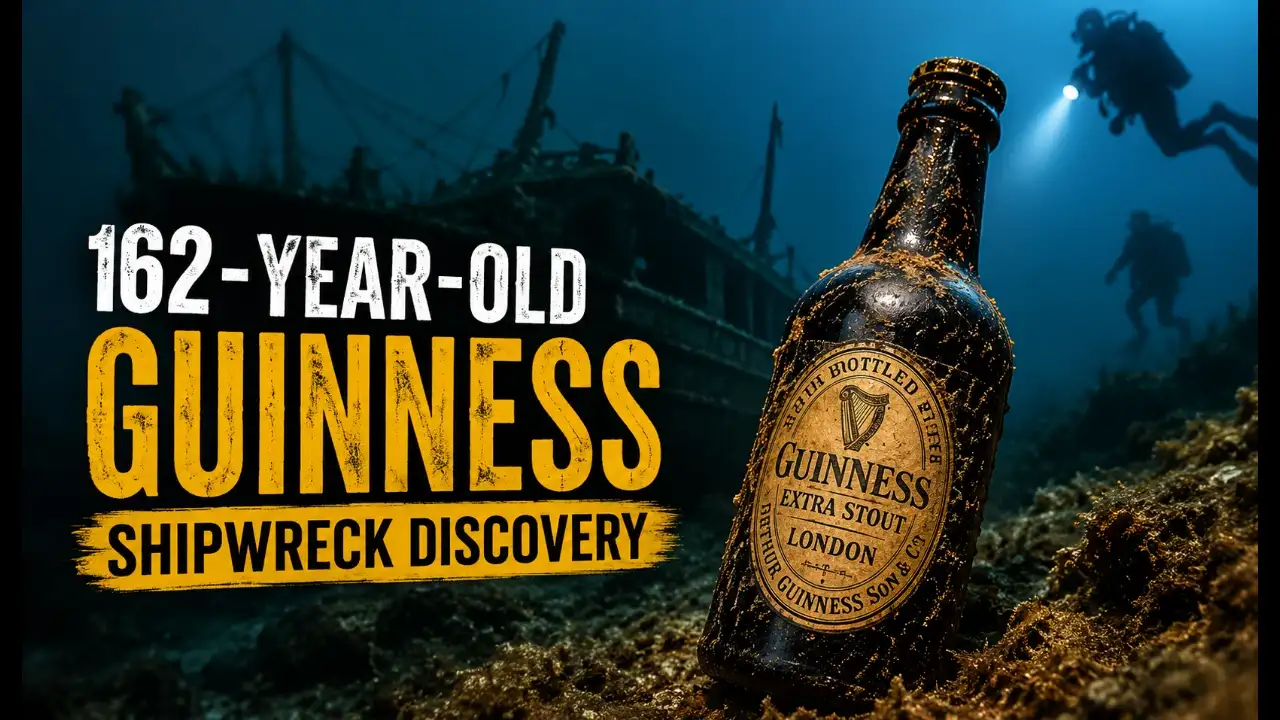
A bottle of Guinness pulled from a 19th-century shipwreck is offering scientists something far rarer than an old drink. It may preserve a small piece of brewing history inside a sealed glass container. The bottle was recovered from the Mindoro , a British sailing barque that sank in the English Channel on November 27, 1864, during the reign of Queen Victoria. If its contents remain chemically intact, researchers could get an unusual glimpse of how Guinness was made and tasted more than a century and a half ago. The discovery was made by diver Stefan Panis while exploring the wreck with a friend. The Mindoro is not a static archaeological site.
That label immediately changed the significance of the find. The Mindoro sank in 1864, meaning the bottle could have spent roughly 162 years beneath the sea before being recovered. Panis had not realized Guinness had a brewing history extending back that far. He shared the discovery with fellow diver and researcher Pawel Truszynski, who recognized that the bottle might contain more than an unusual souvenir. A sealed bottle could preserve chemical clues about an extinct version of a familiar beer.
The most intriguing question is not simply whether the Guinness is still liquid. It is whether anything inside the bottle can tell researchers what Victorian-era stout was actually like. Modern Guinness is the product of generations of changes in ingredients, brewing equipment, yeast management, storage and production methods. A bottle from 1864 therefore represents a snapshot from a very different brewing world, one that disappeared long before modern laboratory analysis became possible.
Why the sealed bottle matters so much
Beer is normally a poor candidate for surviving unchanged for 162 years. Once exposed to oxygen, microorganisms and fluctuating temperatures, its chemistry begins to shift. Compounds responsible for aroma can break down or react with one another, while alcohol and other volatile substances can slowly change. A sealed glass bottle, however, creates a far more controlled environment. If the closure remained intact, the beer would have been isolated from much of the outside world.
That does not mean the contents would taste exactly as they did in 1864. Time itself changes beer, even without obvious contamination. Oxygen trapped inside the bottle can participate in slow chemical reactions, while proteins, sugars and other compounds can transform over decades. Some flavors may disappear, while others develop through oxidation and aging. The result could be less like a perfectly preserved pint and more like a chemical record of both the original beer and its long journey underwater.
The bottle's environment adds another layer of complexity. The Mindoro rested in the cold, dark waters of the English Channel, where temperatures are considerably more stable than those experienced by an object exposed to sunlight and repeated warming on land. Darkness also limits light-driven chemical reactions. These conditions may have helped protect the contents, although researchers would need laboratory analysis to determine how much the beer has changed.
Guinness in the Victorian Era was not modern Guinness
The Guinness name is centuries old, but the beer inside this bottle would not have been identical to the stout sold today. Brewing in the mid-19th century depended on different equipment, ingredients and production practices. Industrial brewing was advancing rapidly, but modern temperature control, microbiological monitoring and highly standardized fermentation systems were still developing.
Yeast is particularly important because fermentation is not simply a matter of adding sugar and waiting. Yeast converts fermentable sugars into ethanol and carbon dioxide while producing a wide range of secondary compounds that influence aroma and flavor. Different yeast populations can create markedly different beers, even when brewers use similar grains and hops. A historical yeast strain could therefore provide clues about the character of Victorian stout that cannot be recovered from a modern bottle.
This is why Truszynski and his collaborators are interested in analyzing the bottle rather than immediately opening it for a taste. Researchers could potentially examine material associated with the beer and search for surviving yeast or fragments of microbial DNA. Modern sequencing methods can recover genetic information from surprisingly small biological traces, although degraded DNA and contamination would make the work technically demanding.
Could scientists recreate the old Guinness?
If usable genetic material survives, researchers could compare it with modern brewing yeast and investigate how the historical strain differed. DNA would not provide a perfect recipe for the beer, because flavor depends on much more than genetics. Grain varieties, roasting levels, water chemistry, hops, fermentation temperature and storage conditions all affect the final product.
Still, a historical yeast genome could answer important questions. Scientists could determine whether the microorganisms associated with the bottle belong to lineages related to modern brewing strains or represent a population that has since disappeared from commercial production. They might also identify genetic differences linked to fermentation behavior, alcohol tolerance or flavor-producing pathways.
The bigger challenge would be deciding whether any recovered organism is genuinely from the 1864 beer. A wreck lying underwater for more than a century and a half is an environment filled with potential sources of contamination. Modern microbes could have entered the bottle if its seal was compromised, and handling during recovery could introduce additional DNA. Researchers would therefore need careful controls and independent evidence before claiming that a particular sequence came from the original beer.
The temptation to take a swig
There is an obvious human impulse behind the discovery. If a bottle of Guinness has remained sealed since Queen Victoria's reign, why not open it and find out what it tastes like? In theory, the experiment sounds wonderfully simple. In practice, opening the bottle would permanently destroy part of the evidence researchers have spent decades learning how to preserve.
There is also no guarantee that the beer would be pleasant, or even suitable for drinking. A sealed bottle can protect against new contamination, but it cannot reverse chemical aging. Researchers would first need to determine what microorganisms, toxins or degradation products might be present. The fact that the liquid survived inside the bottle does not establish that it is safe for human consumption.
For archaeologists and brewing historians, tasting may therefore be less valuable than sampling scientifically. A small amount of liquid could potentially be analyzed for alcohol content, acidity, sugars, proteins, volatile compounds and other chemical markers. Those measurements could provide a much richer picture than a single person's impression of whether the beer tastes good.
A bottle that turns brewing history into laboratory evidence
The Mindoro bottle is valuable precisely because it connects several kinds of history at once. It belongs to a ship that sank in 1864, carries the name of a brewery with a long industrial history and may preserve biological and chemical evidence from Victorian brewing. Instead of relying entirely on written recipes or historical descriptions, researchers could potentially examine physical evidence from the beer itself.
The discovery also shows why shipwrecks remain important scientific archives. Objects buried beneath sediment can survive because the surrounding environment slows processes that would rapidly destroy them on land. Bottles, tools, food containers and other everyday objects can preserve details about ordinary life that rarely appear in official historical records. Sometimes the most revealing artifact is not a treasure, but something as mundane as a bottle of beer.
For now, the biggest mystery remains sealed inside the glass. The researchers have a rare opportunity to determine how much information has survived since 1864 without sacrificing the entire sample. If the yeast, chemistry or other biological traces can be recovered, the bottle could help reconstruct a small but remarkably vivid part of Victorian brewing history. And if someone eventually does take a carefully controlled sip, it may be one of the oldest Guinness tastings ever attempted.