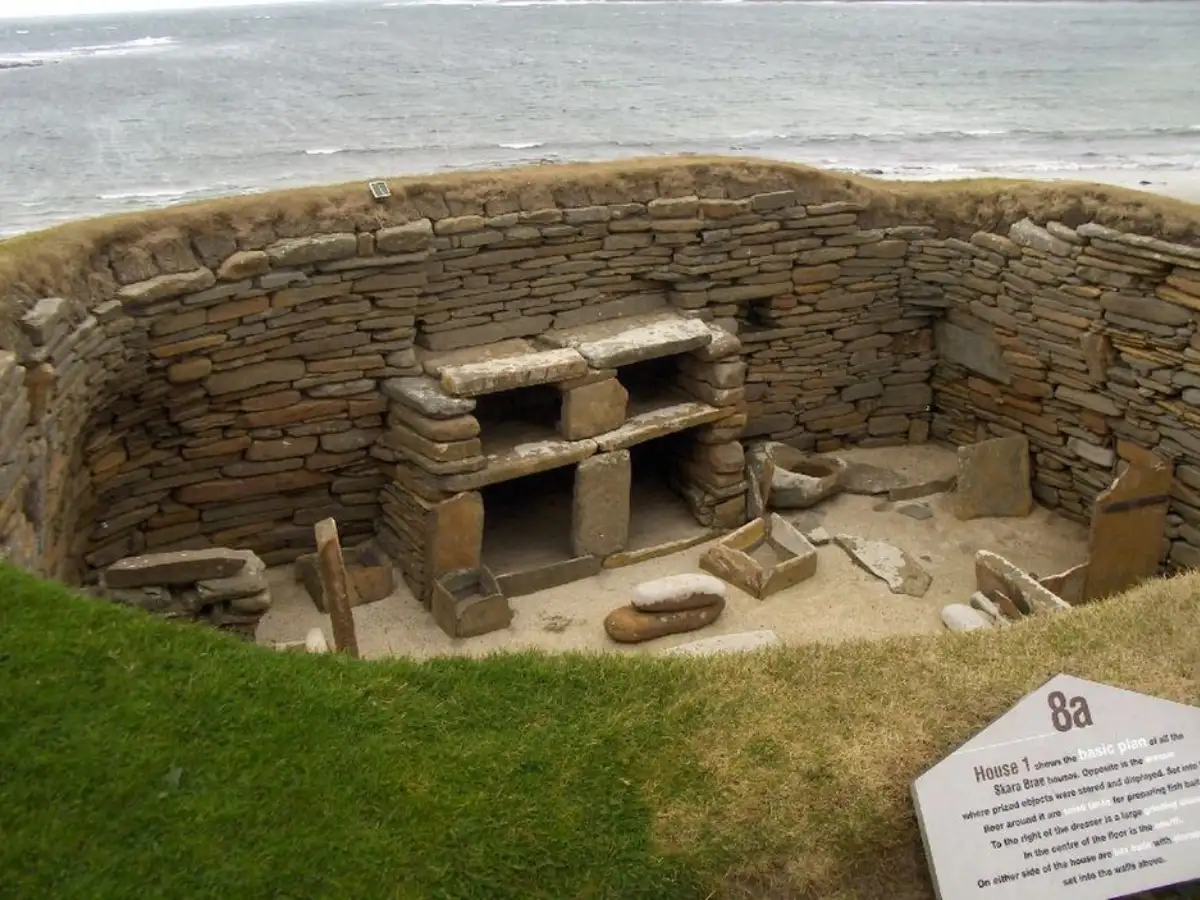
Skara Brae, which has been in existence for many millennia, lay buried under layers of shifting sand dunes on the Orkney Islands off the coast of Scotland until 1850. This archaeological site, which lacks fortifications or any form of protection from enemies, armies, and natural destruction, managed to be intact due to the efforts of nature to bury it. The ruins came to light when a severe storm washed away the dunes and uncovered ancient stone buildings that had been buried for over 5,000 years.
The discovery of Skara Brae in 1850 resulted in one of the best-preserved Neolithic villages discovered in Europe. The University of the Highlands and Islands states that Skara Brae is crucial in telling the heritage story of Orkney.
A village hidden by the landscape itself
The preservation of Skara Brae would depend precisely on the same environmental factors that almost wiped it out. Centuries of strong winds carried sand over the land, which eventually buried the village under layers of dunes. As indicated by studies conducted at the University of St Andrews, aeolian deposition of sand made an important contribution to the preservation of Skara Brae.
It was important for this reason because the accumulation of dunes ensured the protection of houses from erosion caused by decades of weather and agriculture. The walls, passageways, and other structures stayed relatively well-preserved under the layer of sand.
Archaeologists indicate, however, that Skara Brae does not represent a preserved snapshot of the ancient civilization. While the study at the University of St Andrews acknowledges the difficulty of measuring precisely how much sand was accumulated and over what period of time, it also emphasizes the main idea – the sand served as a kind of shelter that helped the settlement survive in excellent condition.
The storm that changed everything
The history of Skara Brae in recent times was marked by a storm that occurred in 1850. The storm revealed stone walls and other remains from under the sands through the stripping away of coastal dunes. As reported by the University of the Highlands and Islands, the site soon became one of the most popular sites in Orkney following this event.
The storm did not make the site important to archaeology. Instead, it merely stripped away the last remaining covering over a structure that had already survived for thousands of years. Rather than finding loose stones strewn across the dune, they uncovered evidence of a settlement.
What they found in the storm was a village made up of homes, walls, and pathways.
Why Skara Brae matters to Archaeology
Skara Brae's importance lies not merely in its age, but rather in the fact that it provides information regarding the lives of the average individual in that time period. While many archaeological locations were constructed with a particular purpose, such as religion or protection, Skara Brae provided an understanding of how individuals truly lived.
For example, the buildings had elements that can be seen in modern-day residences, such as furniture, storage rooms, and living quarters. The location was considered a valuable resource for researching the lifestyles of the individuals during the late Neolithic period.
Furthermore, according to researchers at the University of St Andrews, the conservation of the site relies on the extensive burial process undergone by the area. As the sand helped cover the village, it also assisted in slowing down decay and preserving essential elements of the structure.
Overall, this aspect of preservation and visibility is rather unique within the field of archaeology. Most structures tend to be uncovered only in parts.
From a buried settlement to a public landmark
Since its discovery, Skara Brae has established itself as one of the most renowned historical sites in Scotland. The University of the Highlands and Islands indicates that guidebooks, public presentations, and historical literature have influenced this process.
The village has transformed from an interesting discovery following a storm into a recognized archeological attraction. People stopped visiting Skara Brae solely because of uncovered buildings; they started coming to understand the survival mechanisms of a prehistoric settlement protected by nature.
On the other hand, there is always a need to be cautious when discussing the potential of the site. Researchers highlight that despite all the preservation efforts, Skara Brae is still far from being a perfect historical monument, which had undergone some degradation before excavations. Besides, the complex history of sand movements and erosion prevents the understanding of some of the aspects of the settlement.
Overall, Skara Brae serves as a good illustration of the protective power of natural landscapes, which at the same time conceal important historical findings. The dunes buried the village for many years, yet protected it from damage. Thus, its greatest protector is the environment that caused its burial in the first place.