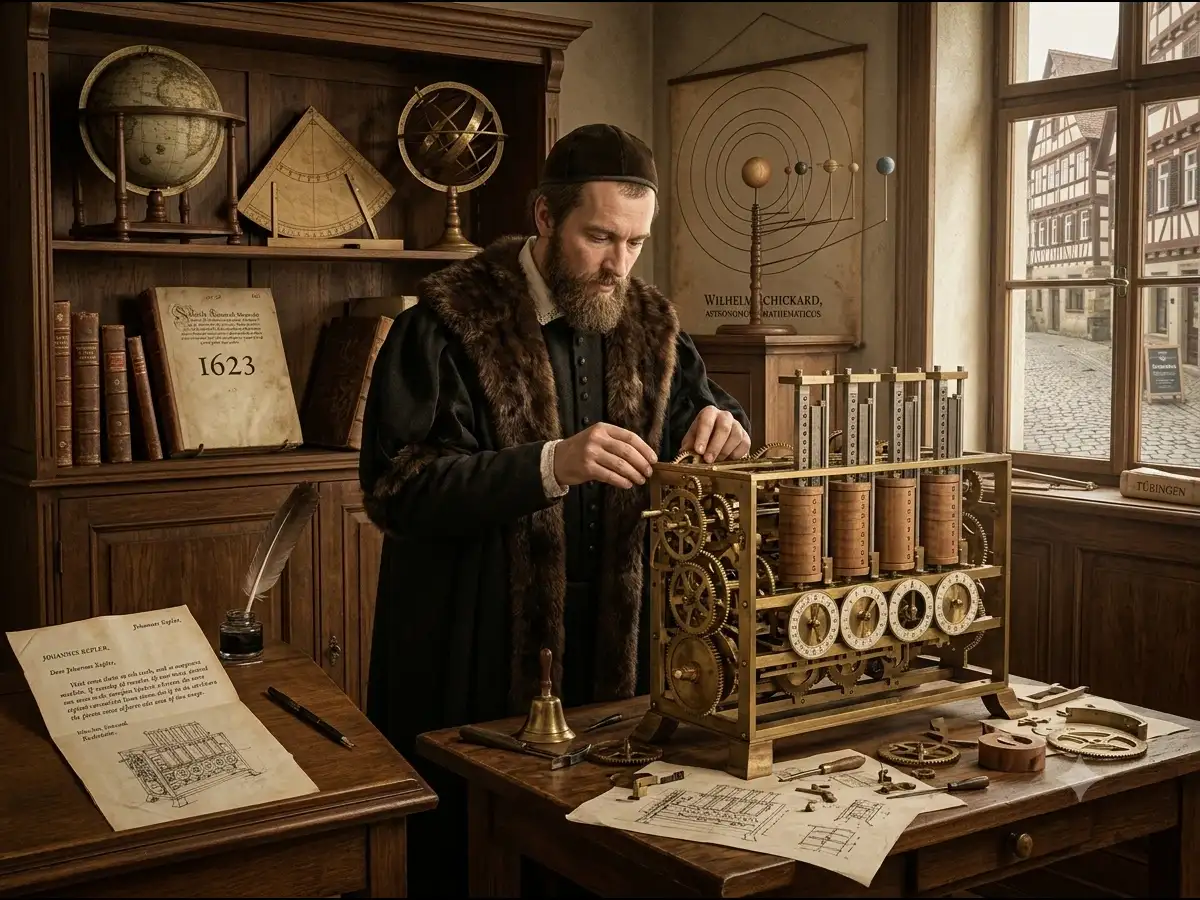
In 1623, a German astronomer invented the earliest known mechanical calculating machine . The inventor was Wilhelm Schickard, a German astronomer, mathematician and cartographer who lived from 1592 to 1635. His device became known as the calculating clock. Schickard designed a machine that combined an adding and subtracting mechanism with a system based on Napier's bones for multiplication and division. He described the machine in letters to Johannes Kepler in 1623 and 1624. The letters later became important in discussions about the history of mechanical calculators. No original machine has survived, but replicas have been made from the surviving drawings and descriptions.
Wilhelm Schickard and his work
Wilhelm Schickard was born on April 22, 1592, in Herrenberg, Württemberg, in what is now Germany. He studied at the University of Tübingen. His education included theology and oriental languages. He received his B.A. in 1609 and his M.A. in 1611. He continued studying at Tübingen until 1613.
In 1613, Schickard became a Lutheran minister. He continued working with the church until 1619. He was then appointed professor of Hebrew at the University of Tübingen. Schickard was involved in several areas of study. He taught Hebrew and Aramaic and worked in astronomy, mathematics and surveying.
In 1631, he became professor of astronomy at the University of Tübingen. His work was not limited to academic teaching. He developed machines for different purposes. One was designed to help calculate astronomical dates. He also worked on Hebrew grammar and contributed to mapmaking. His maps were more accurate than many earlier maps. He was also known as a wood and copperplate engraver.
How the calculating clock was designed?
The calculating clock was designed as a mechanical calculating machine.
The machine had two main sections:
- The lower section was an arithmetic unit for addition and subtraction.
- The upper section contained cylinders for multiplication and division.
- The multiplication and division system worked in a way similar to Napier's bones.
- Six rotating knobs allowed users to enter numbers of up to six places.
- Six vertical dials displayed values used by the addition and subtraction mechanism.
- Counter wheels represented the numbers.
The design brought two calculation methods into one machine. The addition and subtraction mechanism used rotating parts to process numbers. The upper mechanism used cylinders based on the calculating method associated with John Napier. Schickard probably used findings connected to Napier's work when developing his machine. The design is important because it combined an adding machine with a multiplication system in one device.
The letters to Johannes Kepler
The history of the calculating clock became known centuries after Schickard created it. Schickard had communicated with Johannes Kepler, the German mathematician and astronomer. Two letters written by Schickard to Kepler contained drawings and information about the calculating clock. The letters were dated 1623 and 1624.
The drawings became known much later. Franz Hammer, a biographer of Johannes Kepler who worked with Max Caspar, examined the letters in the 20th century. Hammer argued that the drawings showed a calculating machine created about two decades before Blaise Pascal publicly released his calculator.
Because the letters had been unavailable for about three centuries, Hammer argued that Pascal had received credit for inventing the mechanical calculator when Schickard had developed an earlier machine. This claim became part of a debate about who should receive recognition in the history of mechanical calculation.
Why the machine is linked to the history of calculators?
The calculating clock is often described as the first known mechanical calculating machine. It appeared during a period when European scholars were developing devices to assist with mathematical work. Other 17th-century designs followed. These included machines and instruments associated with Blaise Pascal, Tito Burattini, Samuel Morland and René Grillet.
Devices connected with Caspar Schott and other inventors also appeared during the period. However, mechanical calculating machines were not produced in quantity until the middle of the 19th century. This means Schickard's machine was an early design rather than the beginning of mass-produced mechanical calculators. Digital calculating aids existed long before the 17th century. The Romans used the hand abacus for calculations.
What happened to Schickard's original machine?
No original Schickard calculating clock has survived. Researchers have therefore relied on drawings and written descriptions to understand the machine. Replicas have been constructed using the available information. The surviving design shows that the machine was not simply a basic adding device. It combined an adding mechanism with a multiplication and division system.
However, later examination raised questions about whether the machine could work as intended. Research found that Schickard's machine was incomplete. It required additional wheels and springs. Researchers also examined its carrying mechanism. The machine used a single-tooth carry system. This system did not work properly when used in calculating clocks. These findings changed the way some historians viewed the machine.
The debate over the discovery
Hammer's discovery led to the claim that Schickard should be recognised as the inventor of the mechanical calculator before Pascal. Later research provided a more complicated picture. Schickard's drawings had not remained completely unknown after the 17th century. Researchers found that the drawings had been published at least once in each century beginning in 1718.
This weakened the argument that the machine had been completely forgotten for three hundred years. There was also a technical issue. The machine was not complete and its carry mechanism had problems. As a result, historians continue to discuss what should count as a mechanical calculator and how much influence Schickard had on later designs.
How Schickard influenced later machine designs?
Schickard's machine was one of several direct-entry calculating machine designs created during the 17th century. Its design combined two ideas. The first was a system based on Napier's bones for multiplication. The second was an adding machine operated through rotating knobs.
The machine also included a number register. Rotated numbers could be displayed through windows. Later devices followed related approaches. Examples include Samuel Morland's multiplying and adding instruments, Caspar Schott's Cistula, René Grillet's machine arithmétique and Claude Perrault's rhabdologique.
The Bamberger Omega, developed in the early 20th century, has also been discussed in relation to this development path. Historian Taton argued that Schickard's work had no direct impact on the development of mechanical calculators. The debate therefore involves both invention and influence. A machine can be an early design without directly causing later machines to be developed.
Schickard's place in computer history
Schickard has sometimes been called the father of the computer age. The description comes from his work on mechanical calculation and his attempt to build a machine that could assist with mathematical operations. His calculating clock appeared centuries before electronic computers.
The machine could not perform the work of a modern computer. It had no electronic components and was designed for specific mathematical operations. Its importance comes from its place in the development of mechanical calculation. The calculating clock shows how scholars in the 17th century were trying to reduce the amount of manual calculation needed for mathematical and astronomical work.
Schickard's astronomy and mapping work
Schickard's calculating machine was only one part of his scientific work. He worked on astronomy and proposed to Johannes Kepler the development of a mechanical method for calculating ephemerides. Ephemerides are tables or predictions showing the positions of celestial bodies at particular times. His work in astronomy was connected with the need for calculations.
Schickard also worked on surveying and mapmaking. His maps improved accuracy compared with many earlier examples. His interests covered mathematics, languages, astronomy and practical instruments. This range of work reflects the type of scholarship found among scientists of the period.
His final years
Schickard remained active at the University of Tübingen after becoming professor of astronomy in 1631. He continued his academic and scientific work during a period of conflict and disease in Europe. Schickard died in Tübingen in October 1635.
Sources give October 23 or October 24 as his date of death. He died from the bubonic plague. His name was later given to a lunar crater. In 1651, Italian astronomer Giovanni Riccioli named the lunar crater Schickard after him.
Why the calculating clock still matters?
The story of Wilhelm Schickard and his calculating clock shows that the history of computers did not begin with electronic machines. Mechanical calculation developed through a series of ideas and devices. Schickard's 1623 design combined rotating mechanisms, counter wheels and a multiplication system based on Napier's bones. The machine was not produced in quantity and the surviving evidence also shows technical limitations. Still, its design remains part of the history of mechanical calculation.
The letters to Johannes Kepler helped bring Schickard's work into modern historical discussion. They also created a debate about the difference between designing a calculating machine, building a working machine and influencing later inventions. The calculating clock therefore remains significant not only because of its date but also because it shows an early attempt to use mechanical parts for mathematical calculation.
Wilhelm Schickard life
- Wilhelm Schickard was born on April 22, 1592.
- He studied at the University of Tübingen.
- He became a Lutheran minister in 1613.
- He became professor of Hebrew in 1619.
- He became professor of astronomy in 1631.
- He designed the calculating clock in 1623.
- The machine was intended for addition, subtraction, multiplication and division.
- Schickard described the machine in letters to Johannes Kepler.
- No original calculating clock has survived.
- Replicas have been built from the surviving evidence.
- The machine used rotating knobs, counter wheels and cylinders.
- Its multiplication system was based on the principle of Napier's bones.
- Later research found technical problems with its carry mechanism.
- The drawings were published at least once per century from 1718.
- Schickard died from bubonic plague in October 1635.
- Giovanni Riccioli named the lunar crater Schickard in 1651.