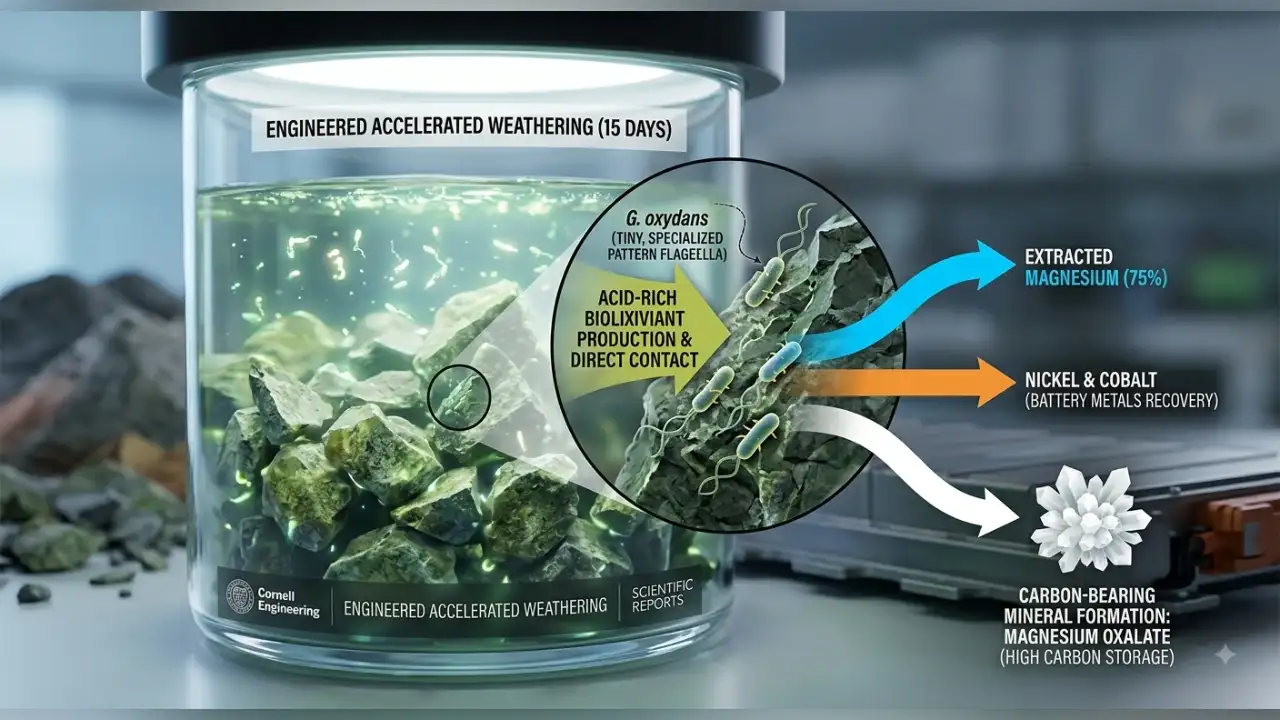
A Cornell-engineered bacterium has shown it can rapidly weather olivine, extracting up to 75% of its magnesium in just 15 days while also releasing nickel and cobalt and producing a carbon-bearing mineral.
The finding could offer a way to combine carbon storage with the recovery of critical metals used in electric vehicle batteries. The research was published on August 5 in Scientific Reports.
The bacterium speeds up a natural process
The researchers worked with an engineered strain of Gluconobacter oxydans, a bacterium known to produce organic acids that can dissolve minerals, as per a Cornell Chronicle report.
Rather than creating a process that does not occur naturally, the team wanted to accelerate weathering that already happens over time.
Olivine is an iron- and magnesium-rich silicate mineral. When rainwater and groundwater slowly break down rocks containing it, magnesium can react with carbon dioxide and form stable carbon-bearing minerals.
The Cornell team engineered G. oxydans to produce an acid-rich biolixiviant and tested its ability to weather ultramafic minerals.
The bacteria extracted most of the magnesium in 15 days
The experiments showed that direct contact between the bacteria and mineral surfaces increased dissolution compared with using only the acidic compounds produced by the microbes.
The researchers found evidence that the bacteria promoted the oxidation of iron in the minerals. This allowed the microbes to keep producing acid and sustain the weathering process for longer.
After 15 days, the engineered strain had extracted up to 75% of the magnesium in the olivine samples. The process also released nickel and cobalt, both important metals for battery manufacturing.
Magnesium oxalate could store carbon
The experiments produced another result that caught the researchers' attention.
Under room-temperature, low-pH conditions, magnesium oxalate formed as the magnesium was released from the mineral. The relatively understudied compound contains carbon and can bind two carbon atoms per magnesium atom.
That gives it twice the theoretical carbon-storage capacity per magnesium atom of magnesite, a more commonly studied magnesium carbonate mineral.
The discovery adds another possible pathway for studying how mineral weathering could contribute to carbon storage.
Mine tailings could be a possible application
The experiments were conducted in laboratory flasks, but the researchers see potential for using the process on ultramafic mine tailings.
Because these mining wastes have already been crushed into fine particles, they could be suitable for accelerated weathering. They could also provide a source for recovering remaining critical minerals while storing carbon.
Senior author Esteban Gazel said, “By coupling carbon sequestration with the extraction of valuable battery metals, this approach has the potential to improve the economics of large-scale carbon removal by targeting unconventional sources,” as quoted by Cornell Chronicle.
More research is needed before scaling up
The researchers say the approach is still at the experimental stage.
Future work will examine how to increase the amount of magnesium converted into magnesium oxalate, identify lower-cost materials for growing the bacteria and determine how stable the mineral remains as a form of carbon storage.
The team also plans to study in greater detail how the engineered bacteria interact with rock surfaces during weathering.
For now, the Cornell experiments show that an engineered microbe can accelerate the breakdown of olivine while producing several potentially useful outcomes: recovering magnesium, releasing nickel and cobalt, and forming magnesium oxalate under laboratory conditions.