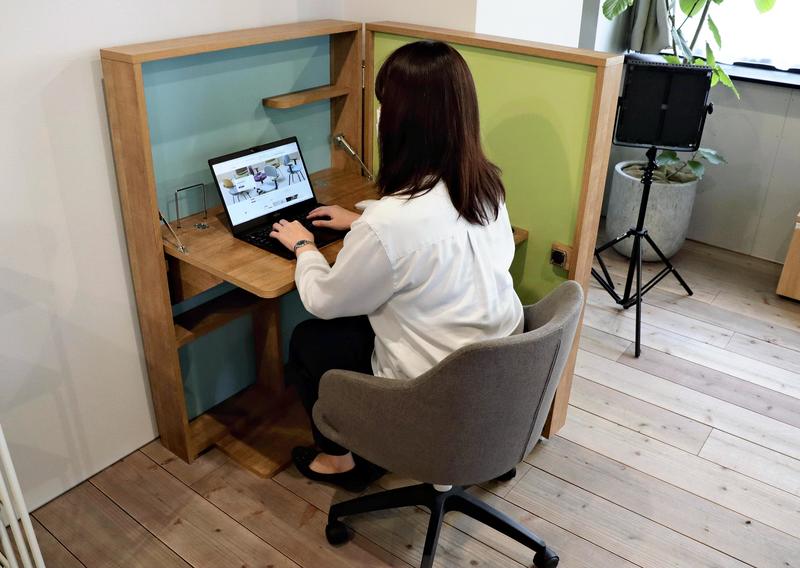
The declaration of a state of emergency by the government gave impetus to the rapid spread of telework in Japan. According to a survey of companies in Tokyo conducted by the Tokyo metropolitan government, 62.7% of them introduced telework as of April, up 2.6 times from the previous month. What is the actual situation? A survey released by the Japan Productivity Center is likely to provide some clues.
The survey was conducted between May 11 and 13 on 1100 employees nationwide. More than 60% of those who have experienced teleworking said positively, "I want to do telework even after the infection has settled down." However, regarding efficiency in labor productivity, just over 30% of respondents felt that efficiency had increased -- with 41.4% saying it was "slightly-down" and 24.8% saying "down," accounting for the majority.
The top issues were "Online sharing of materials and data can only be viewed at the office," "communication environment" and "home environment." From this, it seems that there are a lot of materials that cannot be taken home, or that children make noise and create distractions at home. Because the declaration was sudden, companies were not able to sort out tasks to be covered by telework, and the preparation of telecommunications equipment was insufficient. Some companies have continued teleworking even after the declaration was lifted, but if it does not contribute to the improvement of productivity, it is unlikely that teleworking will spread further.
The underlying problem is the low productivity of Japanese companies compared to those overseas. Since the late 1990s, Japan has lagged behind the United States and Europe in the introduction of information and communications technology (ICT).
"Foreign companies use ICT to help individuals generate results based on free thinking. In Japan, where there is a deep-rooted corporate culture that places importance on working hours, there are many companies that cannot get out of the idea of binding people through ICT even in telework," said Yasuhiro Kiuchi, senior researcher at the Japan Productivity Center. It seems a fundamental rethinking of Japan's work culture is needed.
The study also asked about possible changes after the pandemic has calmed down. Thirty percent of the respondents answered "migration from the city to the countryside" is "likely" or "more likely to happen," while 70% answered negatively.
A government survey conducted in January showed that half of the people living in the Tokyo metropolitan area were interested in living in the countryside. And with the government encouraging people to work from home and people actually embracing telework -- where people can choose where they want to work from -- it is not surprising that people would opt to move to rural areas instead of remaining crowded cities.
"As rural areas were closed to people coming and going from heavily infected urban areas, the division between them created a barrier to local migration" said Meiji University Prof. Tokumi Odagiri, an expert on regional revitalization. If teleworking reduces the frequency of commuting, it is possible that the option of living in the suburbs of cities has emerged as a more attractive alternative.
How will telework spread and change society? It will be a litmus test for post-corona.
Read more from The Japan News at https://japannews.yomiuri.co.jp/






.jpg?w=600)