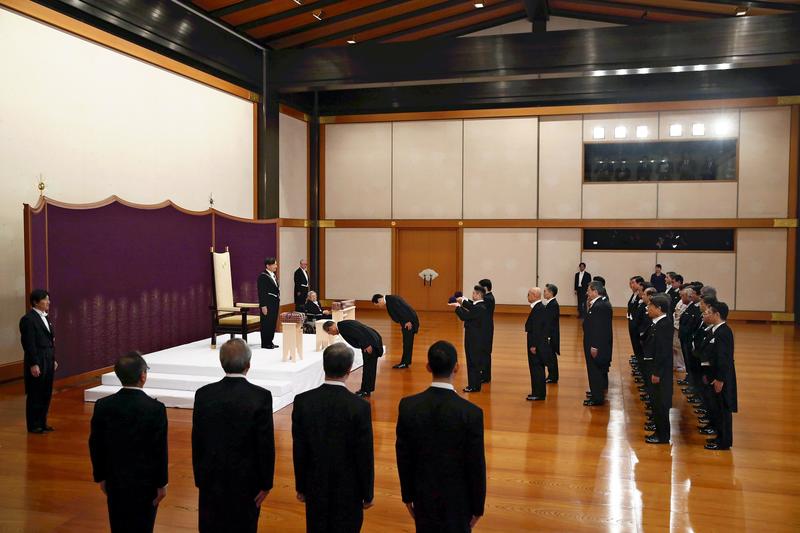
The government will start considering ways to ensure a stable line of succession to the throne from this autumn or later, after the ceremonies related to the new Emperor's ascension to the throne wind down.
The move has been prompted by concerns that the continuation of the Imperial system could be jeopardized if the number of Imperial family members eligible to be heirs to the throne continues to decline.
"There are various ideas and opinions on this matter, but proper analysis and consideration will be needed to gain a public consensus," Chief Cabinet Secretary Yoshihide Suga said at a press conference after an extraordinary Cabinet meeting Wednesday.
The government is also contemplating establishing an expert panel to carefully advance discussions on methods for ensuring a stable line of succession.
The Imperial House Law stipulates a "male offspring in the male line" shall succeed to the Imperial throne. This restricts potential heirs to sons of the emperor, and males in the line of the sons. At present, only three members of the Imperial family can succeed to the throne -- in order, they are Crown Prince Akishino, 53; Prince Hisahito, 12; and Prince Hitachi, 83.
There are few options available to stabilize the line of Imperial succession.
In the past, the cabinets of former Prime Ministers Junichiro Koizumi and Yoshihiko Noda, the latter of whom was in power during the Democratic Party of Japan-led government, considered options such as allowing a female emperor or a female-line emperor, and restoring membership in the Imperial family to male-line males of the former branches of the Imperial family that relinquished their status after World War II.
Allowing a female-line emperor would also require recognizing the eligibility of descendants of a female emperor to succeed the throne. However, there are no historical examples of such an emperor, and opposition to such a move remains strong among conservative members of the ruling Liberal Democratic Party and elsewhere.
Suga alluded to this at Wednesday's press conference, saying, "This matter must be carefully and cautiously considered, given the gravity of the fact that male-line succession has been maintained without exception since ancient times."
In 2012, Prime Minister Shinzo Abe, who was in the opposition bloc at the time, wrote an article for a monthly magazine in which he expressed a negative view toward allowing emperors of female lineage and touted allowing members of the former male-line branches to regain their Imperial family membership.
The government would need to address the issue of how to gain public understanding for making people, who have lived as ordinary private citizens for many years after the war, members of the Imperial family. It is said that some of these former branch members are reluctant to return to the Imperial family's ranks.
CDPJ eyes female succession
The opposition Constitutional Democratic Party of Japan's panel to consider stable Imperial succession plans to release by early June a summary of its document, which would propose allowing a female emperor or an emperor of female lineage.
Attempts to gain support from the LDP and some other parties for this proposal appear doomed to fail, and discussions in the Diet are expected to face many bumps.
"Reaching an agreement between the ruling and opposition parties will be difficult, and any talks will not make progress while Prince Hisahito is still so young," a senior government official said.
In addition to measures for ensuring stable Imperial succession, the government is also coming under pressure to devise ways to reduce the burden of official duties shouldered by the Imperial family. As the number of Imperial family members dwindles, there are concerns the family could be bogged down by these activities.
Consideration had been given to establishing a female-headed branch, which would allow women to remain members of the Imperial family even after they marry commoners.
However, deep-rooted concerns about this step remain within the LDP. "That could be the opening move toward realizing an emperor of female lineage in the future," a conservative LDP lawmaker said.
Read more from The Japan News at https://japannews.yomiuri.co.jp/