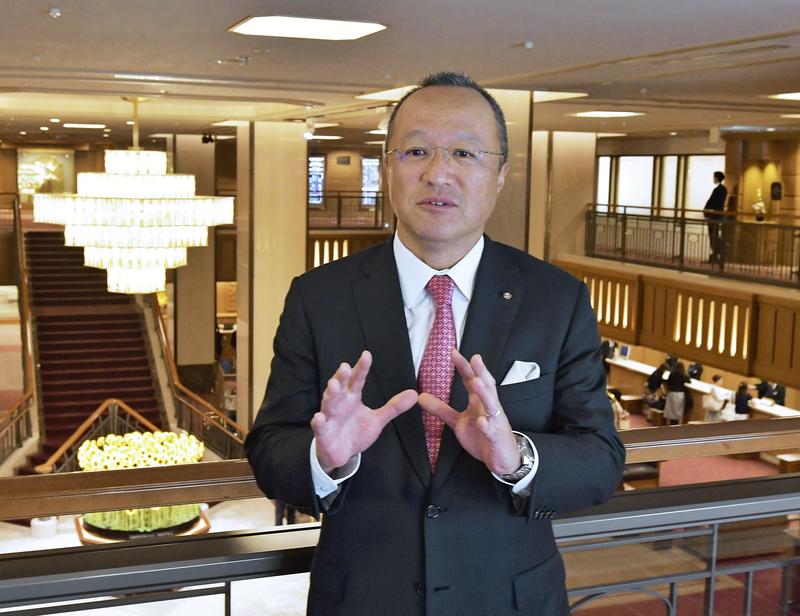
Amid the excitement over rising inbound tourism, competition in the hotel industry is intensifying. How does Imperial Hotel, Ltd., one of Japan's most prominent and venerable establishments, intend to win? For this installment of Leaders, a column featuring corporate management and senior executives, The Yomiuri Shimbun spoke with President Hideya Sadayasu.
The hotel industry is booming at the moment. Favorable conditions prevail for the first time in a while, with positive factors including the government's relaxation of visa requirements for other Asian countries, a weak yen, and the upcoming 2020 Tokyo Olympics and Paralympics.
The year 2019 will be packed with major events, including the rugby World Cup, a summit meeting of the Group of 20 major countries and regions in Osaka, and the Sokui-no-Rei enthronement ceremony, which will bring many foreign VIPs to Japan.
However, the true test of hotels' mettle will likely come after the Olympics have ended. How can we make the step from the Olympics to 2021 and beyond?
We want to provide service one can only experience by coming to Japan, so that when foreign guests return home, they will say: "That was wonderful. Let's go again sometime." We hope this will create a cycle in which they will tell their families, relatives, and friends about the attractions of Japan.
[The first chairman of the Imperial Hotel, which opened for business in 1890, was the entrepreneur Eiichi Shibusawa, called the father of the modern Japanese economy.]
In those days, Eiichi Shibusawa told his employees: "Accommodating guests from various countries with various customs is very hard work. However, this work is important for the country, because if you devote yourself conscientiously, we ensure that they will remember Japan fondly for the rest of their lives after they return home. Please do your best."
He said this in the Meiji period, but it still applies today. This year marks the 150th anniversary of the Meiji Restoration. The Imperial Hotel was born as Japan's VIP guest house amid the Meiji government's movement closer to the West and promotion of modernization. We must recall Shibusawa's words once more.
A favorable wind is blowing, but we are also exposed to competition from foreign-owned hotels that are entering Japan one after another. The strength of foreign brands lies in their international name recognition and the conveniences only chain hotels can offer, such as point rewards for customers. The facilities are also new and stylish, and there is no secret way to compete against that.
However, new hotels mainly draw experienced staff from numerous other hotels, so it is not easy for them to provide service that has a sense of consistency. Our company teaches principles and hospitality handed down for nearly 130 years to our employees from the start. I believe that this is our forte, and it is not something easily imitated.
A second home for guests
As well as foreign guests, domestic guests are also important. I think foreign-owned hotels have a higher proportion of foreign guests, but for the Imperial Hotel Tokyo, half of the more than 400,000 guests annually are domestic customers, a fact that has remained unchanged over many years.
[The Imperial Club membership group for guests has around 54,000 members in Japan.]
In the main, they are influential people from every field, such as company owners, doctors, lawyers and so on. They will bring their whole families to stay for anniversaries, and hold banquets and parties. Our business aimed at these guests is extremely stable.
In the immediate aftermath of the Great East Japan Earthquake in March 2011, the number of guests from overseas plummeted, and the guest room occupancy rate fell to around 40 percent in April and May. However, from summer onward, the recovery among these domestic repeat customers was quick. They always come back to us.
To keep this up, meticulous service is essential. Guests who stay with us regularly often request to stay in the same room. They have their own preferences, such as which bed they use if staying alone, how many pillows they want, or whether they need extra towels. Every time they stay, we amass data. We welcome them as though this was their second home. This we will continue to do.
Our company has a saying which has been passed down through the years: "100 minus 1 equals zero." This means that in hotel work, if one thing does not meet expectations in a given area, then everything will be a disappointment, and it all comes to nothing. It is important to have a positive sense of tension, and a sentiment that all departments will work together to welcome guests.
We also have an ongoing promotional campaign called "Sasuga Imperial Hotel." Every month, we recognize incidents praised by customers and the like. There is also a yearly grand prize voted on by all employees.
I will give some recent examples. There was a guest who took a taxi from the hotel, and forgot their luggage in the car. They consulted us because they did not get a receipt, and so did not know which taxi company it was. A veteran doorman had the idea to check details related to departure. Based on the departure time, it was possible to track down the taxi successfully, and the luggage was quickly returned.
In the restaurants, the staff was approached by a guest who had lost their mother the previous year, and wanted to have a memorial during their meal on this Mother's Day. A place was set at the table for the mother, and food and drink were also prepared and served. The guest was deeply moved, saying, "It is not just that I stay here when I come to Tokyo, I want to come to Tokyo in order to stay here."
Sharing information like this can provide food for thought, and receiving an award also boosts motivation. We will continue to esteem diligent efforts like these.
Service quality has priority
My father worked for an airline, so as a child, I experienced life in places like West Germany and Hong Kong. On a temporary trip back to Japan, we stayed at the Imperial Hotel. The lobby was imposing, and had a crisp, orderly atmosphere. It left a strong impression on me. That is what prompted me to take a job here.
During my training after joining the company, I rotated through many different jobs, from waiter, to housekeeper, to bellman. Once, working in the restaurant, I could not get the wine corks to come out, and I failed on three bottles in a row. I was wearing my trainee badge, so the American guest patted me on the shoulder and said, "You can do it!" There were also times when it took me almost an hour to clean a guest room.
My experience on the job is a major asset now that I am president. Make preparations, welcome the guests, and have them enjoy the service. That is the foundation of everything. Even now, employees in the comprehensive course spend 18 months devoted wholly to on-the-job training.
[As the Japanese population begins to shrink, a growing number of major Japanese hotels are expanding overseas.]
I do not know what the future holds, but at the moment, our company has no intention of going overseas to grow our business. This is because it is difficult to guarantee the quality of service there. Maintaining and improving the quality of service we have cultivated over many years is most important, and expanding the business comes second. We want to continue to fulfill our role as Japan's guest house to the best of our abilities.
The word "hospitality" became a buzzword for a time, but what is it? Even I, a hotelman of more than 30 years, still have not found the answer. If I had to say, I think it is that the best path is to do the essentials things as a matter of course, and emphasize the fundamentals.
-- Hideya Sadayasu / President of Imperial Hotel, Ltd.
Born in 1961. Native of Tokyo. Joined Imperial Hotel Ltd. after graduating from the Gakushuin University Faculty of Economics in 1984. Gained experience in a wide range of departments, including banquets, sales and the Los Angeles liaison office. While in charge of sales in the United States, increased the number of guests from the United States by roughly 20 percent. Became general manager of Imperial Hotel Tokyo and executive director of the company in 2009, followed by senior managing director in 2012, assuming his current post in April 2013.
-- KEY NUMBERS
1890
The hotel opened for business in 1890 as a guest house to receive foreign dignitaries at the behest of the Meiji government. The former main building was designed by the famed American architect Frank Lloyd Wright. The current main building is the third to be constructed. There are hotels under its direct management in Osaka as well as in Kamikochi in Matsumoto, Nagano Prefecture. The consolidated results for March 2018 reported sales of 57.2 billion yen. It had 1,983 employees as of the end of March 2018.
Read more from The Japan News at https://japannews.yomiuri.co.jp/