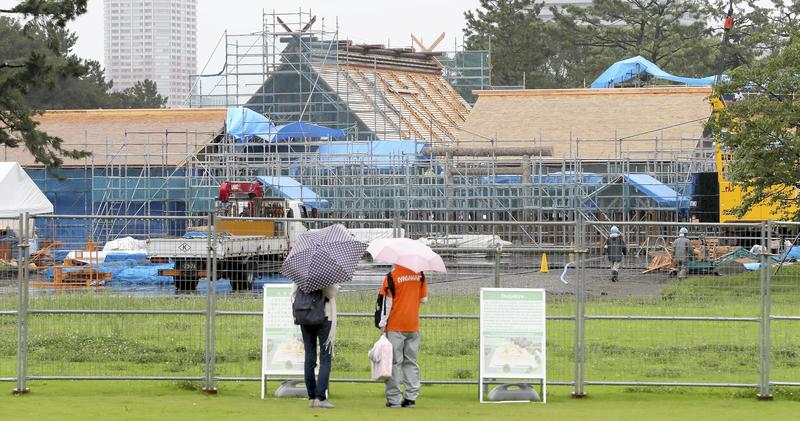
Construction of the Daijokyu (see below) temporary hall for the Daijosai -- a rite of offering new rice, which is to be held on Nov. 14-15, after the enthronement ceremony for the Emperor -- is proceeding rapidly at the East Gardens of the Imperial Palace.
The Imperial Household Agency did not reveal the construction site for the previous Daijokyu 29 years ago, but it has changed its policy this time for the sake of boosting tourism and interest among the public.
Expert shrine carpenters
The construction site is a few hundred meters west of Tokyo's Otemachi skyscraper district, with wooden structures gradually taking shape on what is usually a grassy area in the Honmaru area of the East Gardens.
"We gathered craftsmen from all over the country to complete it in a short period of time," a senior agency official said.
Construction began in earnest after a ground-breaking ceremony July 26. The goal is to finish by the end of October. The project requires about 40 structures to be built in just three months. Building the three main structures involves traditional techniques, such as using logs with the bark still attached.
Contractor Shimizu Corp. brought in about 120 expert carpenters for shrines and temples from the Kanto, Tohoku and other regions to work under a foreman who was involved in repairing the Izumo Taisha shrine in Shimane Prefecture.
Peeking through the fence
Visitors to the East Gardens can observe the progress of the construction. "Seeing the structure under construction is exciting," said a 54-year-old self-employed woman from Setagaya Ward, Tokyo, who was at the gardens with a friend on Sept. 18.
The difference between the current and the 1990 Daijosai is striking. The previous Daijosai ceremony was marred by activities by radical guerrilla groups opposed to the accession ceremony -- a number of terrorist incidents occurred around the country, including mortar launches and arson.
The East Gardens were completely closed during the construction of the Daijokyu, and the three main structures were covered with special protective tents that could repel mortars. The names of the five contractors that took part in the project were not disclosed, and workers entered and exited the site in vehicles bearing the name of a fake company.
Due to improved public safety and other factors, the agency has limited the area of restricted access in the East Gardens to only part of the Honmaru area where the Daijokyu is being built.
The agency is actively seeking publicity, taking such steps as setting up panels with pictures near the fence around the site explaining the building of the Daijokyu and other matters to visitors. Construction will be visible from the Honmaru area until around the end of October, it said.
Foreign tourists
Tourism is another reason for the agency's change in policy. About 390,000 people visited the East Gardens in 1989, but more than four times that number -- about 1.65 million -- came last year. Foreign tourists made up more than 40 percent of the 2018 visitors.
And with construction using a massive amount of taxpayer money, the agency is also seeking to win public understanding for the endeavor. Construction is expected to cost 957 million yen. Because the Daijosai is a secret ceremony, the inside of the main structure will not be made public and the Daijokyu will be dismantled after the ceremony.
"The ceremony is not something most people are familiar with, but I hope by viewing the construction they can understand the significance of the Emperor's praying for abundant harvests," a senior agency official said.
Arashi to perform
A festival celebrating the Emperor's accession will be held Nov. 9 in the square in front of the Imperial Palace, civic groups putting on the event announced Tuesday. The popular idol group Arashi is planning on performing a congratulatory song at the event, which about 60,000 people are expected to attend.
The event is being organized by three groups, including a nonpartisan association of Diet members. The first part of the event, a "celebration festival," will be a parade involving the Metropolitan Police Department band and others. In the second part, a "congratulatory ceremony," Prime Minister Shinzo Abe and other important figures will give congratulatory remarks.
Arashi is to perform alongside the blind pianist Nobuyuki Tsujii.
-- Daijokyu
A ceremonial site where a new emperor performs the important rite of Daijosai. Emperors perform this rite only once in their reign, making offerings of new rice to the gods and praying for peace and abundant harvests for the nation and the people. About 40 wooden structures are built on the site.
Read more from The Japan News at https://japannews.yomiuri.co.jp/