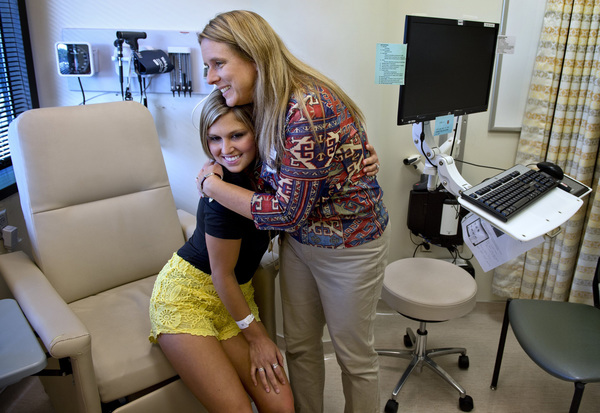
KANSAS CITY, Mo. _ Last Friday was Rebecca Hertzog Burns' birthday. She turned 2. She says that's her age, though she's really 27. After a relapse in her fight with acute myelogenous leukemia, Burns received a stem cell transplant on Sept. 9, 2014, through an infusion of umbilical cord blood from a baby boy.
By her way of thinking, she and her immune system were reborn that day. "My new birthday," says Burns, who has been in remission since.
The treatment she received at the University of Kansas Hospital falls within a broad spectrum of care called immunotherapy. It is the hot topic, the "it" word, in addressing cancer. While doctors report success combating several types of cancer through different versions of immunotherapy, KU clinicians say some of the most remarkable stories arise in the treatment of blood cancers.
Deadly forms of leukemia and lymphoma, which commonly strike young adults such as Burns, are now managed, and in many cases vanquished, using treatments unavailable just a few years ago.
"In 26 years of practice, this is absolutely the most optimistic I've ever been," said Joseph McGuirk, medical director of KU's blood and marrow transplant program. Patients from around the world travel here to take part in experimental trials.
"It's not hyperbole at all to say we're in the middle of a revolution in cancer therapy," he added.
The idea behind immunotherapy is to coax a patient's own body to attack cancer cells. The way of doing that _ in short, by harnessing the immune system to do the work that cancers don't let it do _ differs from patient to patient, from cancer to cancer.
For former President Jimmy Carter, suffering from an advanced melanoma that many thought would kill him, the key may have been a "checkpoint inhibitor" drug with the brand name Keytruda.
Carter last year stunned the globe when he announced that his immunotherapy treatment, combined with radiation and surgery, eradicated tumors that had developed in his brain and liver.
Immunotherapy isn't new, but it's getting a lot of attention now for a reason, said McGuirk, a soft-spoken physician reluctant to trumpet medical breakthroughs before they've been proven to work.
"We've reached this critical mass where, kaboom, all of sudden (immunotherapy) has taken off like a rocket," he said.
National news media are jumping aboard, largely because of Carter's success. The U.S. government and drug companies pour billions of dollars into research, and clinical trials underway at KU and hundreds of other facilities have produced strong data.
By itself or in combination with other treatments, immunotherapy is being credited for putting some terminal cancer patients _ but far from all _ in remissions that can last for years.
Some of the drugs being developed block a mechanism, the immune checkpoint, that cancer exploits to keep the immune system at bay. Other treatments remove from patients millions of disease-fighting cells, reconfigure them in a lab and infuse them back into their sick owners.
The hope is for these so-called T-cells to do the job they're meant to do.
KU clinicians credit immunotherapy as one of the treatment paths that has allowed more blood-cancer patients to enjoy extensive remissions than ever seen before. The final blow to their disease is often an allogeneic stem cell transplant, which can rebuild the immune system from scratch.
Still, many patients don't respond to these treatments.
For them, conventional steps such as chemotherapy and radiation remain potential lifesavers. But in those treatments' quest to attack all cells they can get, and not only cancer cells, their side effects usually are much harsher than immunotherapy's.
Others warn that too much hype around immunotherapy could steal attention and funding from those more traditional strategies and other promising treatments.
"Through the history of oncology, there are periods in which something gets really hot and everyone gets excited that it's the answer," said Otis Brawley, chief medical officer for the American Cancer Society.
"The immunotherapy treatments being developed are here to stay. But I worry about research and money shifting away from other approaches."
The Kansas City Star chose to look at immunotherapy _ and tell a story of hope _ through the lives that converge on the third floor of the Richard and Annette Bloch Cancer Care Pavilion in Westwood.
It's where McGuirk works with blood-cancer outpatients. Many of them, running out of options, have joined clinical trials that made them immunotherapy test cases.
None of the patients in this story is out of the woods. But at least their bodies are fighting.