There are three compelling arguments in favour of maintaining the fundamental principle of EU freedom of movement. First, a people-inflow satisfies short-term demand in an imperfect labour market, and offers a long-term solution to the actuarial uncertainties of an ageing population. Second, a people-outflow allows the opportunity for personal growth and a broader choice over quality of life. Third, a people-interflow broadens mutual understanding.
If these economic and cultural arguments are passionately articulated by our professional politicians, there is no rational, graceful counter-argument. So when John Harris panders to Ukip (Don’t dismiss public fear of migration as mere bigotry and prejudice, 22 October), he bridges the faultline that separates those supporting the principle of EU solidarity and those against.
Surely, if populism defeats our own political principles, it is primarily because our own politicians and own party manifestos seek to follow, rather than shape, such opinion. And it does not matter if John Harris presents a splinter argument that the “modern left” should challenge freedom of movement on the grounds that it primarily benefits “laissez-faire” capital. In the real world of party politics, he is presenting an invalid argument.
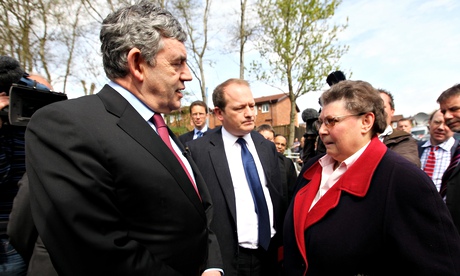
Remember, during the last election campaign Gordon Brown was publicly vilified for instinctively associating fears over immigration with “bigotry”. His judgment then, albeit insensitive, was intellectually reductive: we perhaps need to translate Gordon’s clunking instinct for fairness and decencies into a new, logical and more persuasive narrative.
Mike Allott
Chandlers Ford, Hampshire
• John Harris is correct. Debates about cheap labour practices cant just be left to the opportunist “right”. Neoliberal immigration – particularly from outside the EU – is very different from previous manifestations of the phenomenon. My father’s generation’s arrival here from the Caribbean and the rest of the black Commonwealth was partly an apology for the many evils of imperialism and partly a thank-you for the massive war effort of Britain’s colonies. The work they and the Irish did here was – under near-socialist conditions – either contributing to nationalised, not-for-profit public services in education, health, transport and natural monopoly energy utilities and/or sharing in their communal bounty.
That’s very different to being brought here to force down labour costs for foreign tax-dodging corporations. This raises the question: why are migrants coming here? Often it is either because their home countries are impoverished as a legacy of imperialism and/or because tax-dodging western corporations are not allowing them to keep and use the wealth their own labour power generates. Tellingly, some immigrants are even arriving from countries where, in order to subvert our employment standards, western corporations have exported British jobs.
Neoliberal immigration is an aspect of globalisation. It involves the exploitation of immigrant workers, their home countries, British workers and ultimately the planet. Astoundingly, in an era when the west fights “wars for oil”, its environmental footprint – like the global movement of goods – is not even properly costed.
Dr Gavin Lewis
Manchester
• John Harris points out fears about free migration in towns like Wisbech, where east European immigrants are living five to a room and working long hours. He says that current polling shows 46% of UK people opposed to free movement of labour in the EU. It would be interesting to see the equivalent figures for those who oppose unscrupulous employers who pay way below the minimum wage, or greedy landlords who profit from overcrowding. Where I live, in one of the poorest London boroughs, we experience large-scale migration from the EU and beyond. Left concerns here, even “fashionable metropolitan” ones, tend to be about too little money spent on overcrowded health and education services, and the privatisation of housing, which is helping the greedy landlords. Surely we should be targeting them, and not poor people from abroad?
Lindsey German
London
• John Harris rightly suggests that the current Brownite leadership of the Labour party is incapable of viewing migration or any other issue from the point of view of labour rather than capital. Nor are they likely to change, since their internal battle with continuity Blairites is merely one for control of the machine, not the agenda.
But it’s not true to say that they don’t get it. Like other neoliberals, they know exactly what’s at stake. As Jean-Claude Juncker told the BBC, “[if] we change rules on freedom of movement today, tomorrow others will try to change freedom of movement of capital”.
The point the left needs to make to those cut adrift by Labour is that controls on migration would be useless without controls on capital. Get that across – which will have banker Farage spluttering into his pint – and we can follow up later with the point that controls on migration are redundant if capital is properly disciplined.
Dr Julian Wells
Principal lecturer in economics, Kingston University
• The key phrase in John Harris’s insightful piece on EU migration refers to the “laissez-faire conditions” under which it operates. Traditionally, the left’s response to the importation of cheap labour has been to address the imbalance of power through trade union or regulatory pressure on wage rates and labour conditions. This is still the best approach – though, given the enfeebled state of the labour movement (including the Labour party), action on regulation seems more feasible in the short term than increased union power.
At the same time, there is surely a missing element in the EU model of free movement. In any quasi-federal system, free movement of labour should go along with a capacity for financial transfers designed to help with social costs that arise (housing, education, healthcare etc). This could be funded by a levy on the capitalist interests that benefit from the movements – in the case of East Anglia, large food processors and supermarkets.
Richard Middleton
Castle Douglas, Dumfries and Galloway
• At last, a piece on immigration that does not patronise the readers. I’ve had enough of those who repeat that “immigrants contribute more to the economy than they take out”. But of course they do; it is not a special characteristic of immigrants. Anyone who works contributes more to the economy than he or she takes out, and there are more than a million workers in the UK who will jump at the chance of being able to contribute to the economy more than they get out, if only they can get a job. As for the argument that immigrants do the jobs that British workers do not want, apart from its racist undertones associating immigrants with menial, low-paid jobs, the solution is simple: pay those who do these “menial” jobs, be they fruit pickers or office cleaners, £10, £15 or £20 an hour and there would never be a shortage of takers.
Fawzi Ibrahim
London
• Perhaps I should be honoured that you devote an editorial (23 October) to attacking the recent announcement of my peerage. It certainly marks a change in your editorial policy, which for 13 years appears to have been to avoid any mention of MigrationWatch.
Despite your boycott, often mimicked by parts of the BBC, our reputation has grown steadily. Of course we accept that a modern dynamic economy benefits from properly managed migration and that the UK is no exception. The issues are about who and how many. By sticking to a factual approach we have, as has often been remarked, made it possible for immigration to be discussed in public without people any longer feeling deterred by false accusations of racism. Given its importance for the future of our society, many would regard that as a significant public service.
On your specific points, I should make it clear that I would not have accepted a party whip as I am not, and never have been, a member of any political party. I think I should also make it known that I was first sounded out about a peerage for public service last January – long before Ukip had acquired their present prominence.
The delay, I understand, was to permit a widening of the criteria to “encompass a range of individuals with a proven track record of public service, not solely public servants on retirement”. The number has remained limited to 10 in any one parliament.
Andrew Green
Chairman, MigrationWatch UK