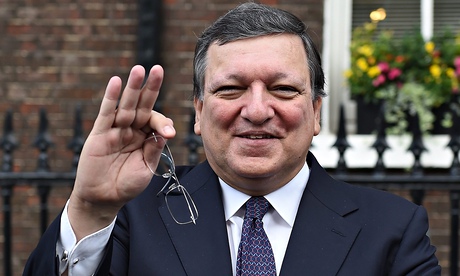
The European commission president, José Manuel Barroso, is right to warn that those in favour of the European Union must not expect by default to carry the day, nor should they leave presenting the positive case for EU until the last moment in a spirit of panic, as happened in Scotland (Report, 20 October).
He might also reflect that the Better Together campaign in Scotland wasn’t able to halt the significant momentum generated by the exit lobby. That only happened by external intervention: the belated acknowledgement by those outside Scotland of the core separatist concerns, irritations and resentments, together with a degree of humility in the face of a large democratic groundswell, all sweetened by the offering of substantial, significant and credible concessions. David Cameron is simply not in a position to offer these in respect of Europe, any more than Alistair Darling was in respect of Scotland.
The tone of Mr Barosso’s intervention will have a wearily familiar ring to it for those who followed the Better Together pronouncements in the early days. If lessons are indeed to be learned from the Scottish referendum, those in Brussels and Strasbourg have at least as much to reflect on as folk in London or Edinburgh.
Rev Jonathan Jennings
Gillingham, Kent
• You report that Nigel Farage welcomes José Manuel Barroso’s comments on the free movement of people within the EU because they show clearly that David Cameron’s objectives are unachievable. It seems to me, however, that Barroso’s comments are just as problematical for Ukip. Barroso was not just talking about the rules of the EU but about the rules of the single market (the “four freedoms” of movement of goods, services, capital and people). Countries currently outside the EU that participate in the single market (Norway and Switzerland) have to accept the free movement of people – as Barroso says, this is absolutely fundamental. Ukip’s position, however, is that the UK could leave the EU, continue to participate in a free market and at the same time refuse to accept the free movement of people. Barroso tells us this is just as impossible outside the EU as it is within.
Michael Matthews
London
• David Cameron’s demand for a halt to the free flow of EU migrants will wrongfoot both Labour and the Greens. The way out of this electoral trap is for these non-market-fundamentalist parties, who nevertheless support Europe’s free flow of people, to change course. They should make an end to uncontrollable EU immigration central to their manifestos, not because of Ukip but to show that they are truly democratic, that they want to lessen the strain on public services and to burnish their internationalist credentials.
Democratic, because all polls show that the majority of people want to see the flow of immigrants to the UK adequately controlled. The UK’s population is projected to increase by 10 million in the next 25 years. Failure to see these population pressures as making it much harder to tackle social problems insults voters’ intelligence. Finally, the present EU open borders policy is the opposite of internationalism. Romania has in recent years lost a third of its doctors to richer EU countries, and our hospitals scour poor EU countries to fill the gap in our inadequately resourced NHS.
Colin Hines
Twickenham, Middlesex
• The claim that migrants are net contributors to the public purse is demography’s equivalent of off-balance-sheet financing, for today’s young migrants will become tomorrow’s old and infirm (Editorial, 17 October). A similar claim that newcomers will do society’s menial jobs is like a Ponzi scheme, for increasing numbers of unskilled immigrants will be needed as the offspring of today’s unskilled immigrants shun menial jobs offering less than a living wage.
Then there is the claim that national debt will become unmanageable without mass immigration, yet the recent ballooning of national debt coincided with an unprecedented influx of migrants.
It was morally wrong to import cheap labour with the aim of driving down unskilled wages. Reversing the process by controlling immigration from within an ever-expanding EU will result in a transfer of purchasing power from the haves to the have-nots, as menial jobs that cannot be outsourced abroad become more costly. This is a small price to pay for anyone concerned about national cohesiveness and a living wage.
Yugo Kovach
Winterborne Houghton, Dorset
• Your otherwise admirably balanced editorial column overlooks one of the wider implications of immigration for the UK – that of food security. England was already one of the most densely populated countries in the developed world before the arrival of large numbers of European immigrants. The increase in the number of people and the diminishing supply of agricultural land means that our dependence on food imports is growing. This makes us vulnerable to the vagaries of international commodity markets, a situation exacerbated by the growth in world population and the adoption of western dietary habits by recently industrialised countries such as China and India. The laws of supply and demand indicate that the cost of food imports will inevitably rise, with possible ramifications for social cohesion. And in the event of future international instability our supply of imported food could be threatened altogether, with wholly unpredictable consequences. Policymakers need to embark on strategy to limit the UK’s population and increase the supply of agricultural land. The first step is to regain control of who can enter the country by withdrawing from the EU.
Terence Glover
Chalfont St Giles, Buckinghamshire
• The free movement of labour made sense when the EU membership was restricted to the west European countries. Would Poland, Bulgaria and Romania have joined if there was no free movement of labour option available? Would Ukraine, Georgia and Moldavia, which recently signed on the dotted line, still be interested if the clause pertaining to free movement of labour was removed from the Lisbon treaty?
Randhir Singh Bains
Gants Hill, Essex
• Citizens of EU countries are entitled to each others’ social systems when living and working there. We all have some sort of national insurance that people pay into in their countries and this entitles us to use theirs and them to use ours. Admittedly, what is available varies according to the wealth of the country, but Holland, Sweden and France, for instance, have more generous systems than ours. We should not blame immigrants for the fact that successive British governments for the past 30 years have failed socially on many fronts, particularly housing.
Katerina Porter
London
• There are estimated to be up to two million UK citizens living in the EU but outside UK. It is reasonable to assume that if the UK leaves the EU, the position of these citizens will be adversely affected. As a minimum, by loss of access to healthcare, and perhaps through difficulty in obtaining work permits, and even elderly people needing to repatriate.
Martin Ray
Banbury, Oxfordshire
• If fruit pickers from Romania are not to be allowed to work in the UK (Conservative backs Ukip view, 17 October), who will pick the fruit? British workers certainly don’t and won’t.
Charles Foster
Chalfont St Peter, Buckinghamshire