Since Sam Paredes crossed into the U.S. illegally from Mexico nearly 30 years ago, he followed a simple philosophy of keeping his head down and trying to stay out of trouble.
Paredes, 39, put in long hours for little pay as an office manager at a clothing wholesaler. He paid his taxes and hoped that after many years of waiting, there would come a way to grant him a path to becoming a U.S. citizen.
But one glimmer of hope afforded many young immigrants escaped him: Because the New York resident came too long ago, he did not qualify for immigration relief under the Obama administration's Deferred Action for Childhood Arrivals program.
Now he watches as the White House and Congress continue to negotiate and argue _ but at least talk about _ the future of DACA beneficiaries.
"I'm very bitter. These DACA kids definitely have this sense of entitlement," Paredes said. "People fought for them and they got DACA and they got their work permit and then they went to sleep, instead of working to fight for the rest of us."
As the Senate debates immigration in a race to come up with a plan that would win bipartisan support, the future for the so-called Dreamers has gained even more prominence. What to do about DACA helped to spark a brief federal government shutdown and prompted House Minority leader Nancy Pelosi, D-Calif., to give an eight-hour speech.
Even President Donald Trump has occasionally softened his frequently harsh, hard-line immigration tone when talking about Dreamers. In a Twitter post, the president said, "Republicans want to fix DACA far more than the Democrats do."
Last Wednesday, Trump pushed senators to oppose any bill that did not support his tough approach to immigration, including closing the country's doors to many immigrants who want to come to the U.S. legally. A day earlier, a second federal judge issued an injunction ordering his administration to continue the DACA program _ a decision the Trump administration wants reversed.
But the Dreamers will continue to be front and center in the debate over immigration, no matter what.
There are many reasons the DACA beneficiaries have moved to the center of the debate about illegal immigration. Many point out that they are here illegally through no fault of their own, brought as children by their parents. Many of them have gone on to college and public service, making them ideal poster children in the debate.
But the focus on Dreamers has caused tension between those in the community who can qualify for DACA and those who cannot.
Alessandro Negrete, 35, was getting ready for a night out in downtown Los Angeles recently when one of his friends worried aloud about Trump taking away the protection he got from the DACA program.
Negrete, a public relations worker, was 3 months old when a smuggler carried him from Mexico into the United States. Too old now to apply for DACA protection, he said he cannot help but feel resentment at how much attention the plight of this one segment of the immigrant community is receiving while people like him seem to get so little.
"You think you have it hard?" he angrily told his friend. "You at least have legal status. For some people like me, my mom and some of my neighbors, we don't have (that)."
This month, Hilario Yanez, a DACA beneficiary and immigrant rights activist, went on the TV show "Fox & Friends" and expressed his support for Trump's legislation, saying he believed that the president has shown "leadership and compassion toward" him and other Dreamers.
"Here's a guy who wants to provide a pathway to citizenship for myself and really make a difference in my life," said Yanez, a technology analyst at Accenture Technology in Houston.
Yanez was praised by many conservative immigration hawks.
At the same time he sparked outrage in the immigrant rights movement, with some saying that Yanez embodies the extreme stereotype of entitlement among some DACA beneficiaries
Karla Estrada, a DACA beneficiary and longtime immigrant rights activist who lives in Los Angeles, said Yanez's comments come as no surprise.
"For months now, everyone has been freaking out. As things have been getting ugly and desperate, the divide between DACA recipients has become more prevalent," Estrada said.
One group wants clean legislation that will provide a path to citizenship for DACA beneficiaries but with no strings attached, such as doing away with the visa lottery. The second group is willing to take whatever they can get as long as they get some sort of immigration relief, Estrada said.
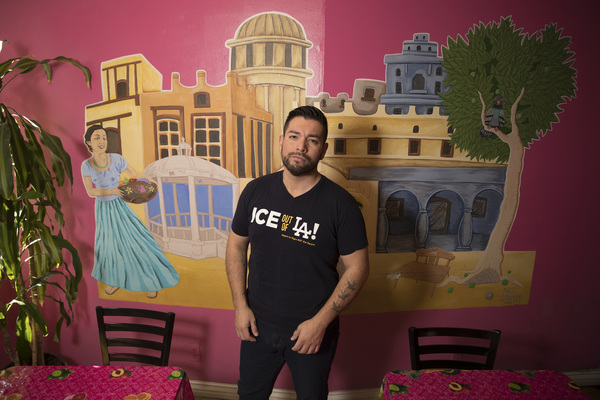
Although Estrada is lobbying for legislation with no strings attached, she said she's trying hard to understand why other DACA beneficiaries would be willing to compromise.
"I truly believe that desperation has led some of us to the degree, I'm hoping, of temporary insanity. They see no other option. They see no other door," she said. "It's very disheartening and sad. We're supposed to be a united community and we obviously are not."
The divisions have increasingly sprung up in social media outlets, such as Facebook forums used by DACA immigrant youth.
Some argue that DACA beneficiaries should settle for whatever Trump can give them because the alternative would be life without work permits. They have bills to pay and mouths to feed, they say. Other DACA beneficiaries say they refuse to support legislation that would help them if it means it would hurt loved ones, including parents.
One of the large issues during the negotiations over bipartisan legislation the past few weeks was that Dreamer organizations were reluctant to sign on to any bill that would protect their status but not protect their parents or other family members. It was a major reason three Democratic senators voted against a compromise bill.
The question of who should be allowed to join American society has historically been contested, provoking divisions even among movements that seem otherwise unified like immigrant rights, said Leo R. Chavez, a professor of anthropology who focuses on immigration at the University of California, Irvine.
In the late 1800s, the Chinese Exclusion Act did not allow Chinese immigrants to become U.S. citizens. Similarly, while western and northern Europeans were favored to become naturalized, the U.S.-born children of southern and eastern European immigrants were considered "too foreign," Chavez said.
"A lot of these people were seen as swarthy and likely to change the complexion of America," he said.
Although DACA is scheduled to end in March, activists and legislators, including some Republicans, have rallied to support the program.
This comes as many of the approximately 11 million immigrants in the country illegally feel painted as criminals and DACA beneficiaries are being leveraged by the Trump administration to achieve concessions from Democrats on stricter border security and tougher immigration enforcement.
Some immigration-enforcement hard-liners say they hold a soft spot for DACA beneficiaries because they were brought at a young age. But many are not pleased with Trump's plan to legalize their presence.
"He ran on a platform to build the border wall and strong border security. So it was an unpleasant surprise to border control activists, like myself," said Robin Hvidston, executive director of We the People Rising, a Claremont, Calif., organization that lobbies for stricter immigration enforcement.
"President Trump never mentioned this plan while he was campaigning for votes," Hvidston said.
If DACA legislation does pass, Hvidston said she believes it's only a matter of time before that group then advocates for those left out.
"The overall impression is that DACA recipients are the champions of those here illegally," she said.
The lives of immigrants who benefit from DACA and those who don't are very often intimately intertwined.
Sandra Hernandez, 46, runs a money-remittance business in Lincoln Heights. She said she is grateful that her 19-year-old son is a DACA beneficiary. Hernandez also has a 12-year-old son who was born in the U.S. and a 16-year-old daughter who qualified for DACA but did not apply before the deadline.
Hernandez, who has lived illegally in the U.S. for 15 years, said she can't remedy her legal status but is hopeful that she someday can.
Javier Hernandez Kistte, 27, a DACA beneficiary who lives in South Los Angeles, said he is relatively new to the immigrant rights movement, partially propelled by the guilt he feels about qualifying for a protection that is out of reach for others, including his parents.
Shortly after Trump rescinded DACA, Kistte visited his parents who are in the country without legal status. He broached the topic at the family's kitchen table.
"I can guarantee things will get a lot more difficult in the coming years," he told parents. "So we, as a family, need to think about what we are going to do."
He said his mother told him that she and his father would be fine returning to Mexico "as long as I know you kids will be OK."