And that's all for today.
Coverage of the IMF's new growth forecasts starts here.
The news that Barclays is fighting back over its Dark Pool lawsuit begins here.
And the earlier summary covers the other key points from a busy morning.
Back tomorrow morning for the official UK growth figure. Goodnight. GW
Our economics editor, Larry Elliott, write that the IMF has egg on its face again, after admitting that it under-estimated Britain's growth potential:
Yet again the Washington-based International Monetary Fund has been obliged to revise up its forecast for UK growth, both this year and next. Only 15 months after it warned George Osborne that he would be "playing with fire" if he failed to ease up on his austerity programme, the IMF is predicting growth for Britain of 3.2% in 2014, comfortably the highest for any of the G7 countries.
With an election less than a year away, the Chancellor has every reason for feeling just a little bit smug.
Surely not....
More here: Another UK growth forecast, another dollop of egg on the face of the IMF
Here's our news story about the IMF's World Economic Outlook:
IMF predicts Britain's GDP growth rate will surge to 3.2% by year end
The International Monetary Fund has raised its forecast for Britain's GDP growth rate for the second time this year, heaping further embarrassment on the Washington-based organisation following its warning in 2013 that George Osborne's austerity policies were "playing with fire" and could trigger a slump....
Here's the full economic projections from the IMF:
2014 World Economic Outlook: Latest IMF economic projections for different regions and countries #WEO pic.twitter.com/0LHYdiozc6
— IMF (@IMFNews) July 24, 2014
The IMF's new forecasts come a day before we get the first estimate for UK economic growth in the second quarter of 2014.
Economists predict that GDP expanded by 0.8%, matching the growth in January-March.
The IMF now forecasts the UK economy will grow 3.2% this year: almost twice the pace of the US (1.7%) and three times the Eurozone's (1.1%).
— Oliver Cooper (@OliverCooper) July 24, 2014
Here's how #IMF 2014 growth forecasts have changed over last 2 years for selected euro-area economies. pic.twitter.com/s7X355EBRq
— Maxime Sbaihi (@MxSba) July 24, 2014
George Osborne: The plan's working, but the job isn't done
What a difference 15 months makes, eh?
Back in April 2013, the IMF warned that Britain was "playing with fire".
Today, it has raised its forecast for UK growth in 2014 for the fourth time.
The Chancellor of the Exchequer, George Osborne, wasn't slow to comment.
He says:
“Today the IMF has upgraded their 2014 forecast for the UK by more than any other major economy. The Government’s long term economic plan is working. But the job is not yet done and so we will go on making the assessment of what needs to be done to secure a brighter economic future."
To be fair, the IMF aren't the only experts surprised by Britain't strong growth over the last year. And we shouldn't forget that the chancellor's original deficit reduction target has now been pushed back several years.
Some more key points from the IMF report:
- IMF SAYS MONETARY POLICY SHOULD REMAIN ACCOMMODATIVE IN ALL MAJOR ADVANCED ECONOMIES
- IMF SAYS GEOPOLITICAL RISKS HIGHER NOW THAN IN APRIL DUE TO MIDDLE EAST, UKRAINE DEVELOPMENTS
- IMF SEES RISK OF STAGNATION IN ADVANCED ECONOMIES OVER LONG-TERM
The IMF has cut its forecast for growth in advanced economies this year from 2.2% to 1.8%.
We really shouldn't be surprised by that, given that the US economy was dragged into a contraction in the first three months of this year by its bad winter.
But the emerging market growth forecast has also been cut, from 4.8% to 4.6%.
IMF: four negative surprises have hit global growth
The IMF says 'four negative surprises" have hit the world economy in recent months -- with the US, Russia, China and other emerging markets all disappointing.
That's why it has slashed its growth forecast this year by 0.3 percentage points.
In the United States, the inventory overhang at the end of 2013 turned out to be larger than expected, leading to a stronger correction. A harsh winter further dampened demand, exports declined sharply after a strong fourth quarter, and output contracted in the first quarter of 2014.
In China, domestic demand moderated more than expected, reflecting the authorities’ effort to rein in credit growth and a correction to real estate activity.
Activity in Russia decelerated sharply as geopolitical tensions further weakened demand.
In other emerging market economies, weaker-than-projected growth resulted both from weaker external demand, notably from the United States and China, and, in a number of cases, softer domestic demand with weaker investment growth.
Updated
IMF cuts global growth forecasts, but upgrades UK
Breaking: The International Monetary Fund has cut its forecast for global economic growth this year, but upgraded the UK again.
The IMF now expects the global economy will growth by 3.4% this year, down from 3.7% back in April.
It blamed "the legacy of the weak first quarter", in which the US economy contracted, and "a less optimistic outlook for several emerging markets".
The IMF still expects global growth of 4% in 2015. But it also warned that "increased geopolitical risks" could hurt the global economy, by driving oil prices sharply higher.
The UK, though, has seen its outlook upgraded again.
The IMF now expects rollicking growth of 3.2% this year, up from 2.8% before. In 2015, it expects growth of 2.7%, up from 2.5% before.
More to follow...
Updated
Heads-up... it's nearly time for the International Monetary Fund to release its latest World Economic Outlook, at 4pm BST....
Barclays: Dark Pool Lawsuit is based on clear errors
Here's the key points from Barclay's official rebuttal to the lawsuit brought by US authorities over its Dark Pool:
"Fundamentally, the Complaint fails to identify any fraud—establishing no material misstatements, no identified victims, and no actual harm"
"The complaint is based on clear and substantial factual errors. Unfortunately, at this stage of the litigation, the pleading standards limit Barclays’ ability to rebut those factual errors—but should this litigation proceed to the next stages, Barclays will introduce evidence demonstrating how far off base these allegations are".
The attorney general had argued that Barclays had told customers they would be protected from high frequency traders when using its "dark pool" in marketing materials, when this was not the case. In its filing, Barclays said: "For present purposes, though, the very marketing documents and emails from which the Complaint selectively quotes, along with the Complaint’s other fatal flaws, are sufficient to require dismissal of this “fraud” action"
Barclays has just confirmed that it is fighting the New York Attorney General's lawsuit:
Barclays on fraud allegations last month by the NY attorney general about its dark pool: "We do not believe that this suit is justified"
— Jill Treanor (@jilltreanor) July 24, 2014
Barclays Dark Pool - some background.
Barclays' legal action comes a month after the New York Attorney General, Eric Schneiderman, declared that its Dark Pool trading platform was allowing high-frequency traders to prey on other investors.
“Barclays grew its dark pool by telling investors they were diving into safe waters. According to the lawsuit, Barclays’ dark pool was full of predators – there at Barclays’ invitation.”
Trading at Barclays' dark pool has reportedly fallen sharply since Schneiderman made his claims.
A 'dark pool' allows investors to deal anonymously, until their trades are completed.
Barclays 'files motion to dismiss lawsuit over dark pool trading venue'
News is breaking that Barclays has launched a legal bid to dismiss a lawsuit brought against its 'dark pool' trading platform last month:
Here are the Reuters snaps:
- BARCLAYS FILES MOTION TO DISMISS NEW YORK ATTORNEY GENERAL’S LAWSUIT AGAINST ITS DARK POOL TRADING VENUE
- BARCLAYS MOTION TO DISMISS NY ATTORNEY GENERAL LAWSUIT SAYS MANY ALLEGATIONS TAKEN OUT OF CONTEXT
- BARCLAYS MOTION SAYS NY ATTORNEY GENERAL LAWSUIT MISCONSTRUED PARTS OF ITS MARKETING MATERIAL FOR LX TRADING VENUE
- BARCLAYS MOTION SAYS NY ATTORNEY GENERAL DOES NOT HAVE AUTHORITY TO ACCUSE BANK OF FRAUD AT ITS TRADING VENUE
We'll have more on this shortly - stay tuned!
US manufacturing PMI falls back in July
Back on the data treadmill, and Markit reports that growth in the US factory sector has slowed a little this month.
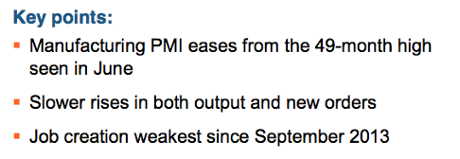
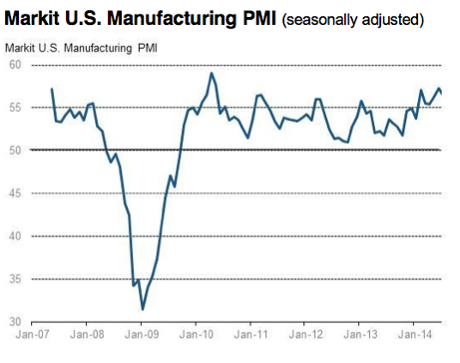
Markit's US manufacturing PMI came in at 56.3 in July, down from June's 57.3. That's weaker than expected, but still safely in expansion territory (anything over 50 suggests the sector is growing).
Factories reported that output grew strongly, close to a four-year high.
However, new export order growth remained subdued and employment growth slowed.
And here's Chris Williamson, chief economist at Markit:
“US manufacturers are enjoying a summer of scorching growth. Output grew in July at a rate only just below the four-year peak seen in June as inflows of new orders surged higher again. The data suggest the sector is growing at an annualised rate of roughly 8% as we moved into the second half of the year.
“The growth rebound that the survey has signalled for the second quarter therefore looks to have been sustained into the third quarter.
“Factories were able to raise their prices to the greatest extent seen so far this year as a result of the improvement in demand, suggesting there may be some inflationary pressures building in the manufacturing supply chain.
“Worryingly, job creation slid to its lowest since last September, which in part reflects concerns that current sales growth may not be sustained. A key source of concern is export sales, which continue to show disappointingly meagre gains.”
Facebook trading at all-time highs; $FB shares up 6% • http://t.co/GGr6U13QSe pic.twitter.com/M5FPeDm34v
— CNBC (@CNBC) July 24, 2014
Facebook shares have also hit a new all-time high, after reporting strong results last night.
At $76 each, they're now worth twice their flotation price in 2012 -- awkward for those who claimed the social network giant was overvalued.
BREAKING: Facebook climbs above record intraday high: http://t.co/X9aavLFjaO $FB
— Bloomberg News (@BloombergNews) July 24, 2014
Facebook shares surge to double IPO price http://t.co/9xA63OAcx5
— fastFT (@fastFT) July 24, 2014
The S&P 500 index has hit a new record high, in opening trading in Wall Street.
And the S&P 500 has hit another intraday record: 1989.67
— MarketWatch (@MarketWatch) July 24, 2014
Lunchtime roundup
A splurge of economic surveys have shown that much of the global economy picked up speed this month, but France continues to drag the eurozone back.
Chinese factories began the day by reporting the biggest jump in activity in 18 months, suggesting the Beijing government's mini-stimulus measures are working.
In Europe, Germany's service sector is growing at the fastest rate in 37 months, suggesting growth is accelerating.
And the eurozone as a whole is enjoying its biggest rise in output in three months.
France, though, lags behind -- its factory sector is contracting at a faster pace in July, with firms cutting staff and reporting another fall in new business.
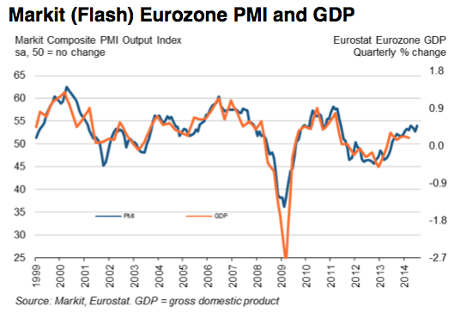
Full update on #euro area manufacturing in July, and how #France's downturn is deepening http://t.co/jhAYeQdohC pic.twitter.com/sRL9iEINcp
— Chris Williamson (@WilliamsonChris) July 24, 2014
As Markit put it:
"At the heart of France‟s woes are a stagnant services economy, which points to weak domestic demand and falling confidence among business and households, as well as an increasingly alarming rate of decline in the manufacturing sector.”
There was encouraging news from Spain, where employment rose at its fastest rate in nine years.
And in the last hour, America's initial jobless claims total has hit its lowest level since the financial crisis began. Just 284,000 people signed on for unemployment benefit, as the US labour market continues to heal.
But in the UK, more than 1,200 jobs are being lost as a car parts firm falls into administration.
In other news:
-
The ex-chairman of Banco Espirito Santo has been detained
-
The ECB has admitted one of its website has been hacked
-
UK retail sales have risen at the fastest pace in almost a decade, although growth did slow last month.
-
General Motors has reported that its various recall programmes, and likely future costs, have almost wiped out its profits for the last quarter.
-
Royal Mail has avoided a pay revolt at its first AGM
Updated
Sam Bullard, senior economist with Wells Fargo Securities, reckons this month's Non-Farm Payroll (which measures US employment) will be decent, but "probably not as strong as June."
Some economists are cautioning that the tumble in new American jobless claims, to an eight year low, may be partly due to one-off factors.
Stephen Stanley, chief economist at Pierpont Securities, said:
“I highly doubt that we settle out at such a low level.
“The last time claims spent more than a week or two below 300K, in 2006, the unemployment rate was well below 5%.”
The US jobless rate is currently 6.1%.
More context -- last week's US jobless claims figure is one of the strongest in over a decade:
Initial Jobless Claims (past 20 years): pic.twitter.com/g2diN5yf0I
— Michael McDonough (@M_McDonough) July 24, 2014
US initial unemployment claims tumble to eight-year low
The number of Americans filing new claims for unemployment benefit has hit its lowest level since early 2006, as the US labour market continues to improve.
Initial claims for unemployment benefit slid by 19,000 last week to 284,000, the lowest level in eight years.
Economists had predicted the jobless claims total would rise to 308,000.
The four-week rolling average of jobless claims, which irons out some volatility, also fell - to 302,000, the lowest level since May 2007.
GM profits hit by recall costs

The seemingly constant stream of vehicle recalls by General Motors has hit the company hard in the pocket again.
GM just reported that it made a net profit of just $200m in the last quarter – with the $1.2bn cost of recall-related repairs wiping out most of its $1.4bn pre-tax earnings.
GM's ignition switch compensation program cost $400m, as the company tries to fix problems linked to 19 deaths.
It is also taking a $900m non-cash pre-tax special charge, to cover the cost of recalls over the next decade.
It explained:
The company expects recall expense to normalize to a slightly higher rate than it experienced prior to this year, but not materially. The company is changing how it estimates future recall expense and will now accrue at the time of vehicle sale an amount that represents management’s best estimate of future recall costs in North America.
CEO Mary Barra insisted that GM's "underlying business performance" was strong. But shares have fallen around 2% in pre-market trading.
1,244 jobs lost as Unipart Automotive enters administration
More than 1,200 jobs are being lost in Britain after one of the UK's largest car parts suppliers fell into administration.
Solihull-based Unipart Automotive called in administrators from KPMG after failing to find a buyer for the whole company.
They have sold 33 branches and distribution centres, out of a total of 180, to other companies -- saving 361 jobs. But another 1,244 staff are being made redundent.
KPMG partner Mark Orton said:
"Unfortunately, the business had been experiencing financial stress for a number of years, so the level of cash and further operational restructuring required to rescue a more substantial part of the business posed too much risk for most interested parties."
Royal Mail AGM results
Royal Mail appears to have avoided a major shareholder revolt -- all the resolutions at today's AGM were passed with at least 90% approval (although that doesn't include abstentions...).
All resolutions at Royal Mail AGM including pay approved by 90pc or more of votes cast
— Juliette Garside (@JulietteGarside) July 24, 2014
The threat of a pay revolt abated after the government, which still owns a 30% stake, said it would back the renumeration report.
Banco Espirito Santo's former chairman arrested

Over in Portugal, the Espirito Santo crisis has taken another twist with the arrest of the former boss of Banco Espirito Santo.
Ricardo Salgado, who stepped down this month after running the bank for 23 years, was arrested this morning.
He's due to appear before magistrates later today, in connection with a money laundering and tax evasion probe known as Operation Monte Branco.
Here's the official statement (in Portuguese).
The days of postal workers buzzing around on bicycles are numbered...
Brydon: Bicycle deliveries for this company are going to be a thing of the past (no longer efficient for modern parcel sizes)
— Juliette Garside (@JulietteGarside) July 24, 2014
A campaign group has asked Royal Mail whether it will embrace the Living Wage.
Chairman Donald Brydon says he will discuss whether to pay living wage to contract staff like cleaners.
One shareholder tells Royal Mail's AGM that it should do away with first and second class stamps:
Shrhldr: Why do we have two mails? Just send all of the letters as soon as you get them and don't waste time sorting them into 1st and 2nd.
— Juliette Garside (@JulietteGarside) July 24, 2014
Royal Mail is fielding questions about its universal service, and the threat from competitors:
Moya Greene: We take pride in delivering the universal service.
— Juliette Garside (@JulietteGarside) July 24, 2014
Ian Murphy, shareholder: is there any prospect of the company calling for a judicial review over the impact of direct delivery?
— Juliette Garside (@JulietteGarside) July 24, 2014
Chair Donald Brydon responds Royal Mail will wait and see how Ofcom responds to request for an inquiry.
— Juliette Garside (@JulietteGarside) July 24, 2014
The Royal Mail AGM begins with management thanking the workforce for their role in getting last autumn's privatisation off the ground:
Moya Green thanks the Unite and CWU first, for their hard work making the privatisation possible pic.twitter.com/RvGHqoqwVT
— Juliette Garside (@JulietteGarside) July 24, 2014
Updated
The Royal Mail annual general meeting is underway -- my colleague Juliette Garside tweets:
The Royal Mail's first AGM IS JUST BEGINNING. pic.twitter.com/V7AsA9aTZC
— Juliette Garside (@JulietteGarside) July 24, 2014
Royal Mail AGM - spot the shareholder
Royal Mail is holding its first ever annual general meeting today - a chance for investors to quiz the postal operator about its performance, and boardroom pay.
However, the National Exhibition Centre in Birmingham isn't exactly heaving with shareholders, despite the lure of some impressive plates of biccies.
Er, a low key start to Royal Mail's first-ever AGM. More biscuits than shareholders so far in Birmingham's NEC. pic.twitter.com/5xrozYkzDu
— Becky Barrow (@beckymbarrow) July 24, 2014
Updated
But despite the sharp rise in employment last quarter, Spain's youth unemployment rate remains far too high:
Spanish youth #unemployment rate remains above 50%, dipping to 53.1% in Q2 pic.twitter.com/aEV6fHkHV4
— Markit Economics (@MarkitEconomics) July 24, 2014
The recovery in Spanish employment is fairly broad-based:
Spain-14Q2 job creation by age group pic.twitter.com/3xipzA3Swv
— Charles Butler (@ibexsalad) July 24, 2014
Italian consumer confidence stumbles
The latest economic news from Italy is less encouraging, though.
Italian consumer confidence has hit a four month low this month, dropping to 104.6 from 105.6 in June. And retail sales fell by 0.7% in May, as food sales dropped.
Its a fragile picture, suggesting the early optimism created when Matteo Renzi became prime minister is tailing off.
Lots of poor Italian data through June and July it seems. Pressure on Renzi to re-emerge?
— World First (@World_First) July 24, 2014
Spanish unemployment rate hits two-year low.
Spain's economic recovery may finally be feeding through to its labour market as firms take on more staff.
The National Statistics Institute reported that a total of 402,400 new jobs were created in April-June, the highest number in any quarter since 2005.
That pulled the Spanish unemployment rate down to its lowest level in two years, dropping to 24.5% in the second quarter of 2014.
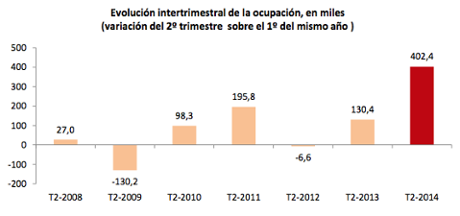
This still leaves Spain with a painfully high unemployment rate, more than double the eurozone average (11.6%).
But today's figures are certainly encouraging.
Jose Luis Martinez, economist at Citi in Madrid, told Reuters that the Spanish economy may be normalising:
"These figures are much better than expected and while there's an important seasonal element, seasonally adjusted figures are also strong."
Updated
UK retail sales strongest in a decade
Britain's consumer-driven recovery continues, although it cooled a little last month.
The latest retail sales figures show that shops have enjoyed their strongest quarter in a decade, with volumes up by 1.6% in April-June compared to the previous three months.
June's figures, though, are weaker than expected. Sales rose by just 0.1% month-on-month.
Retail sales edge up just 0.1% in June but up 1.6% Q2 for a 4.5% increase on a year earlier.
— David Smith (@dsmitheconomics) July 24, 2014
Updated
European Central Bank website hacked, contact details stolen
The European Central Bank has admitted that one of its websites has been hacked, and contact details such as email addresses have been stolen.
It insists that no market-sensitive information has been lost, and has called in the police to investigate this embarrassing breach of security.
In a statement, the ECB explains:
The database serves parts of the ECB website that gather registrations for events such as ECB conferences and visits. It is physically separate from any internal ECB systems.
The theft came to light after an anonymous email was sent to the ECB seeking financial compensation for the data. While most of the data were encrypted, parts of the database included email addresses, some street addresses and phone numbers that were not encrypted. The database also contains data on downloads from the ECB website in encrypted form.
The ECB is contacting people whose email addresses or other data might have been compromised and all passwords have been changed on the system as a precaution.
The ECB takes data security extremely seriously. German police have been informed of the theft and an investigation has started.
Markit: Eurozone seeing stronger growth, but not strong enough
Chris Williamson, chief economist at Markit, says the eurozone economy is growing at one of the strongest rates seen in the past three years.
But despite output hitting a three-month high this month, the eurozone is probably only growing at a modest pace of approximately 0.4% per quarter.
This growth is not fast enough to encourage firms to take on staff in sufficiently large numbers to have a meaningful impact on unemployment. The July survey once again saw only very modest job creation.
And the French economy continues to drag Europe back. As this chart shows, the French economy (orange) is struggling as the rest of the euro area picks up (Germany in blue, everyone else in green):
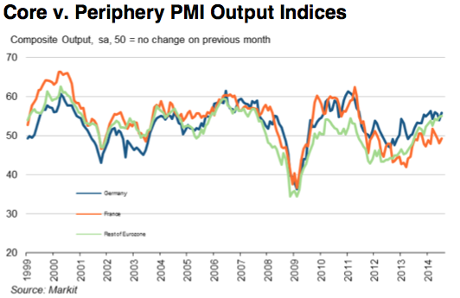
Williamson says:
While the periphery is picking up speed and the German economy is growing at a robust 0.7-0.8% pace at the start of the third quarter, the French economy is stagnating at best.
At the heart of France‟s woes are a stagnant services economy, which points to weak domestic demand and falling confidence among business and households, as well as an increasingly alarming rate of decline in the manufacturing sector.”
Markit: Eurozone economic growth rebounded in July
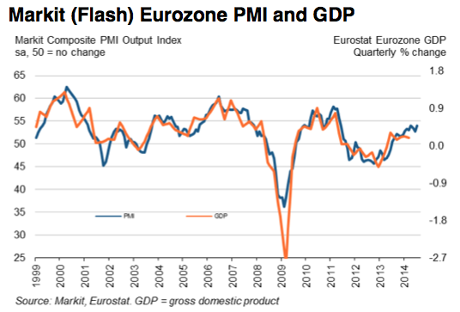
Eurozone economic growth has rebounded in July, data firm Markit estimates, with smaller nations outperforming France.
Markit's monthly estimate of activity across the eurozone, just released, has hit a three-month high.
It says:
Many companies reported that business had picked up again in July after an unusually high number of holidays and a knock-on effect of mild winter weather had depressed activity in prior months.
However, there are also signs that the Ukraine crisis is weighing on companies, especially in manufacturing.
Service sector firms are leading the recovery, Markit adds:
While growth of service sector business activity accelerated to the fastest for just over three years, growth of output and new export orders in the manufacturing sector picked up only marginally, remaining well below the rates seen earlier in the year.
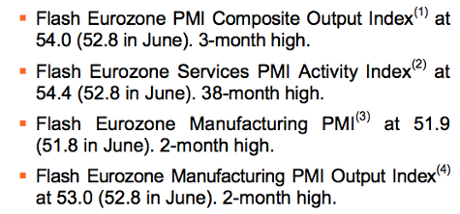
While France contracted (see earlier), Markit also found that growth accelerated in other parts of the eurozone.
Indeed, if you strip out France and Germany, the rest of the eurozone recorded the largest monthly increase in business activity since August 2007. New orders also grew at the sharpest rate for seven years.
Unilever hit by emerging market slowdown, and Russian problems

Consumer giant Unilever has also been hit by geopoliticial events.
It missed City sales forecasts this morning, blaming a slowdown in emerging markets and tricky conditions in developed markets too.
The Anglo-Dutch maker of Ben & Jerry's ice cream, Dove soap and Lipton tea said underlying sales - which exclude the impact of foreign exchange, acquisitions and disposals - rose 3.8 percent, compared to analysts' expectations of 4.3 percent.
"Overall there's a slowdown in Asia," Chief Financial Officer Jean-Marc Huet told Reuters, citing China and Vietnam in particular. "Russia has been difficult, you can imagine why."
The strong German PMI data pushed the euro up by 0.3% against the US dollar to $1.347.
That won't please those who believe the strength of the single currency is hampering the recovery:
French Prime Minister Valls Says Euro is 'Too Strong' >> ....aaaand EUR/USD hits a new high for the day. Tres bien.
— Katie Martin (@katie_martin_FX) July 24, 2014
Back in the financial markets, shares in EasyJet have fallen by 4% after it issued profit expectations that missed City forecasts.
EasyJet predicted annual profit growth of between 14% and 19%, lower than analysts had expected, as it factored in the impact of political events in Israel, Egypt and Russia.
Updated
Markit: more good news for Germany
After slowing down in recent months, Germany's economy appears to be romping ahead again.
Today's PMI report shows Germany is enjoying a broad-based recovery, says Markit economist Oliver Kolodseike:
“Following the joy of lifting the football World Cup trophy, July’s flash PMI results provide further positive news for Germany. The headline index – which measures the combined output of both the manufacturing and service sectors – rose to a three- month high at the start of the third quarter, suggesting that growth in the eurozone’s largest economy has re- accelerated, having slowed in the previous two months.
Furthermore, rising workloads continued to feed through to employment gains, suggesting that companies retain positive expectations for growth in the coming months.
Updated
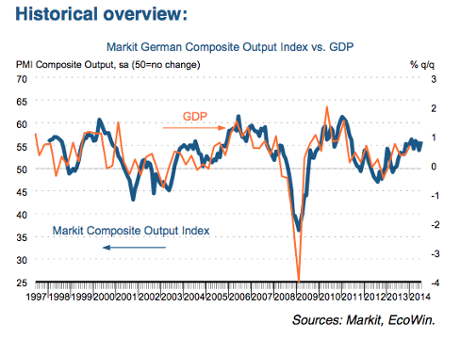
German service sector activity hits 37-month high
Germany's private sector is roaring ahead – as firms in Europe's largest economy outpace their French rivals again.
Markit reports that the German manufacturing and service sectors both expanded robustly this month, beating forecasts.
Firms report that new business continued to pour in, exports rose, and firms took on more staff - meaning employment rose for the ninth month running.
The German manufacturing PMI rose to 52.9, up from 52.0 last month, showing faster growth.
And the service sector PMI really jumped, to 56.6 from 54.6 in June. That's the strongest rise in activity in 37 months.
This pushed the overall German private sector PMI to a three month high of 55.9.
Reaction to follow....
French private sector shrinks again as factories struggle
France's private sector is continuing to shrink, but at a slower pace, showing that the wider economy is still stagnating.
Markit's monthly survey of purchasing managers shows that output across French firms fell again, as new business contracted and companies continued to cut staff.
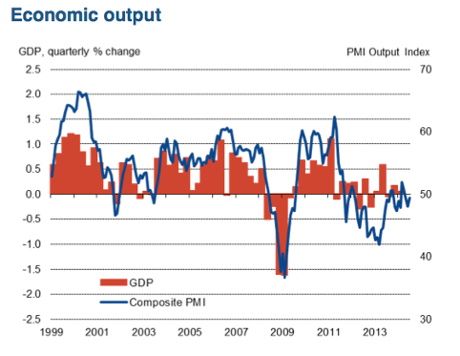
Factories fared particularly badly. The manufacturing output index fell to a 15-month low of just 45, from 47.6 in June.
The overall France Manufacturing PMI fell to 47.6, from 48.2 in June, a 7-month low.
But there are reasons for optimism too. The Service sector PMI rose to positive territory, at 50.4 (up from 48.2 in June).
The overall France Composite Output Index rose to a three-month high of 49.4, still in contraction territory:
Jack Kennedy, senior economist at Markit, says the French private sector economy "remained in reverse gear".
“Companies reported that further price cutting was insufficient to hold back the receding tide in new business, as the weak demand environment continued to stoke intense competitive pressures.
“PMI data remain consistent with quarterly GDP close to stagnation levels, as the economy continues to show little sign of turning around its recent sluggish performance.”
Updated
Shares in Kingfisher have slid 5.5% at the start of trading; the City hadn't expected such weak sales for the last few weeks:
Kingfisher: trading in France and Poland is slower than expected
DIY chain Kingfisher continues to struggle in France, as consumers continue to cut back in the face of a weak economy.
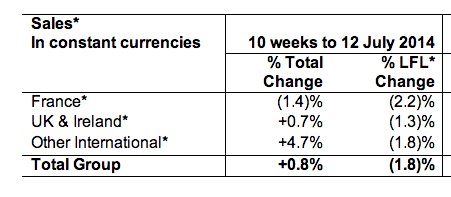
It has reported that like-for-like sales at its French stores slid by 2.2% in the last 10 weeks.
Kingfisher blamed 'softer markets', pointing to official figures showing that the wider home improvement market contracted sharply in June.
And comparable sales also fell in the UK, where it runs B&Q and Screwfix.
Sir Ian Cheshire, chief executive, said trading in some European countries had been tougher than expected:
Trading in our second quarter was always expected to be more difficult, annualising a very strong Q2 performance last year and following this year's weather boosted Q1.
However, our markets in Q2, notably in June, have been slower than anticipated particularly in France and Poland. It is unclear whether this recent weakness is short term phasing in nature, though we will know more by our interims in September having then traded through our key summer months. In the meantime we are accelerating our self-help margin and cost initiatives to help support our second half performance.
Kingfisher isn't giving up on France, though. It's pushing on with the acquisition of Mr Bricolage, another home improvement retailer.
Updated
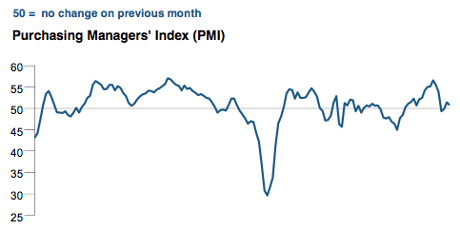
Data firm Markit reports that Japan's factory output was flat this month, although exports have picked up. The overall PMI came in at 50.8, showing small growth.
Japanese mfg output stagnates despite return to growth of exports; headline #PMI at 50.8 http://t.co/61bhqfLzLc pic.twitter.com/qw5ly3Ny77
— Markit Economics (@MarkitEconomics) July 24, 2014
China's stock market rallied by 1.3% on the back of today's PMI report.
The Australian market hit a new six-year high; as investors bet that China's factories would show solid demand for Australia's natural resources.
Asia late... Shanghai up 1.3% HK up 0.5% Taiex ends 0.3% up ASX ends 0.2% up Sensex flat Kospi ends down 0.1% Nikkei ends down 0.3% $NIK
— Michael Kitchen (@KitchenNews) July 24, 2014
Today's PMI data from France (due shortly) may not match China's decent performance.
Michael Hewson of CMC Markets reckons:
Today’s preliminary manufacturing and services PMI data for July from both France and Germany could well reinforce the weak narrative for Q3 with French data expected to remain firmly in contraction territory at 48 and 48.2 respectively.
German data is also expected to weaken slightly though it still remains fairly robust at 51.9 for manufacturing and 54.5 for services.
Shen Jianguang, an economist at Mizuho in Hong Kong, says the Chinese PMI survey is encouraging, but doesn't mean Beijing can afford to stop stimulating:
"The economy is showing initial signs of a recovery. There is no reason the government will stop taking action.
"We believe favourable fiscal and monetary policy need to be expanded further."
(via Reuters)
Chinese factory growth hits 18-month high
Encouraging news from China this morning -- its factories have reported the biggest jump in activity since the start of 2013.
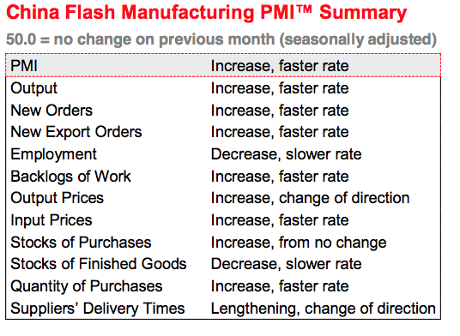
Manufacturers have reported that output, exports and new orders are all rising at a faster pace this month. Firms also slowed the pace of job cuts.
HSBC's Flash China Manufacturing Purchasing Managers’ Index (PMI), rose to 52 in July, up from 50.7 in June. That shows stronger growth (50 is the cut-off point between expansion and contraction)
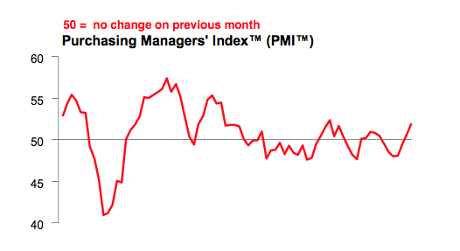
Hongbin Qu, HSBC's chief economist for China, says it shows Beijing's targeted stimulus plan is having an impact.:
"Economic activity continues to improve in July, suggesting that the cumulative impact of mini-stimulus measures introduced earlier is still filtering through.
We expect policy makers to maintain their accommodative stance over the next few months to consolidate the recovery.”
Here's the full breakdown:
French and German PMI surveys may show slowdown
Good morning, and welcome to our rolling coverage of the financial markets, the world economy, business and finance.
Busy day ahead, with lots of economic data, corporate news, and political developments.
In Europe, the latest PMI surveys will show how France and Germany's private sectors are faring this month. They're due at 8am and 8.30am BST, and analysts fear they will show a slowdown in the eurozone's largest economies.
The International Monetary Fund will be giving its view of the global economy - the latest World Economic Outlook report is due at 4pm BST (corrected).
There's also the latest US jobs report (1.30pm BST), to show if America's labour market improved last week.
A swathe of major European companies are reporting results this morning, including electronics firm Nokia, DIY and retail chain Kingfisher, chemicals maker BASF, airline Easyjet, and consumer goods giant Unilever.
Europe's stock markets are expected to open a little lower:
A slightly weaker open seen for share markets after yesterday's lacklustre close. Financial bookies: FTSE100 -10, DAX -8, CAC40 -8
— Peter Hoskins (@PeterHoskinsSky) July 24, 2014
Investors will be watching to see whether European ministers agree tough sanctions on Russia over the Ukraine crisis.
The FT's Peter Spiegel is reporting that diplomats will consider "Russian sanctions", including a proposal to" ban all Europeans from purchasing any new debt or stock issued by Russia’s largest banks".
Big scoop by @SpiegelPeter - EU weighs ban on buying any new debt or stock issued by Russia’s largest banks http://t.co/pU41x5FTSm
— Tony Tassell (@TonyTassell) July 24, 2014
And we'll be watching Greece, where the government is pushing to implement various measures before its troika of lenders return in September.
The coalition leaders are due to meet to discuss the situation today... as doctors prepare to lodge a mass appeal against salary cuts demanded by the troika.
I'll be tracking the main events through the day...
Updated