President Donald Trump smiled as he signed away nearly three million acres of protected public land in Utah, handing out souvenir pens while tribal leaders described the loss of their ancestral homeland as heartbreaking.
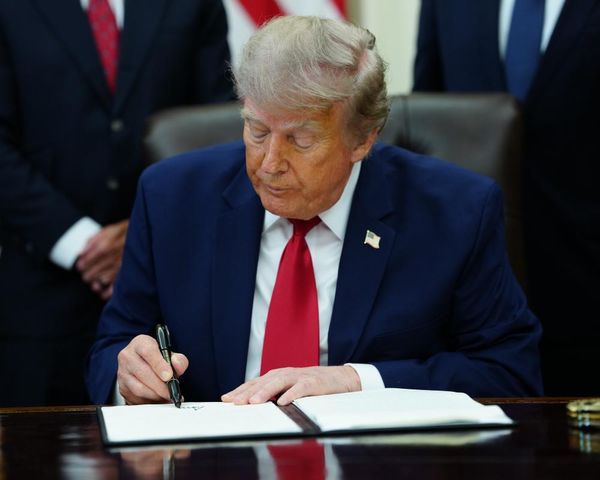
In a live-streamed Oval Office ceremony on 13 July 2026, the president signed two proclamations shrinking the Bears Ears and Grand Staircase-Escalante national monuments by roughly 90 percent each, the largest rollback of public-land protections in American history.
The excluded land, sacred to five tribal nations and layered with uranium and coal, will reopen to mining and drilling within 60 days. Surrounded by Utah's all-Republican congressional delegation, Trump called the moment better than his first-term attempt and told the room the vast acreage would now be well taken care of.
A Signing Ceremony Marked By Celebration And Souvenir Pens
The mood in the Oval Office was triumphant. 'Let's sign,' Trump said as he put pen to paper, according to Utah News Dispatch, whose reporter covered the event. 'This is very nice. I'm very happy about this. And better than the first time.' As he signed the second proclamation, he added, 'Almost 3 million acres, going to be well taken care of now.'
Trump framed the action as a correction of a historic wrong done to the state. 'We've done something that was, I think, very desperately needed,' he said in a remark. 'It was very unfair to the people of Utah, and now fairness has been brought back. It's going to be better taken care of, and they'll be able to use it a little bit.' Governor Spencer Cox, standing beside him, called it 'a big day for Utah'.
Trump announces that he is terminating 3 million acres of national monuments, opening them up to drilling, mining, and industrial development. pic.twitter.com/2kq6KXqjDK
— FactPost (@factpostnews) July 13, 2026
One of Trump's central justifications was demonstrably false. He asserted that people could not hunt, fish or 'virtually not even walk' on the monuments, but hunting, fishing, camping and other recreation are all permitted under existing state and federal rules, as Steve Bloch, legal director of the Southern Utah Wilderness Alliance, pointed out to the Associated Press.
The Scale Of The Largest Public-Land Rollback In US History
The numbers behind the ceremony are staggering. Trump's proclamation modifying Bears Ears cut the monument from roughly 1.36 million acres to approximately 121,096 acres, excluding 1,238,904 acres from protection. His companion order shrank Grand Staircase-Escalante from about 1.87 million acres to roughly 181,500 acres.
Taken together, the two orders stripped monument status from more than 2.9 million acres, reducing the combined protected area from about 3.23 million acres to roughly 302,600. That is a deeper cut than Trump made during his first term, when he left one million acres at Grand Staircase and about 228,000 at Bears Ears before President Joe Biden restored the full boundaries in 2021.
The land itself does not change ownership. It remains federally owned public land, but the protections that came with monument status fall away, meaning areas once off-limits can again be opened to mining, drilling, road construction and other development under ordinary public-land laws.

The move runs against public opinion in the region. A Colorado College survey published earlier this year found 91 percent of western voters believe national monuments should stay protected, and support held at 87 percent even among voters identifying with the MAGA movement.
Uranium, Copper And The Minerals Named In The Proclamation
The extraction motive is written into the order itself. The Bears Ears proclamation states that the region contains resources 'vital to energy and resource independence and, in turn, critical to national security', naming silver, copper, molybdenum, lead, uranium, vanadium and zinc among the minerals it says the country should no longer source from abroad.
Grand Staircase-Escalante, for its part, sits atop large coal reserves beneath the Kaiparowits Plateau, deposits that mining interests have eyed since the monument was first created in 1996. State officials have long argued that the sprawling boundaries locked away resources that could generate jobs and revenue for rural Utah.
Conservationists read the mineral language as the true purpose of the exercise. Jackie Grant, who directs Grand Staircase Escalante Partners, warned the KUER audience that the action seemed designed to open protected ground to extraction, saying it appeared to be laying the groundwork to further degrade and develop the monument. The proclamation sets the excluded lands to reopen to mineral leasing and mining claims at 9am eastern time exactly 60 days after signing.
Tribal Nations And The Legal Battle Now Heading To Court
For the five tribes who conceived Bears Ears, the decision cut deep. The monument was the first in the country created at the request of tribal nations, established in 2016 after years of advocacy by the Bears Ears Inter-Tribal Coalition, which unites the Hopi Tribe, Navajo Nation, Ute Indian Tribe, Ute Mountain Ute Tribe and Pueblo of Zuni.
Davina Smith-Idjesa, a citizen of the Navajo Nation and co-chair of the coalition, told the Associated Press the reduction was 'heartbreaking' and accused federal officials of sidestepping their legal duty to consult affected tribes.
'From a Navajo perspective, Bears Ears is not simply a piece of federal public land,' she said. 'This is a living cultural site that holds our histories, our ceremonies, our traditional foods and medicines and our ancestors' footprints.'
The proclamation also disbanded the Bears Ears Commission, the tribal body created to help manage the land.
Legal challenges began almost immediately. The Southern Utah Wilderness Alliance vowed to sue, with executive director Scott Braden calling the reductions unlawful and pledging to see the monuments restored in federal court. The central legal question is one the courts left unresolved in 2017, namely whether the Antiquities Act of 1906, which lets presidents create monuments, also permits them to gut monuments established by their predecessors.
That unanswered question is precisely the point. The rollback appears designed to drive the issue to the Supreme Court, where a ruling in Trump's favour could unravel protections for dozens of monuments nationwide and, in the words of the Project 2025 blueprint that called for it, put the future of the Antiquities Act itself on the line.
For the tribes who spent generations fighting to protect Bears Ears, the pens handed out in the Oval Office marked the reopening of a wound that public land protections were supposed to have closed.