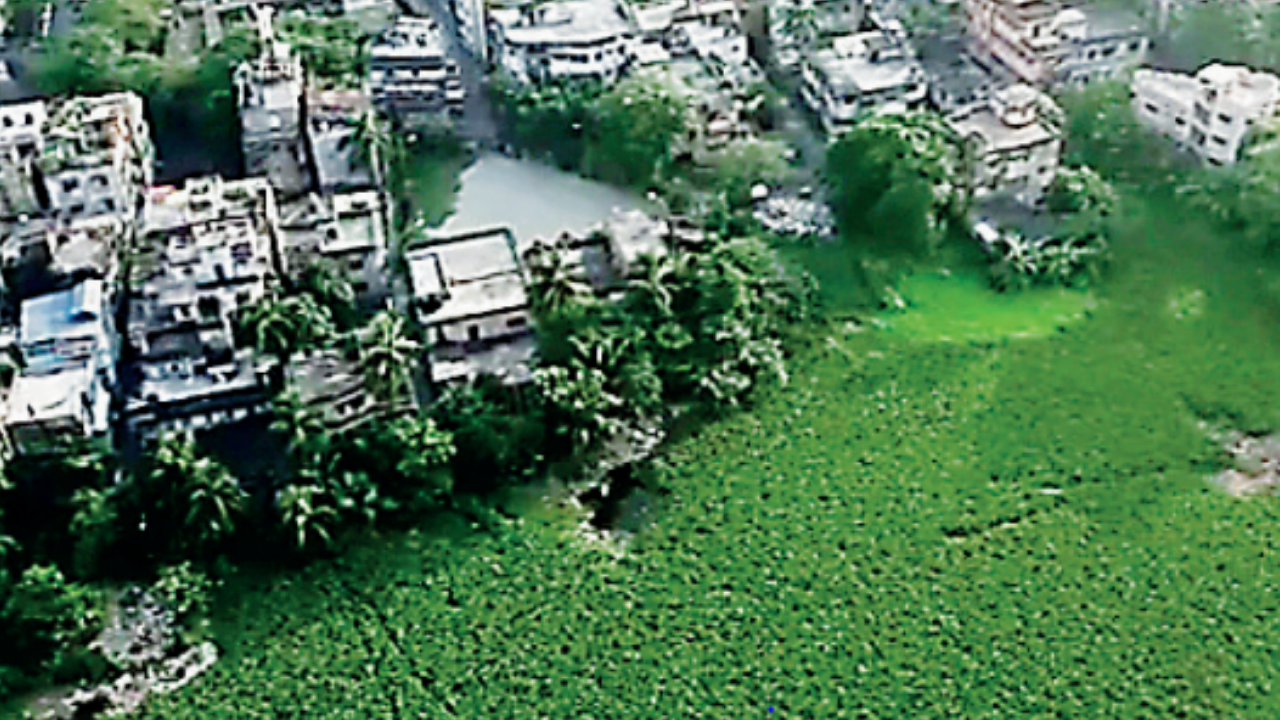
KOLKATA: Although the two-storey building on East Kolkata Wetlands (EKW) was being demolished on Wednesday, construction of a metalled road from Bantala lock gate to the site continued unabated. On Thursday, too, construction continued in full swing.
The promoter of the building, Kajeul Sardar of Nityananda village, was forced to undertake the demolition that even police and civic officials from Bidhannagar were avoiding despite an earlier Calcutta High Court order following a PIL filed by PUBLIC.
"It is a beginning. But this will not have any lasting impact if similar alacrity is not shown in every such case. The East Kolkata Wetlands are a boon to the city that we need to protect for our own benefit.-Timesview"
Sources said a goof-up by the power utility that had disconnected the line of another consumer had exposed to the HC that power continued to be provided to the illegal building.
Environmentalists lauded the development.
“The illegal structure part of a 60-acre site was probably the single-largest violation since the landmark Calcutta HC judgment in 1992 by Justice Umesh Chandra Banerjee that paved the way for preservation of the wetlands. We hope the EKW Authority restores the water body as the court has directed,” said green activist Bonani Kakkar of PUBLIC.
Officials at East Kolkata Wetlands Management Authority (EKWMA) said Kolkata was fortunate to still have the wetlands, unlike other cities where their destruction has triggered floods during monsoon and drought during summer. But, they said, its preservation is a challenge as people who want to convert the land into real estate are buying out bheris.
“Many people still don’t want to part with the bheris because they provide them with livelihood and decent profits. But there are several others who are being lured to sell. It’s a huge challenge,” the official said.
Till date, EKWMA has filed 358 FIRs. In 320 cases, charge sheets have also been filed. But action has been taken in very few cases. In some, the violators have moved a higher court to stall the demolition. In others, political connections have shielded their encroachment from police action.
Dhruba Das Gupta, a wetland researcher engaged in research on EKW at IIEST Shibpur, said the original bheri count in 1997 — according to the baseline document — put the number of fully functional bheris at 264. In a re-visit in 2014, the count had come down to around 200. It will have gone down further thereafter, though the exact count is not available right now. “This year, this Ramsar site completes 20 years of recognition and we have a critically endangered wetland. We need a stronger law where the EKWMA Act 2006 is bolstered by the land reform laws recognising Ramsar wetlands as no-build space,” she said.