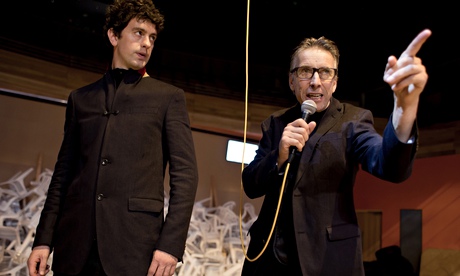
Space permitting, I intend to mention the F-word later. First, though, to war: Greeks v Trojans. A 10-year siege related in the epic poem we know as Homer’s Iliad, written almost three millennia ago still fires imaginations today (the BBC last week announced plans for its own multimillion-pound dramatisation). It’s easy to see why. The Iliad offers “fast, clear, several-stranded narrative, action, character, violence”, as the poet Christopher Logue (1926-2011) put it. He should know. His translations and adaptations of the epic are reckoned among the greatest poetic achievements of the 20th century: vigorous, sinuous, rhythmic, viscerally suggestive and cinematic; clashing ancient and modern idioms in a spark-shower of images and evocations.
For this new National Theatre of Wales production, directors Mike Pearson and Mike Brookes (the team behind NTW’s previous interpretations of The Persians and Coriolan/us) stage Logue’s five books as “four dramatically self-contained parts” across separate evenings (and back to back in next Saturday’s all-night marathon): Kings, The Husbands, Red/Cold and War Music. The newly refurbished, multi-possibility Ffwrnes theatre is transformed. Stage and auditorium are united by a pale wooden floor. Audiences promenade around the space and/or stand and/or sit, as they please. Set elements for all four plays include: truck tyres, wooden sheets, timbers and hundreds of white plastic chairs; microphones dangle; television screens above head height dot encircling walls; projections fill a film-sized screen.
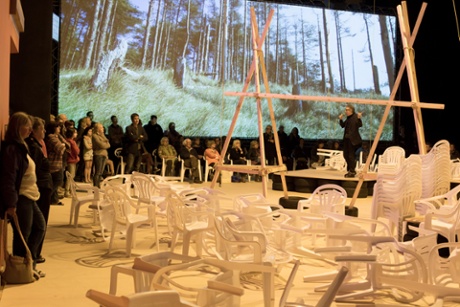
In The Husbands (the part that I see), screen images present views of a pine forest. A chaos of chairs creates a partial wall across the space. Parallel to this, tyres stacked three-high support wooden sheets, creating a set of low platforms. Men and women in almost identical dark jackets and trousers stand sentinel. Over the next 90 minutes, some will move almost ceaselessly: deconstructing the “wall”, setting its chairs for us to sit on, transporting lengths of wood, assembling them into tripods, erecting them around the playing area. Others deliver the lines of the poem – as narrator or as characters. Simultaneously, their words scroll on TV screens. On other screens appear the various gods of the story, embodied as the speaking heads of “annoying teenagers”. Throughout, actions and words are accompanied almost continuously by percussive music and sounds (the team that is John Hardy Music and Mike Beer respectively).
I get the sense of an extraordinary vision – especially at the conclusion when the chairs, flung against the back wall, seem to sputter like the spume flecking the crest of a rising tidal wave. Overall, though, for me, the poetry is swamped by constant movement and sonic effects. Dynamic interplay between elements, rhythmically playing one off the other, is lacking. Maybe the directors will disagree, but here I bring in the F-word: funding. Creativity of this complexity takes time to achieve its full potential. I wish our inventive theatre artists had more resources.