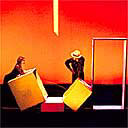
All great juggling acts reach a point when the performer no longer seems to be in charge of the juggling balls, but simply a witness to their miraculous, independent flight. In Compagnie 111's show, IJK, this point occurs very early on. But it doesn't feel like an illusion created by timing and dexterity - the balls actually behave as if they are in control.
The conceit that drives this production is juggling as music. On a cleverly amplified set, created out of variously sized wooden boxes, the three French performers bounce and catch their juggling balls in a dazzle of precise, percussive rhythms. By varying the distance thrown, the angle at which the balls hit the boxes, the force with which they rebound from one surface to another, this expert trio can control an extraordinarily complex array of riffs and counterpoint. So controlled that in the opening section, when Anne de Buck plays an old circus tune on her accordion, Aurelien Bory can add a perfect rhythm section with his juggling balls.
It's a duet of enormous wit and charm, but then some of the balls start to set their own agenda. They bounce back at Bory with impossible force and, in defiance of all laws of physics, start to maintain their own momentum, ricocheting between two boxes without any loss of energy.
Just as you're trying to figure out the engineering behind this, more balls launch into flight from inside the largest box. Bory fields them bravely into his own airy pattern, and it's all so subtly managed that for a while you believe the balls possess some kind of magic. It's only when tiny Olivier Alenda eases himself gracefully out of the box that you accept he must have been sitting there all along - the invisible extra hands controlling the routine.
Like all good tricks, discovering the secret doesn't diminish the wonder. Even if nothing else measures up to this opening routine, Compagnie 111 still keep us staring with a deft succession of acts. At one point the two men sit either side of an upturned box like a pair of gamblers - each juggling, and each raising the stakes with the speed and difficulty of their moves. At another point Alenda performs a breathtaking mix of juggling and flamenco, the five balls keeping perfect time with his footwork. De Buck interpolates her aerial skills in some acrobatic stunts, but the rhythmic thread remains taut throughout, so that the whole show is one continuous flow of energy and sound. The exquisite reflexes of the performers, combined with the adroit editing of their material, make IJK an entrancing little show.