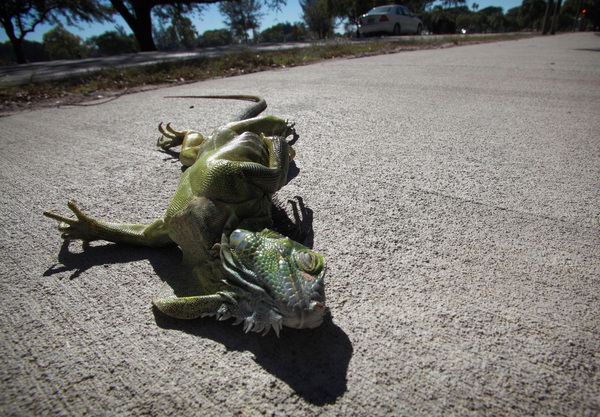
FORT LAUDERDALE, Fla. — When temperatures drop, so do green iguanas — from the trees. But evolution, it seems, could be robbing South Floridians of a tradition as common as checking the heat index on New Year's Day.
Research shows that in recent years, several species of lizards have grown more tolerant of cold temperatures. It's a discovery with big implications for Florida, where bouts of cool weather keep invasive iguanas contained to the southern regions of the state and helps keep populations under control.
It also could mean fewer images on social media and TV news of iguanas lying on their backs under trees, legs in the air, stunned until the warm sunshine gets their bodies moving again.
As recently as four years ago, most of South Florida's most common species of lizards could tolerate temperatures between 46 and 52 degrees. Now, they hold up in temperatures as low as 44 degrees, according to a study done by a researcher at Washington University in St. Louis.
That means it's possible that iguanas could expand their territory beyond their normal stomping grounds of Miami-Dade, Broward and Palm Beach counties.
"The potential is they could spread farther and disperse farther, so that's why it's interesting to Florida, specifically" said James Stroud, the research associate who conducted the study and did his doctoral work at Florida International University.
That's bad news considering iguanas are invasive, propagate profusely and wreak havoc on homes, gardens, sidewalks, pool decks, seawalls, boats and anywhere else they eat and, well, poop. They're so destructive, the state of Florida issued a call for homeowners to kill them. (It later clarified the statement, saying it's best to call a professional to do the deed.)
Iguanas fall out of trees during cool weather because they're cold-blooded and tropical. Low temperatures cause them to become sluggish and, in some cases, immobile. If it happens while they're sleeping in trees, they often fall to the ground. They're cold-stunned, not usually dead — they spring back into action once temperatures warm again if the fall from the tree doesn't kill them.
It happened this past January, raining iguanas when temperatures in parts of South Florida fell to 39 degrees, the coldest air in about a decade. It also happened in January of 2018.
Stroud and his colleagues studied six lizard species common in South Florida — one that's native (the American green anole), three Caribbean lizards that are not native (one each from Puerto Rico, Cuba and Hispaniola), the northeast tropical gecko, and the brown basilisk lizard.
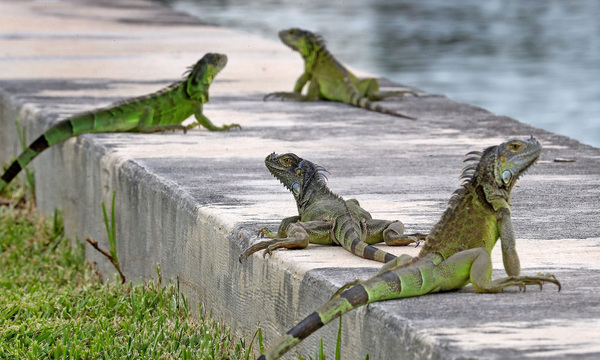
Iguanas weren't included because they were too big to fit into the refrigerator-like device used to study the chilled lizards. But Stroud said he believes the results apply to iguanas, too.
Blake Wilkins, co-owner of Hollywood-based Redline Iguana Removal, said the discovery doesn't surprise him. While collecting iguanas during last January's cold spell, he saw signs that iguanas might be warming up to the cold.
"I noticed a lot of them were actually in the water," Wilkins said. "And the second I pulled them out, I was floored, it kicked my butt, because it was so lively. I thought it was going to be frozen."
Wilkins suspects the iguanas learned the water is a way to get shelter from the cold air the way they've learned to shelter by burrowing underground, under roof tiles, in sheds or other hiding places.
"The ones that we were collecting and that perished were the ones that clearly you could tell from where they were laying they fell out of a tree, a palm tree, for example, so obviously they were very exposed to the weather," he said. He thinks maybe the new instinct to find shelter is being passed down through generations.
Stroud's team slowly chilled their captive lizards earlier this year, poking them as the degrees fell. If the lizard moved or reacted, it still had functioning ability. When it stopped reacting, it was marked as stunned at that temperature. The results were compared to those of a similar experiment conducted four years earlier and revealed the increased tolerance to cold.
"All of them dropped on average to the same lowest temperature," Stroud said. "So they're now all converged on this same limit and that was absolutely unexpected for us."
The next step for Stroud and his team is finding out why the lizards can tolerate colder temperatures.
"Is this evidence of natural selection, where these lizards that just happened to have a lower cold tolerance survive and other ones freeze to death," Stroud said, "or was it an example of physiological adjustment, something we call acclimation, in which exposure to lower temperatures changes a lizard's physiology?"
Whatever the reason, it appears lizards, and perhaps green iguanas, could be on the move north. But slowly.
"I don't think people in north Florida, where it gets pretty cold, have anything to worry about," Wilkins said, "But I do think it may take a little bit colder temps to really dent their population the way it may have in the past."