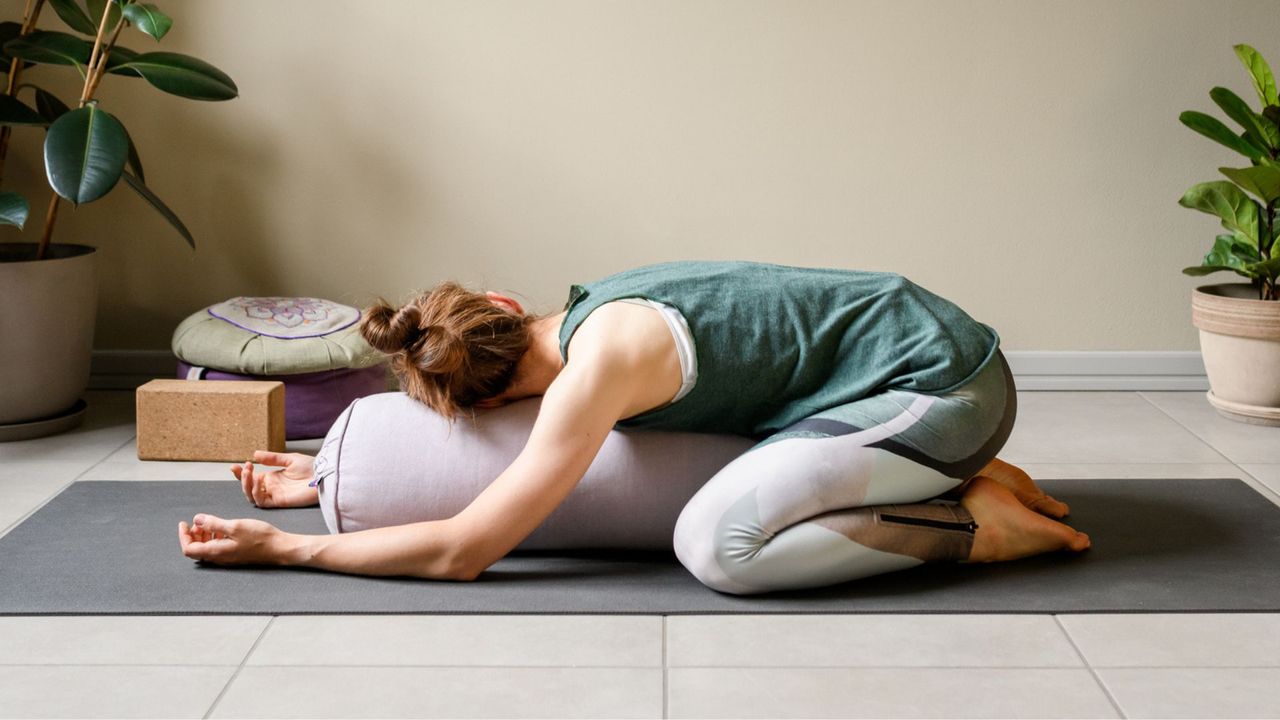
Child’s pose—a position where you sit back onto your heels from kneeling—is a popular and relaxing yoga posture that has a huge number of benefits. These include stretching and lengthening the spine, hips and thighs, releasing tension in the neck and shoulders, improving blood flow, stimulating digestion, and calming the nervous system.But what if the pose causes discomfort in your ankles, knees or hips? It doesn’t mean you have to abandon the posture altogether.If you can’t sit back on your heels, there’s a niggle in your knees or your feet won’t lie flat on the floor, modifications can help. I’ve had to use these myself when recovering from injury. As a yoga therapist, I often share the modifications with my own clients. Many of them are quick fixes that don't require a huge change to the original posture. Here’s how to change up your child’s pose to address common complaints.
If you can’t fold forwards
If you struggle to fold your upper body over your thighs and your forehead is not touching the floor, then you might have tight back muscles or limited hip flexion.The fix: Widen your knees so there’s more space for your torso to fold down. You can also place a bolster under your torso for extra support. If your forehead is still off the floor, rest it on an elevated surface like a cushion, yoga block or create a pillow with your hands. I used this modification when recovering from a bulging disc and still use it now I’ve recovered because it’s so relaxing.
If your knees hurt
When your knees feel uncomfortable pressing into the floor, the surface you’re practicing on could be to blame. An inability to bend your knees fully may also be an issue. The fix: Place a folded blanket under your knees for cushioning or practice on a bed for a softer surface for your joints. Place a rolled-up towel in the crease behind your knees to release pressure.
If your ankles and feet are uncomfortable
Being able to point your toes (plantarflexion) is necessary to sink comfortably in child’s pose. Pain in your shins or the top of your foot might signal a limited range of motion here. The fix: Regularly practicing pointing your toes up (dorsiflexion) and down (plantarflexion) can help increase the range of motion in your ankles and reduce discomfort over time. Place a rolled blanket under your ankles for support or tuck your toes under.
If you can’t stretch your arms forward
Tightness in your shoulders and chest may be the culprit here if you can’t extend your arms fully forward. The fix: Keep a bend in your elbows or rest your arms by your sides, palms facing up.