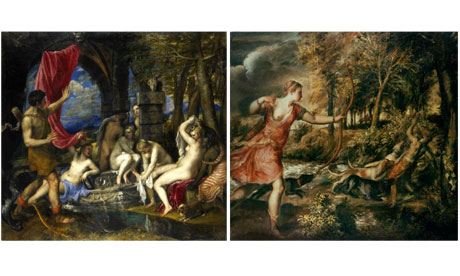
Walk into the main entrance of the National Gallery, London. Climb up the stairs, and turn left into the first room. Here you'll have the most astonishing treat – the chance to see Titian's Diana and Actaeon, and his Death of Actaeon, together. They haven't been together like this for 200 years. The first painting normally hangs in Edinburgh (it has been brought down to London as part of the campaign to purchase it for the nation from the Duke of Sutherland). The second is one of the most famous works of the National Gallery. But they were conceived as part of the same group of paintings, even though Titian kept The Death of Actaeon in his studio until his death, rather than sending it to his patron, Philip II of Spain. And, though I've always thought of these two paintings as utterly distinct in style – the first, precise and closely worked, the second, boldly impressionistic, even expressionistic – the act of bringing them together draws out just how closely related they are.
The paintings both refer to the mythological story of Actaeon, as told in Ovid's Metamorphoses. It's an unpleasant story. Actaeon sees the goddess Diana naked and is slaughtered in revenge. In Diana and Actaeon, the hunter stumbles across the glade where Diana, the chaste hunter-goddess, is relaxing naked – being bathed, in a faintly undignified way, by her attendants (she's being towelled down, with her right leg up on the side of the bath). It's a fantastically fleshy painting – his dark muscles, their delicate white softness. It's a freeze frame – we see precisely the moment when she clocks him looking at her. And her sidelong glance is deadly and ferocious. This is the moment of Aristotleian peripeteia – the moment of reversal. It is all over for Actaeon.
Cut to The Death of Actaeon. His position at the left of the picture is now occupied by Artemis. He was the hunter in the previous work – now he's the quarry, and she's chasing him down. The bow at his feet in the first painting is now unleashing an arrow in his direction. The curious, rather goofily loyal dog by his feet is now ripping him apart, as he is transformed by the goddess into a stag. The limpid waters are turned into angry, choppy waves. The pacific, calm blue sky is dark and heaving, almost Turner-esque. What's brilliant, too, is that there are clues of how it's all going to end contained in the first work. There's the stag's skull, a horrid foreshadowing of Actaeon's death, perched on the column; and there are animal skins hanging from the trees (hard to see in reproduction).
Enough of that. Just go.