In major urban areas, there has been an increase in the cases of new coronavirus infection whose routes of transmission are unknown and those found among people who have returned from areas overseas where infections are prevalent.
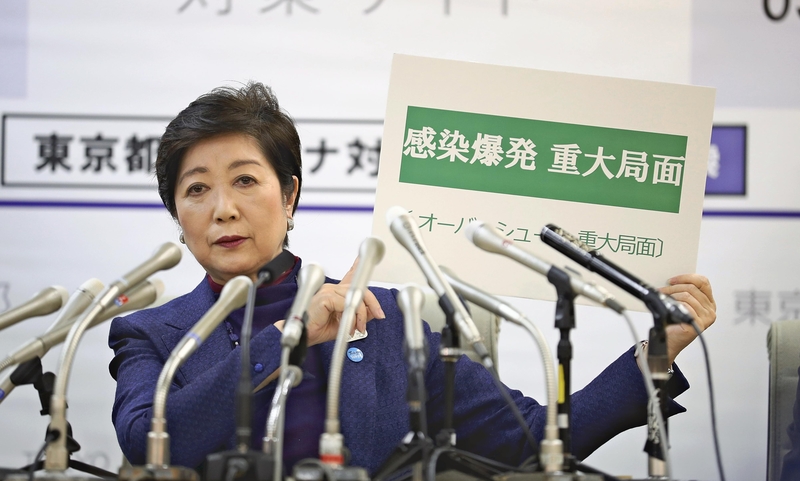
On Wednesday, 41 new cases of the novel coronavirus infection were confirmed in Tokyo. In a bid to prevent "overshoot," an explosion of cases, from hitting Tokyo, Gov. Yuriko Koike announced a request for Tokyoites to refrain from going out over the weekend. Japan is also about to enter an important phase in the spread of infections.
At a press conference on Wednesday, Koike raised the warning level further, saying: "We need the cooperation of people in Tokyo. Actions of each and every person will have an impact on the whole society."
The number of those infected with the coronavirus in Tokyo surpassed that of Hokkaido on Tuesday, a prefecture with the highest number of cases until Monday. Koike also said that the Tokyo metropolis faces a situation where "there is a possibility that we will not be able to help but take such strong measures as a lockdown."
Hitoshi Oshitani, a professor at Tohoku University and a member of a governmental panel of experts on measures against new coronavirus infections, expressed his sense of alarm.
"Those beds to be exclusively used for cases of coronavirus infection are soon to be fully occupied in central Tokyo, leaving the health care system in a serious situation," he said. "Even if the situation may not go as far as overshoot, there can be a certain extent of damage to be caused."
The government is trying to prevent the spread of infections by detecting infection clusters early and identifying the routes of transmission quickly, rather than taking such tough measures as lockdown of cities as countries in Europe and on North America have taken. The government is calling on the people to avoid going to such places where the following three conditions are present: closed spaces, gatherings of people, and conversations at a close range.
The governmental panel of experts, while highly rating such requests made by the government, saying, "There has been a certain [favorable] effect," also announced on March 19 a proposal to reinforce the Japanese-style measures against coronavirus infection. Whether the proposal will prove effective will depend on actions to be taken by residents.
As there had already been an increase in urban areas in the number of those infected cases whose routes of transmissions are unknown, all the panel members shared a strong sense of alarm. But their opinions differed when it came to how the proposal should be conveyed to the public. During the four days just prior to its announcement, the proposal was revised at least four times.
In particular, the issue of "holding a large-scale event," which may generate a cluster of infections, was discussed heatedly. Although panel members at one time moved in favor of having the word "call off" stipulated in the proposal, they changed tack as cautious opinions were voiced, such as "There will be limitations in imposing severe restrictions."
One source said, "There were also those wishes of the government [reflected in the proposal] which do not want the reinforcement of controls."
The final version of the proposal managed to maintain a policy of urging sponsors of such events to cooperate in return, by granting a "conditional approval" of such an event, namely to ask the sponsor to pay heed to the three conditions when holding the event. On the other hand, the panel added a strong word of calling on the people to "brace for a long-lasting battle."
Yet there are many of those who have noted that the strong sense of alarm shared by the panel of experts has not reached the general public.
Yoshitake Yokokura, president of the Japan Medical Association, said at a press conference on Wednesday, "I had an impression that during the three consecutive holidays that started on March 20, people became relaxed, as the weather was fine and cherry blossoms were blooming."
Amid the government call for self-restraint, on Sunday there was a fighting-sport event on the scale of 6,000 spectators held in the city of Saitama.
Hirotada Hirose, a professor emeritus of Tokyo Woman's Christian University who is knowledgeable about disaster psychology, points out, "In order to transmit messages that would strike people's heart, wouldn't it be necessary for the relevant issue to be discussed with the attendance of experts on social psychology?"
With the revised law concerning special measures to cope with new-type influenza, which passed into law in mid-March, prefectural governors are authorized to ask people to restrict themselves from going out, and ask institutions to suspend the use of facilities to hold various events, but with no penalties attached.
Kazunori Oishi, head of the Toyama Institute of Health who is knowledgeable about infectious diseases, emphasized: "There is a possibility of infections spreading rapidly in Japan, too. In such an event, strong measures as taken in foreign countries will be needed."
Read more from The Japan News at https://japannews.yomiuri.co.jp/