
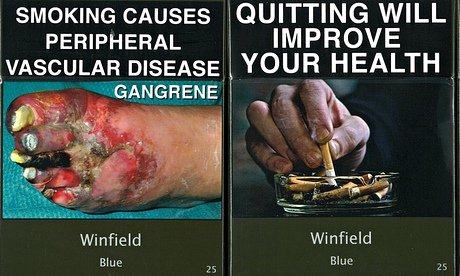
If standardised packaging – there is nothing plain about a cigarette pack emblazoned with graphic health warnings and holograms – does not deter some people from smoking, then it is hard to understand why the tobacco industry fought tooth and nail to prevent its introduction in Australia.
The industry knew that if these unbranded, anti-smoking packs became the norm in one large and affluent country, there would be a domino effect. Sure enough, the UK, Ireland and France are all in the process of toppling.
Big tobacco has tried hard to undermine the evidence in Australia that standardised packs have had an effect since they were introduced in 2012. Studies appeared that were funded by Philip Morris apparently showing at best a tiny impact on young smokers, who are very much the target group for the campaigners.
Those who start behind the school bikeshed at the age of 14 are those most at risk for developing a lifetime habit that has a strong chance of killing them at an early age. Two thirds of smokers start when they are children. Heart disease and cancer do not seem real while you are a teenager. They do 30 years later, when you have a habit you can’t kick.
One of the tobacco industry’s arguments is that the Australian experiment has failed because it has not reduced the numbers who smoke, but swelling the ranks of the quitters was never anticipated.
The aim is to get rid of seductive and exciting packaging that is specifically designed to appeal to young people and make the idea of starting to smoke less attractive. Deprived of billboards and TV ads, the tobacco industry has had to become increasingly imaginative, condensing all its messaging into the outside of a small cardboard box.
Bright colours and an appearance of sophistication beckon young people into an adult world and in this context, the current health warning in massive letters – “Smoking Kills” – may just excite with connotations of forbidden fruit, the campaigners believe.
The government controversially postponed a decision on standardised packaging in the summer of 2013, to a storm of condemnation by health and medical groups and accusations of a sellout to the tobacco lobby.
It was pointed out that Lynton Crosbie, David Cameron’s election adviser, had helped the industry fight the introduction of plain packaging in Australia.
Sir Cyril Chantler, who was asked to look at the potential benefits, particularly to children, of plain packaging after the government postponed its decision last summer, concluded: “There is very strong evidence that exposure to tobacco advertising and promotion increases the likelihood of children taking up smoking,” the report said.
“Industry documents show that tobacco packaging has for decades been designed, in the light of market research, with regard to what appeals to target groups. Branded cigarettes are ‘badge’ products, frequently on display, which therefore act as a ‘silent salesman’.”
In England, more than 600 children aged 11 to 15 start to smoke every day – more than 200,000 a year. If that number could be cut even by 2%, said the Chantler review, 4,000 fewer would take up the habit.
Since Chantler completed his work, the evidence from Australia has become more convincing, if anything. The number of cigarettes bought per person has fallen, according to government figures.
Total consumption of cigarettes and tobacco in the first quarter of 2014 was the lowest ever, and the Australian national drug strategy household survey for 2013/14 showed that the proportion of daily smokers aged 14 years or older in Australia fell from 16.6% in 2007 to 12.8% in 2013.
The other big argument by the industry, that “plain” packaging will make it easier for smugglers to produce and sell counterfeits in the UK, is a blind, say campaigners – the packs are not plain.
Will standardised packaging deter children in the UK from smoking? If it works, even modestly, in Australia, there is no reason to suppose it will not have the same sort of effect here. And anything, say doctors, that can reduce the numbers of young people picking up a lethal habit is worth trying.













