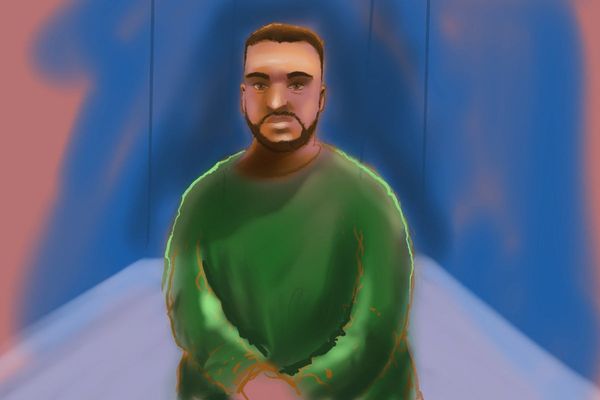
It is a little confusing how a character as robust and powerful as Peter Dutton could, plausibly, become a victim, but the immigration minister is aggrieved enough to demand an apology from media outlets intent on pursuing the who, what, when, where of a violent disturbance on Manus Island two weeks ago.
Dutton fears some media outlets have “morphed into advocates” and “lost control of any dispassionate view of this circumstance” – apparently gripped by some mass outbreak of hysteria.
We have become prisoners of our brimming feelings, and having indulged something akin to a collective tantrum, we (or some of us, in any case) now owe him an apology.
I’ve been a journalist these past 20 years. If journalists are prisoners of anything, it’s not feelings. In fact, as a group, we are often accused with some justification of being pitiless hacks, lacking human feeling.
We do, as a group, have a persistent fact orientation.
We generally press to discover what has happened and why.
Part of the process of piecing together what has happened and why often involves lining up statements key protagonists make, and checking whether the statements are consistent.
In the case of the latest troubling incident on Manus Island, key statements from key people are not consistent.
Hence the interest.
It needs to be acknowledged up front that ministers have access to a range of resources that journalists don’t have. There is a basic information asymmetry which is the bane of a journalist’s working life.
Dutton is insisting his account of events two weeks ago is factual. He says its’ based on advice from his department, and as a minister, his resources are superior to working journalists. That’s just a simple fact.
Last Thursday Dutton said the recent violence, in which shots were fired at and around the immigration detention centre on Manus Island, occurred after local people witnessed asylum seekers leading a five-year-old boy towards the centre, which of course sounded rather sinister.
But the minister’s account has been contradicted subsequently by the top police officer on Manus Island, who has said very clearly, and without qualification, that the two events were unconnected.
The incident involving the child (who was 10, not five) had happened two weeks earlier, according to David Yapu. According to this account, the child was after food.
The violence a fortnight later was sparked by drunk soldiers responding to an argument over the use of a football field.
Yapu has subsequently repeated that account, and he’s indicated that Dutton has not sought him out for a briefing. He’s also warned Dutton against inflaming the situation.
Dutton likes to characterise the conflicting account as being some kind of culture war salvo – the invention of the ABC, or Guardian Australia, or Fairfax Media, “or some of these fringe dwellers out in the internet”.
But it isn’t, not unless the minister thinks the top cop on Manus Island is a separatist and shadowy resident of the world wide web.
I have not, as yet, seen a convincing explanation from the minister as to why his account is quantifiably different from Yapu’s, apart from Dutton’s mildly coy reference to being in possession of facts that not everyone has.
Dutton is very fortunate to be in possession of facts that not everybody has. Let’s call it one of the perks of his job.
Unfortunately for the minister, the perks of the job also carry with them an immutable obligation in a functional democracy: that ministers are accountable for what they say.
I don’t care if we are currently in the middle of a long slide into #alternativefacts and post-truth, accountability in public life is a constant, and Dutton isn’t an exception to the rule.
If these facts exist, there’s one way to clear up the whole mess.
Don’t imply you have them.
Release them.